
Effect of Alpha Energy on Track Characteristics
K.V. Vrinda Devi 1 and Jayshree Ramkumar 2 *
1Radiometallurgy Division, Bhabha Atomic Reasearch Centre, Mumbai - 400094, India, Bhabha Atomic Reasearch Centre, Mumbai, 400094 India .
2Analytical Chemistry Division, Bhabha Atomic Reasearch Centre, Mumbai - 400094, India, Bhabha Atomic Reasearch Centre, Mumbai, 400094 India .
http://dx.doi.org/10.13005/OJPS02.02.05
Radiation imaging using solid state nuclear track detectors is an important non destructive technique for estimation of radioactive species like plutonium, thorium etc. In this study, two alpha sources were used for imaging of alpha tracks. From the image analysis of the tracks, different track characteristics were analysed. The frequency distribution of track parameters is Gaussian in nature and is found to be affected by the energy of alphas. It was seen that the maximum of the frequency distribution was located at higher values of track diameter (or area) for the tracks registered with alphas of higher energy. This could be attributed to greater extents of structural changes within the polymer upon impingement of alphas with higher energy. The studies could prove to be a marker for the identification of alpha sources of different nuclides.
Copy the following to cite this article:
Devi K. V. V, Ramkumar J. Effect of Alpha Energy on Track Characteristics. Orient J Phys Sciences 2017;2(2).
DOI:http://dx.doi.org/10.13005/OJPS02.02.05Copy the following to cite this URL:
Devi K. V. V, Ramkumar J. Effect of Alpha Energy on Track Characteristics. Orient J Phys Sciences 2017;2(2). Available from: https://bit.ly/3911p2R
Download article (pdf) Citation Manager Publish History
Introduction
Solid state nuclear track detectors (SSNTDs) are radiation sensitive materials which are capable of registering nuclear tracks caused by impinging radiations or ions [1,2]. There are several types of SSNTDs based on different materials like inorganic crystals, glasses and plastics like cellulose nitrate (CN) and polyallyldiglycol carbonate (PADC). When a heavily ionising charged particle impinges on the solids, a narrow trail of damage is left behind along the path and this is known as latent track as they are not visible to naked eye [3,4]. The tracks can be viewed by using electron microscopic techniques. The degree of damage is dependent on various external factors namely the charge and velocity of the particles, detector material. As the latent tracks can be viewed only through electron microscope, an alternate approach is quite commonly adopted. The tracks are made more visible by developing them to enable it to be visible under an optical microscopy. This is achieved by etching with different chemical reagents like sodium/ potassium hydroxide, hydrofluoric acid etc. The different conditions of etching combined with the choice of materials as SSNTDs makes it possible to detect different ions or radiations [5]. Plastics are the most commonly used SSNTDs for alpha particles, Cellulose nitrate (CN) being the first to be used [6], has a chemical composition of C6H8O9N2 density of 1.33-1.6 gm/cm3 and a foil thickness of 100-1000µm. The main disadvantage of CN is that the sensitivity is low as the uniformity is poor and though the tracks formed are smooth, the background is very high. Polycarbonates (PC) with composition of C16H14O3 and density of 1.2 gm/cm3 and a foil thickness of 75-250µm is used for recording fission fragment tracks. It has a very good uniformity and good surface view with no background pits. Cellulose nitrate is replaced with a more sensitive detector named CR 39 which is a polyallyldiglycol carbonate [7]. It has a composition of C12H18O7 , density of 1.3 gm/cm3 and a foil thickness of the order of 500 µm. It has a good uniformity and moderate background with detection threshold of < 0.05 MeV/mg.cm2. Each detector is characterised by a critical value of energy loss rate by the charged particle [8] and only those charged particles which can lose the energies excess of the critical values can produce etchable tracks. The detection thresholds of nuclear track detectors can be specified by their energy loss rates. The sensitivity of the detector can be measured as a ratio of the charge to speed of the particles and mostly lie in the range of 5- 100 for most of the organic polymers that are used as solid state detectors [9] and these values for CR 39, CN and cellulose acetate are 6, 30 and 40 respectively. It is seen that smaller the value, the more sensitive is the detector to the radiations. From these values, it is seen that the CR 39 detector is very sensitive. However, track recording sensitivity for minerals and glasses range from about 150 - 450. High sensitive detectors are also characterised by high G scission (number of chain scissions per 100 eV of energy deposited) and low G cross link (number of cross links per 100 eV of energy deposited). The solid state nuclear track detectors find a large number of applications as they are extremely simple to use, low cost, wide choice of materials, amenable to different size and geometrical arrangements, easy storage of information at normal temperature and pressure, accumulation of events for longer time period, easy retrieval of information, no radioactive decay or electronic issues [10].
Our earlier studies showed that CR 39 films could be very effectively used for the characterization of nuclear fuels and also for the identification of different isotope of Pu [11-13]. A novel method using spectroscopic analysis of alpha irradiated SSNTDs was developed for characterization (Th,Pu)O2 MOX fuel samples for plutonium distribution [11]. This methodology was very effective for (Th,Pu)O2 MOX fuel samples having a large range of PuO2 concentration [11]. Optical properties of CR39 have been found to change in correlation with the alpha fluence incident upon it [12]. Analytical evaluation of the effect of alpha fluence and energy on the properties of the irradiated PADC polymers [13] could be easily understood by image analysis and UV-Vis spectrophotometric techniques and the major advantage of the study was that there was no radioactivity involved nor was there a need for a dedicated instrument enclosed in a glove box. Different techniques have been reported to characterize the solid state track detectors to understand the various changes [14-16].
In the present study, it was of interest to evaluate the characteristics of the nuclear tracks formed as a function of the alpha energy incident on the polymer. For this, the images created were captured using optical microscope and subsequently analyzed.
Materials and Methods
A schematic representation of the experimental setup is given in Fig.1.
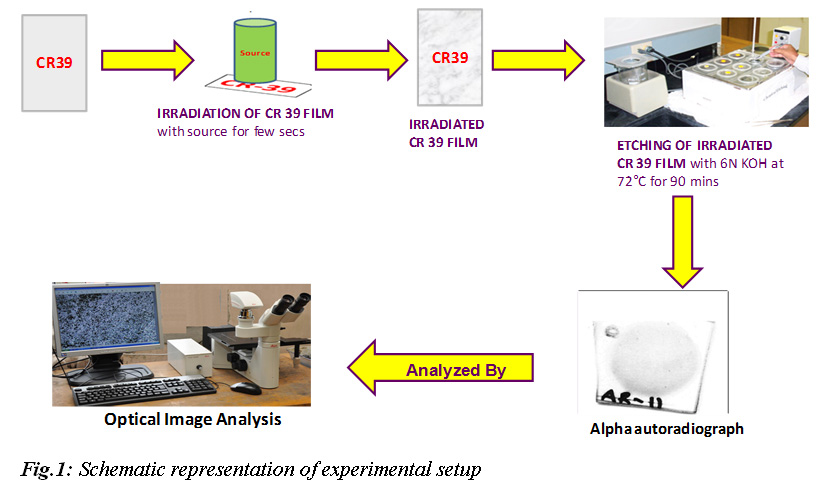 |
Figure 1: Schematic representation of experimental setup
|
600µm thick CR39 films (Pershore, UK) were cut into 20mm X 20mm size. Aluminium mylar films (14 µm) were placed over each of the cut CR39 films. As aluminium attenuates alpha particles having low energy, it can minimize non perpendicular incidence of alpha particles on the film ensuring good quality of the radiation images. Electroplated planchet sources of Pu238 (activity 1435 Bq) and Pu239 (activity 222 Bq) were used for generating two different alpha energies for impinging on the SSNTD film. The mylar topped films were kept in close contact with the planchets for a pre fixed time period for exposure of the films. The exposure time was chosen for differently for each source so that both the sources register approximately 500 tracks each on the film. The exposed films were then chemically etched, washed and dried prior to analysis. The images were observed using optical microscope (LEICA-DM ILM), captured by the attached digital camera and subjected to image analysis using Metal power image analyser version 3.0.0.9 software provided by Metal Power India (Pvt.) Ltd.
Results and Discussion
The alpha autoradiographs are conventionally evaluated manually using a microscope and image analysis as required. The alpha images obtained using Pu-238 and Pu-239 planchet sources are shown in Fig.2. The black dots seen in the image are the visible nuclear tracks registered by alpha particle impingement. It could be observed from the image that the tracks do not always appear circular in shape. Circular tracks correspond to perpendicular incidence of alpha particles and deviation from circularity is either due to non perpendicular incidence or by superimposed registration of more than one track.
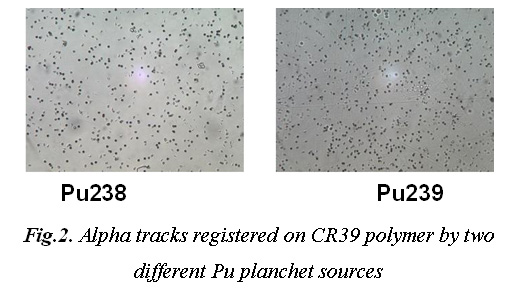 |
Figure 2: Alpha tracks registered on CR39 polymer by two different Pu planchet sources
|
When an alpha particle impinges on the material, the primary process that occurs is the ionization of the molecules in the path of particle by Coulomb force and this prompts successively new chemical reactions resulting in the production of free radicals. This damaged zone known as latent track get enhanced when treated with chemically aggressive reagents like NaOH or KOH, known as etchants. Although both the irradiated and unirradiated portions of the detector are being treated but the irradiated regions show enhanced removal of material at a faster rate due to the structural changes caused by the irradiation making the tracks visible under an optical microscope. No single theory explains the process of track formation completely. Initially the charged particle loses its energy at a very fast rate causing ionization and excitation of molecules and producing free electrons in the material. These free electrons cause further multiple interactions creating an avalanche of free electrons, which may at times deviate much further from the path of the impinging alpha particles resulting in the formation of the so-called delta rays. The path of the incident alpha particles does not undergo any major change during the course of interactions with electrons. However upon interaction with the target nucleus, which is quite rare, a considerable divergence from the initial path may happen. The loss of energy of the incident particle takes place through multiple small steps with respect to its initial energy. Structural modifications are also caused in the target material leading to generation of new chemical species which react preferentially with the etchant as compared to the unmodified matrix. The specific nature of the structural modifications is not clearly predictable and depends on many experimental factors [16]. The description of the track development poses a challenge from the geometrical point. Nevertheless, normal incidence of alpha particles result in the simplest process of track formation.
The images were subjected to the image analysis software in feature analysis mode. The detailed data of area, diameter and aspect ratio of each individual track in the image were measured on approximately 500 tracks in each image. To understand the track characteristics corresponding to each source, it was necessary to consider only the circular tracks. This was to eliminate those tracks formed by non perpendicular incidence of alphas because such alphas would possess lesser energy due to scattering/ attenuation etc. Hence it was understood that each source will register circular tracks when incident perpendicularly which ensured maximum energy transfer from that source. The features having an aspect ratio of 0.8-1.2 were identified as circular tracks. Statistical analyses of these circular tracks were done to study the effect of alpha energy on the characteristics of the registered tracks. The statistical analyses of area and diameter were carried out separately to understand the changes in the individual parameters due to differences in alpha energy values.
The average and range of track diameter and area is given in Table 1. Table 1 reflects the variations in the different values with differing alpha energies as obtained from two different sources. The track diameter is found to vary in the range of 0.1385 mm-0.7493 mm with an average value being 0.2529 mm for Pu238 and this is higher than the corresponding values for Pu239 (range being 0.0693 mm - 0.4381 mm and average of 0.1726 mm). Thus it can be seen that higher energy alphas (from Pu239) can produce tracks with larger track diameters. A similar trend is observed on comparison of track area. Statistics of area was considered to confirm the circularity while evaluating the statistics of track diameter.
Table 1: Track parameters obtained using Pu238 and Pu239 sources
|
Parameters |
Pu238 |
Pu239 |
||||
|
|
Min |
Max |
Ave |
Min |
Max |
Ave |
|
Diameter (mm) |
0.1385 |
0.7493 |
0.2529 |
0.0693 |
0.4381 |
0.1726 |
|
Area (mm2) |
0.0144 |
0.173 |
0.0553 |
0.0096 |
0.1584 |
0.0346 |
Since the energy of the impinging alpha was found to govern the range and average of track diameter and area, it became of further interest to see the frequency of distribution of these characteristics. The plots of frequency (number of tracks in a category) versus the individual parameters namely track diameter and area is given in Fig 2 (a-c). It was observed that, though the distribution is Gaussian in nature for both the parameters of tracks registered by both the sources, the values of maximum frequency is different for the two sources. From Fig 2(a), it is seen that the peak maxima for the frequency distribution of track diameter is at values of 0.3 mm and 0.1 mm for Pu238 and Pu239 respectively. This means that maximum circular tracks formed by exposure of alphas from Pu238 source have a diameter in the range of 0.2 mm - 0.3 mm while in the case of Pu239 source; the majority of the circular tracks produced have a diameter in the range of 0.01 mm - 0.1 mm. Since the alphas from Pu238 source have a higher energy (5.5 Mev), the modifications caused on the polymer structure are more than that by Pu239 alphas (energy 5.1MeV) resulting in larger portion of the polymer preferentially reacting to the etchant and formation of tracks having greater diameter than those produced by Pu239. Fig 2(b) showed the variation of area and it is seen that the maximum occurs at 0.06 mm and 0.04 mm2. This could indicate the removal of greater surface of the polymer impinged by higher energy alphas during etching assisted by irradiation.
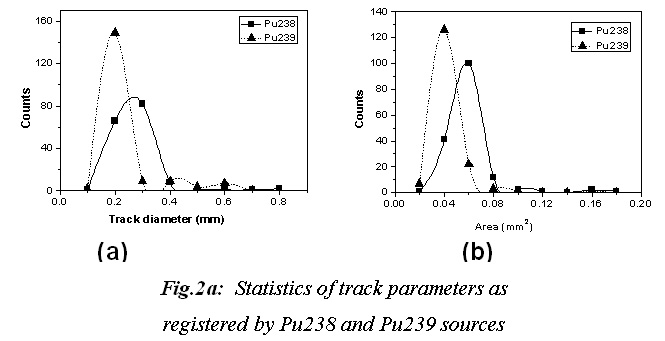 |
Figure 2a: Statistics of track parameters as registered by Pu238 and Pu239 sources |
The frequency distribution of track characteristics could hence be used as markers to identify the alpha sources based on the pre hand knowledge about their energy values. Impingement of alphas of higher energy caused greater extents of structural modifications leading to increased removal of material registering tracks of larger diameter.
Conclusion
Image analytical studies of alpha tracks registered by two alpha sources having different energies indicated that the frequency distribution of track parameters is governed by energy of the impinging alphas. It was observed that peak frequency of the Gaussian distribution of track diameter and were located at higher values for tracks registered by higher energy alphas as compared to that by lower energy alphas owing to more structural modification of the polymer leading to more material removal during chemical etching. The results are of relevance for nuclear industry and could be applied to identify alpha sources of different nuclides.
Acknowledgements
The authors thank Dr.P.D.Naik, Associate Director, Chemistry Group and Shri.V.Bhasin, Associate Director, Nuclear Fuels Group for their support.
References
- Fleischer R.L., Price P.B., Walker R.M., Nuclear Tracks in Solids : 'Principles and Applications' (Berkeley: Univ. of California Press) 1975.
- Barillon, R. and Chambaudet, A, Alpha-Particle Dosimetry Using Solid State Nuclear Track Detectors: Application to 222Rn and its daughters, J.Radioanal.Nuc.Chem.(2000) 243: 607-620
- Iyer R.H., Solid state track detectors. A novel tool for the study of fission phenomena, J. Chem.Ed. (1972) 49: 742-745
- Nikezic D., Yu K.N., Formation and growth of tracks in nuclear track materials, Materials Science and Engineering R (2004) 46: 51–123
- El-Badry B.A., Zaki M.F., Abdul-Kader A.M. et al, Ion bombardment of poly-allyl-diglycol-carbonate (CR-39). Vacuum (2009) 83:1138–1142
- H.B. Lück, On the use of cellulose nitrate as solid state nuclear track detector: Part II: Response to light particles and applications, Nucl.Instr.Methods in Phys.Res. (1983) 212: 483-487
- Henshaw D.L., Applications of CR-39 nuclear track detector in medicine and technology, Physics in Technology, ( 1982) 13: 266-280
- Dienes G.J., Vineyard G.H., (1957) Radiation Effects in Solids, Interscience , New York
- Hassan N., Hafez Abdel-Fattah, Studying the Physical Parameters of a Solid State Nuclear Track Detector. J.Kor.Phys.Soc. (2013) 63: 1713-1719
- Ellis W.R., Advantages of solid state nuclear track detectors for the assessment of alpha emitters and fissile elements, Int.J.Rad.Appl.Instr. D. Nuclear Tracks and Radiation Measurements, (1986) 12: 773-780.
- Vrinda Devi K.V., Jayshree Ramkumar, Sengupta A., Somayajulu P.S., Dubey J.N., Shaikh I.H., Chandramouleeswaran S., Characterisation of nuclear fuel by spectroscopic evaluation of alpha autoradiographs, J Radioanal Nucl Chem (2017) 314:259–271
- Vrinda Devi K.V., Jayshree Ramkumar, Chandramouleeswaran S., Application of Organic Polymer in the Identification of Radioactive Pu Isotopes, MOJ Bioorganic & Organic Chemistry. (2017) 1: 1-4
- Jayshree Ramkumar, Vrinda Devi K.V., Chandramouleeswaran S., Investigative Studies of alpha Irradiated PADC films: Application to plutonium sources, J Radioanal Nucl Chem DOI 10.1007/s10967-017-5597-z
- El Ghazaly M., Aydarous A., Photoluminescence emission spectra of Makrofol DE 1-1 upon irradiation with ultraviolet radiation. Res Phys (2017) 7: 333–337
- El Ghazaly M., Aydarous A., Al-Thomali T.A., Photoluminescence properties of PADC Irradiated with Ultraviolet Radiation of Short Wavelength(UVC). Int J Electrochem Sci (2014) 9: 3650–3657
- Nikezic D., Yu K.N., Formation and growth of tracks in nuclear track materials Mat.Sci.Eng. R (2004) 46: 51-123

This work is licensed under a Creative Commons Attribution 4.0 International License.