
Ramanujan Summation for Powers of Triangular and Pronic Numbers
Dr. R. Sivaraman* 
1Independent Research Scholar, African Moon University, South West Africa and USA .
http://dx.doi.org/10.13005/OJPS05.01-02.03
Copy the following to cite this article:
Sivaraman R. Ramanujan Summation for Powers of Triangular and Pronic Numbers. Oriental Jornal of Physical Sciences 2020; 5(1,2). DOI:http://dx.doi.org/10.13005/OJPS05.01-02.03
Copy the following to cite this URL:
Sivaraman R. Ramanujan Summation for Powers of Triangular and Pronic Numbers. Oriental Jornal of Physical Sciences 2020; 5(1,2). Available From: https://bit.ly/3q5QhvI
Download article (pdf) Citation Manager Publish History



Introduction
The great Indian Mathematician Srinivasa Ramanujan introduced the concept of Ramanujan Summation as one of the methods of sum ability theory where he gave a nice formula for summing powers of positive integers which is connected to Bernoulli numbers and Riemann zeta function. In this paper, I will present the formulas given by Ramanujan and use them to derive the Ramanujan summation formulas for powers of triangular as well as Pronic numbers. In this aspect, I had derived new formulas for determining such summation values.
Definitions and Formulas

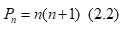
The product of two consecutive positive integers is called a Pronic number and the nth Pronic number is given by
Bernoulli Numbers
Bernoulli numbers are real numbers that occur as coefficients of
 in McLaurin’s series expansion of
  . The nth Bernoulli number is given by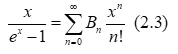
The first few values of Bernoulli Numbers are given by

From the above values, we observe that except for B1, Bn = 0 for all odd values of n.
Let  be a divergent series of real numbers. The Ramanujan summation abbreviated as RS (see [1]) of is defined by
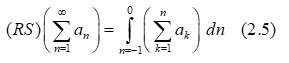
Srinivasa Ramanujan proved a formula connecting Riemann zeta function with Bernoulli numbers (for proof see [2]). The formulas called as Ramanujan Summation were given by


Here r is any positive integer and  is the Riemann zeta function. Using these definitions and formulas, I will prove some new results in this paper.
Powers of Triangular Numbers
In this section, I will determine a formula expressing positive integral powers of triangular numbers.
Theorem 1
If r is any natural number, then the rth power of kth triangular number is given by
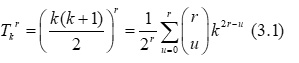
Proof: By (2.1) and using binomial expansion for positive integers we have

This proves (3.1) and completes the proof.
Theorem 2
The Ramanujan summation for positive integral powers of triangular numbers is given by

Proof: Using (2.1), (2.5), (2.6), (2.7) and (3.1), we have

This completes the proof.
Powers of Pronic Numbers
In this section, I will determine a formula expressing positive integral powers of Pronic numbers.
Theorem 3
If r is any natural number, then the rth power of kth triangular number is given by
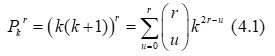
Proof: By (2.3) and using binomial expansion for positive integers we have

This proves (4.1) and completes the proof.
Theorem 4
The Ramanujan summation for positive integral powers of Pronic numbers is given by

Proof: First, we notice by definition that the Pronic numbers are exactly twice the corresponding triangular numbers. That is,

Hence, by (3.2) of theorem 2, we have
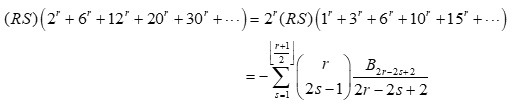
This completes the proof.
Computation of Ramanujan Summation Values
In this section, I will use results obtained in theorems 2 and 4 to evaluate Ramanujan summation of certain divergent series.
Corollary 1

Proof: Taking r = 1, 2, 3, 4 in (3.2), we get
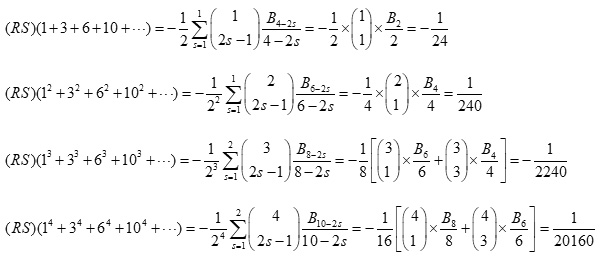
This completes the proof.
Corollary 2

Proof: Taking r = 1, 2, 3, 4 in (4.2), we get
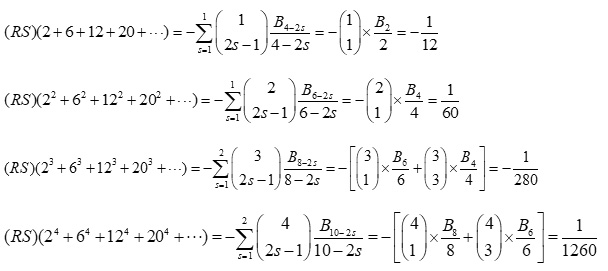
This completes the proof.
Conclusion
Srinivasa Ramanujan presented Ramanujan summation formulas for positive integral powers of natural numbers in terms of Bernoulli numbers. In this paper, I had extended this idea to determine Ramanujan summation for positive integral powers of triangular and Pronic numbers. Pronic numbers are also called as Rectangular numbers or Oblong numbers. For doing this, I had made use of the formulas provided by Ramanujan as given in (2.6) and (2.7). Using these two formulas and Bernoulli numbers, I had proved two new formulas for determining Ramanujan summation values for positive integral powers of triangular and Pronic numbers through (3.2) and (4.2) respectively. Two corollaries were presented in section 5 to compute the Ramanujan summation values of first four powers of triangular and Pronic numbers through equations (5.1) to (5.8). The results proved through theorems 2 and 4 are new and would provide further scope for understanding the meaning and connection between sum ability theory and Riemann zeta functions with respect to analytic continuation.
Acknowledgements
The author acknowledges the encouragement and help rendered by African Moon University, South West Africa and the USA for supporting to publication of this research paper as part of D.Math. Degree.
Funding Source
There is no funding or financial support provided for doing this research work.
References
- R. Sivaraman, Understanding Ramanujan Summation, International Journal of Advanced Science and Technology, Volume 29, No. 7, (2020), 1472–1485.
- R. Sivaraman, Remembering Ramanujan, Advances in Mathematics: Scientific Journal, Volume 9 (2020), no.1, 489–506.
CrossRef - S. Ramanujan, Manuscript Book 1 of Srinvasa Ramanujan, First Notebook, Chapter VIII, 66–68.
- Bruce C. Berndt, Ramanujan’s Notebooks Part II, Springer, Corrected Second Edition, 1999.
- G.H. Hardy, J.E. Littlewood, Contributions to the theory of Riemann zeta-function and the theory of distribution of primes, Acta Arithmetica, Volume 41, Issue 1, 1916, 119–196.
CrossRef - S. Plouffe, Identities inspired by Ramanujan Notebooks II, part 1, July 21 (1998), and part 2, April 2006.
- Bruce C. Berndt, An Unpublished Manuscript of Ramanujan on Infinite Series Identities, Illinois University, American Mathematical Society publication.
- R. Sivaraman, Bernoulli Polynomials and Ramanujan Summation, Proceedings of First International Conference on Mathematical Modeling and Computational Science, Advances in Intelligent Systems and Computing, Vol. 1292, Springer Nature, 2021, pp. 475–484.
CrossRef

This work is licensed under a Creative Commons Attribution 4.0 International License.