
Improved Estimator of Population Variance Using Measure of Dispersion of Auxiliary Variable
Muhammad Khalil , Muhammad Ali , Usman Shahzad* , Muhammad Hanif and Nasir Jamal
1Pir Mehr Ali Shah Arid Agriculture University, Rawalpindi, Pakistan .
http://dx.doi.org/10.13005/OJPS03.01.06
This research study is designed to obtain a more precise class of estimators of a population variance by taking advantage of relation between auxiliary variable and study variable. Here a class of new modified ratio type estimators of population variance by using coefficient of variation (CV), standard deviation, mean and median of auxiliary variable. Further empirical study is made to compare bias and mean square error (MSE) of proposed estimators with the existing estimators. Expressions for bias and MSE are obtained. Few secondary data sets are used to check the efficiency of proposed estimators of population variance.
Copy the following to cite this article:
Khalil M, Ali M, Shahzad U, Hanif M, Jamal N. Improved Estimator of Population Variance Using Measure of Dispersion of Auxiliary Variable. Orient J Phys Sciences 2018;3(1).
DOI:http://dx.doi.org/10.13005/OJPS03.01.06Copy the following to cite this URL:
Khalil M, Ali M, Shahzad U, Hanif M, Jamal N. Improved Estimator of Population Variance Using Measure of Dispersion of Auxiliary Variable. Orient J Phys Sciences 2018;3(1). Available from: https://bit.ly/3rswZ17
Download article (pdf) Citation Manager Publish History
Introduction
In our everyday life variations are available all over the place. It is the idea of law that people or no two things are precisely same. For example, an agriculturist needs a sufficient comprehension of the varieties in climatic factors particularly from place to place (or time to time) to have the capacity to anticipate when, how and where to plant his yield. For consistent learning of the level of varieties in individuals' response a maker need to decrease or increase cost of his item, or make strides the nature of his item. A doctor needs a full comprehension of varieties in the body temperature, level of human circulatory strain and heartbeat rate for full remedy. In this article we estimate one of the measure of variation which is known as variance.
The following Notations are used throughout this paper.
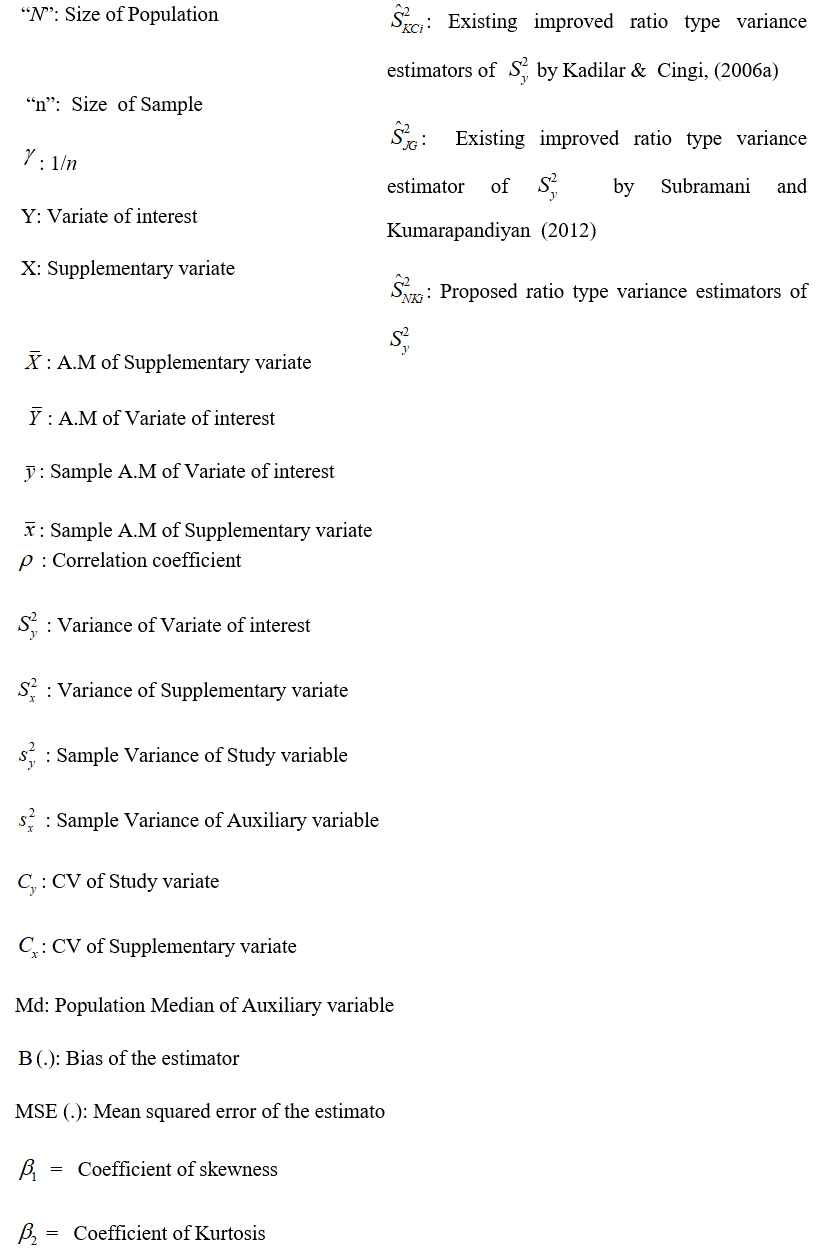
KC (2006) and SK (2012) proposed a class of ratio type variance estimators for the population variance S2y. It is assumed that variance of supplementary variable (S2x ) is known. Family members of KC (2006) and SK (2012) utilizing supplementary information with their theoretical properties such as bias and mean squared error are given below.
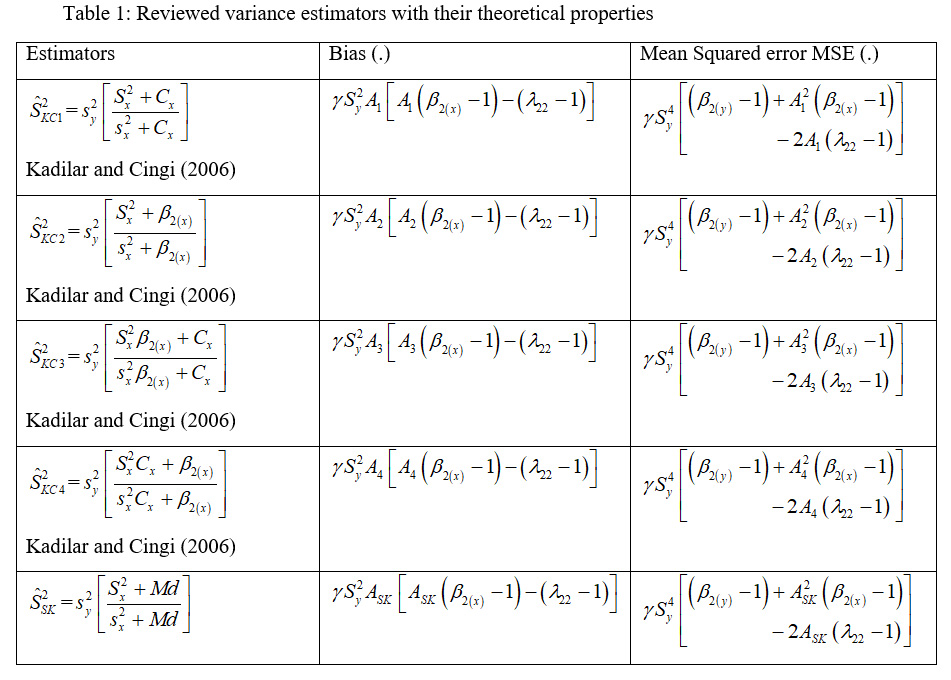 |
Table 1: Reviewed variance estimators with their theoretical properties
|
The purpose of above mentioned ratio estimators is to reduce the variance of estimates when there exist a positive relation between X and Y. The problem of estimating has been extensively discussed by many authors namely Isaki5, Singh et al.3, Cebrian and Garcia.3, Ahmad et al.1, Singh & Singh.11 , KC.7, Singh & Singh.11,Shabbir & Gupta.10, KC.6, Gupta and Shabbir4, Singh and Solanki.12, S.K17,18 ,Khan and Shabbir8 and Yadav et al.20,21,22 etc.
The improved ratio type variance estimators discussed above are biased but have minimum mean square errors compared to the old ratio type variance estimator. The list of estimators given in table 1 uses the known values of the parameters like Sx2, Cx, B2 median and their linear combinations. The materials of the present study are arranged as given below. The proposed estimators with known population Cx, Sx mean, median are presented in section 2 and the condition in which the proposed estimator performs better than the existing estimators are derived in section 3. The performances of the proposed and the existing estimators are measured for certain natural populations in section 4 and conclusion is presented in section 5.
Proposed Estimators
The accurateness of the estimator may be increased by using the supporting evidence in ratio type variance estimator. Estimators depend on the population characteristics in applied field. We use ratio estimator to estimate the values of the population variance by using different characteristics like kurtosis, skewness, mean, median, quartiles. deciles , percentiles and coefficient of variation etc. Supporting evidences are utilized in sampling survey to improve the estimate of S2y. In current section, we have proposed a class of ratio type variance estimator utilizing different parameters of auxiliary variate.
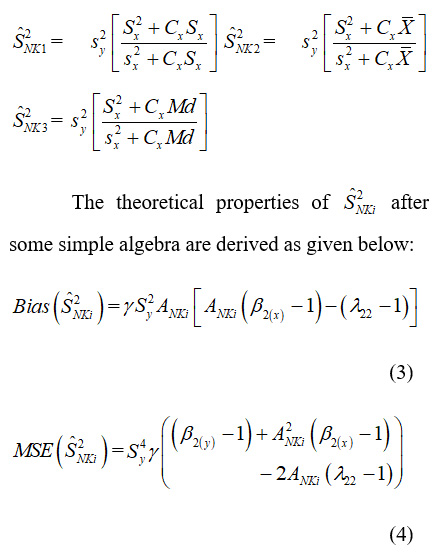
The new and improved class of ratio type variance estimators for population variance S2y is defined as
Theoretical Comparisons of Proposed
Estimators
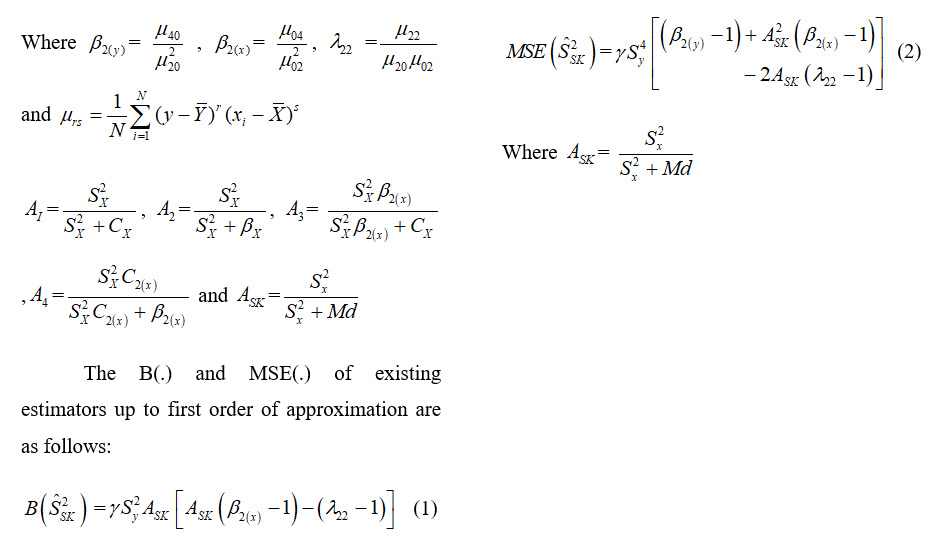
As mentioned the B(.) and MSE(.) of KC (2006) variance estimators are given below:
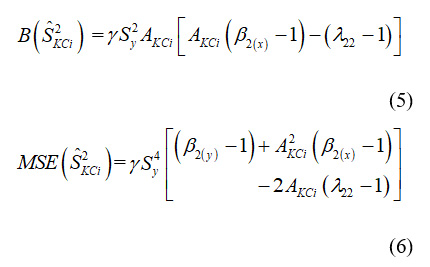
As mentioned the B(.) and MSE(.) of SK (2012) variance estimator are given below:
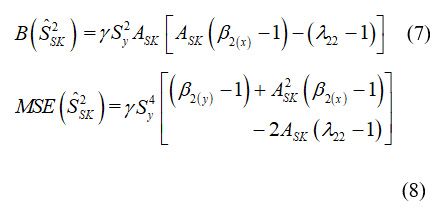
The B(.) and MSE(.) of proposed class (S2NKi ) are derived as given below
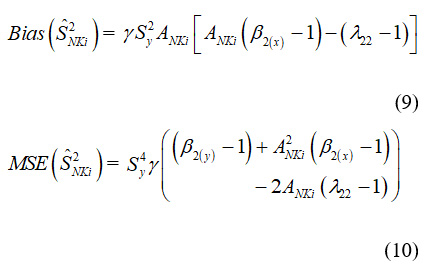
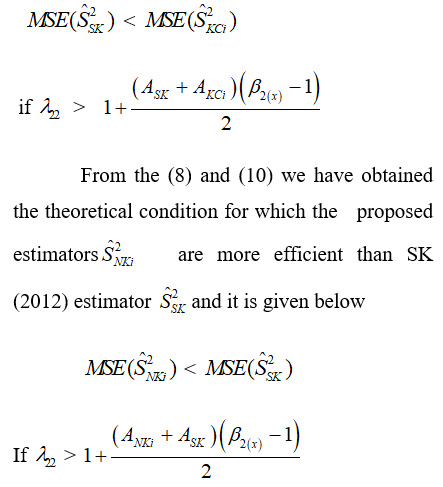
From the expression given in (6) and (8) we have derived the condition for which the Subramani and Kumarapandiyan (2012) estimator
Numerical Study
The performance of the proposed ratio type variance estimators are evaluated with that of existing modified ratio type estimators listed in Table 1 for certain natural population. The population 1 has taken from Singh and Chaudhary (1986, page 141), population 2 has taken from Cochran (1977, page 151), population 3 is real data set taken from Bureau of statistics. The data is about area and production of sugarcane in the districts of Punjab. Where Y= Production of sugar cane in Punjab in 2008-2009 and X= Area of sugar cane in Punjab in 2007-2008, Population 4 and 5 are real data set taken from the Report on Waste 2004 drew up by the Italian bureau for the environmental-protection.
APAT Where Y=Total amount (tons) of recyclable-waste collections in Italy in 2003 X= amount (tons) of recyclable-waste collection in Italy in 2002 and Y=Total amount (tons) of recyclable-waste collections in Italy in 2003 X=Number of inhabitants in 2003. The population parameters and the constants computed from the above populations are given below
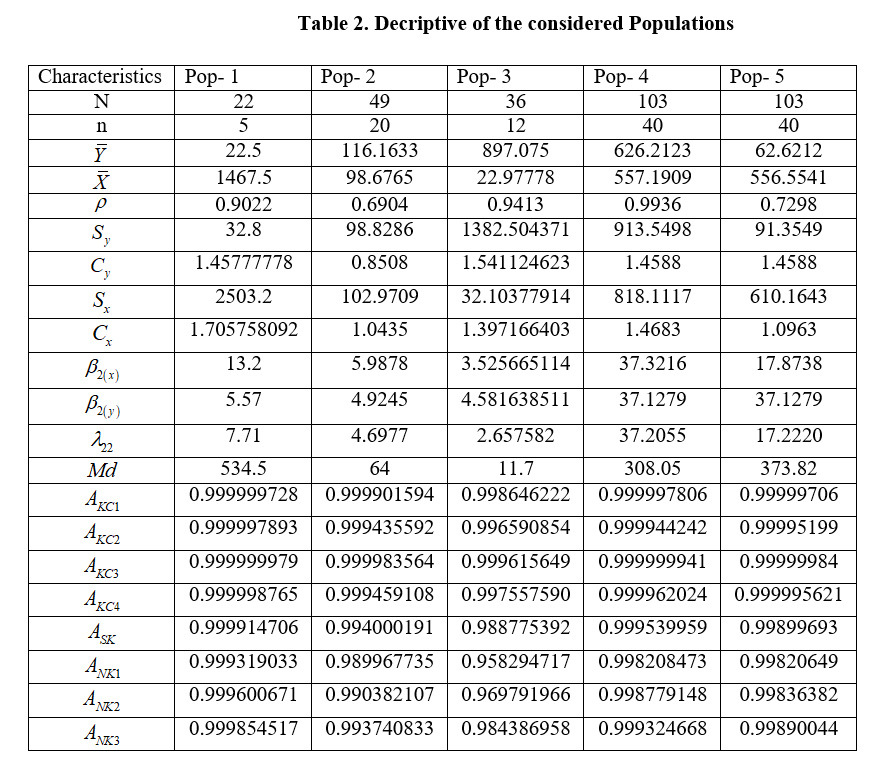 |
Table 2: Decriptive of the considered Populations |
The B(.) and MSE(.) of the reviewed and proposed improved ratio type variance estimators are given in the following Tables:
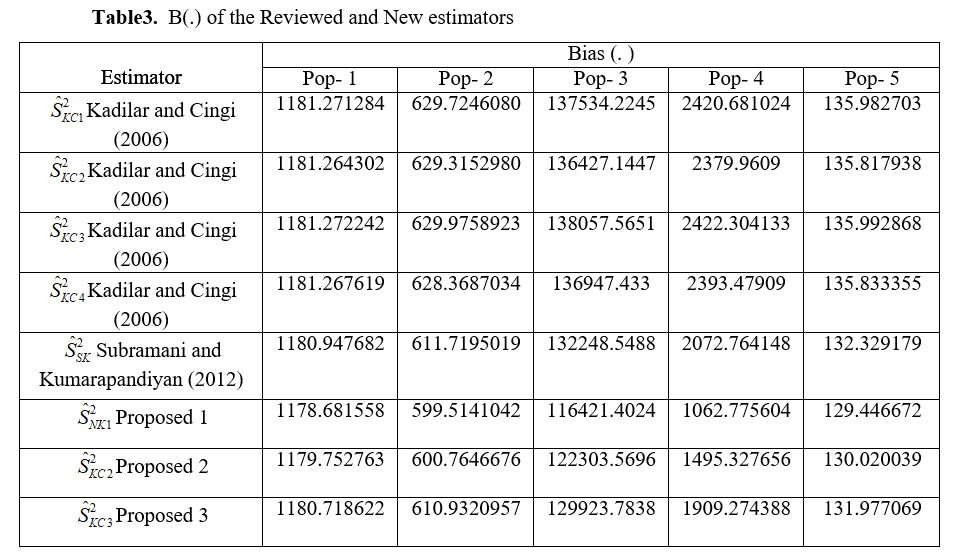 |
Table 3: B(.) of the Reviewed and New estimators |
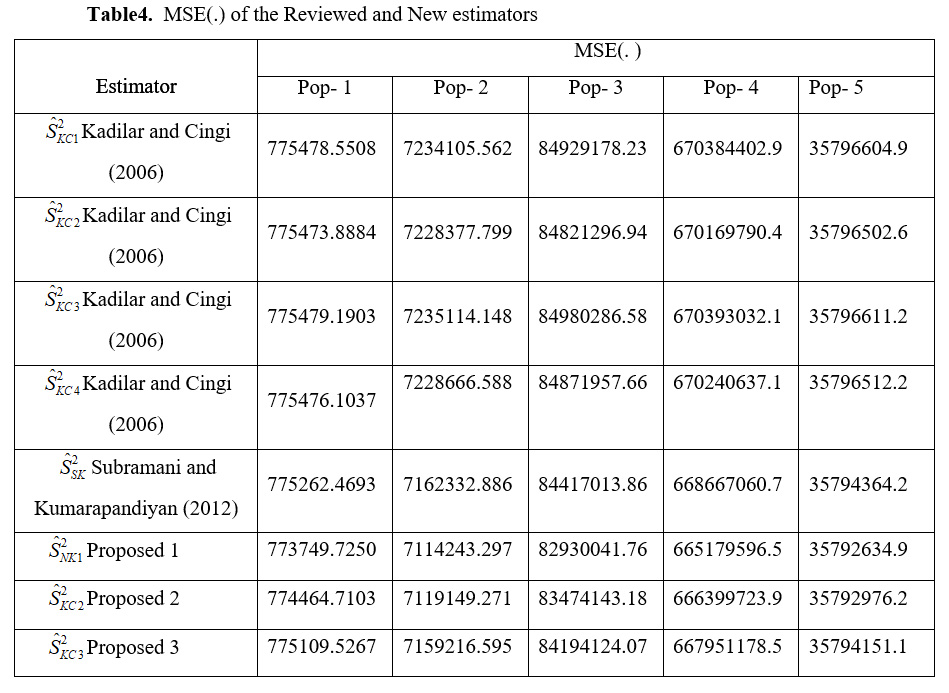 |
Table 4: MSE(.) of the Reviewed and New estimators
|
Numerical results of Table 3, shows that the B(.) of the new class of variance estimators is less as compare to the B(.) of the reviewed estimators. Similarly, numerical calculations of Table 4, shows that the MSE(.) of the new class of variance estimators is less as compare to the B(.) of the reviewed estimators.
Conclusions
In this Study we have defined improved some new variance estimators by utilizing coefficient of variation, standard deviation, mean and Md of supplementary variate. The B(.) and MSE(.) of the new variance estimators are obtained and compared with that of existing improved ratio type variance estimators. Further we have derived some theoretical conditions for which (S2NKi ) estimators are performing much better as compare to the reviewed estimators. So on behalf of the results of population 1, 2, 3, 4 and 5 we claim that the proposed-ratio-type variance estimators are competent as compare to existing ratio type variance estimators.
Refrences
- Ahmed, M.S., M.S.Raman and M.I Hossain. Some competitive estimators of finite population variance Multivariate Auxiliary Information, Information and Management Sciences, Volume11 (1), 49-54.
-
Cochran,W.G. Sampling Techniques, John Wiley and Sons, 3rd edition,New York. 1977.
-
Garcia, M.K. and A.A. Cebrain..Variance estimation using auxiliary information: An almost unbiased multivariate ratio estimator, Metrika. 1997;45:171-178.
-
Gupta, S. and J.Shabbir. Variance estimation in simple random sampling using auxiliary information, Hacettepe Journal of Mathematics and Statistics. 2008;37:1:57-67.
-
Isaki, C.T.. Variance estimation using auxiliary information, Journal of the American Statistical Association. 1983;78:117-123.
-
Kadilar, C. and H. Cingi. Ratio estimators in simple random sampling. Appl.Math. & comp. 2004;151:893-902.
-
Kadilar, C. and H. Cingi. An improvement in estimating the population mean by using the correlation coefficient. Hacettepe J. of Math. and Stat. 2006 35:1:103-109.
-
Khan,M. and J.Shabbir. A Ratio Type Estimator for the Estimation of Population Variance using Quartiles of an Auxiliary Variable, Journal of Statistics Applications and Probability. 2013;2:1:319-325.
-
Murthy, M. N. Sampling Theory and Methods, Statistical Publishing Societ Calcutta, India. 1967.
-
Shabbir,J. and S. Gupta. On Improvement in Variance Estimation Using Auxiliary Information, Communication in Statistics-Theory and Method. 2007;36:2177-2185.
-
Singh, H. P.and R.Singh. Improved Ratio type Estimator for Variance Using Auxiliary nformation,Jour.Ind.Soc.Ag.Statistics. 2001;54:3:276-287.
-
Singh, H.P.,A.K.Singh and R.S.Solanki. Estimation of finite population variance using Auxiliary information in sampl surveys, STATISTICA, anno LXV. 2014;4:1:99- 116.
-
Singh, H. P., R. Tailor and R.Tailor. Estimation of finite population mean using known Correlation coefficient between auxiliary characters, Statistica,anno LXV. 2005::407-418.
-
Singh, H. P., Tailor,R. and Tailor,R. On ratio and product methods with certain known population parameters of auxiliary variable in sample surveys. SORT. 2010;34:2: 157-180.
-
Subarmani, J. Generalized Modified Ratio Type Estimator for Estimation of PopulationVariance, SriLankan Journal of Applied Statistics. 2015;16:1:69-90.
-
Subarmani, J. and G. Kumarapandiyan. Variance estimation using quartiles and their functions of an auxiliary variable. Int.J.of Stat.And App. 2012b;.2:5:67- 72.
-
Subarmani, J. and G. Kumarapandiyan. Variance estimation using Median of the Auxiliary variable. Int.J. of Stat.And App. 2012c;1:3:62-66.
-
Subarmani, J. and G. Kumarapandiyan. A Class of Modified Ratio Estimators for Estimation of Population Variance, JAMSI. 2015;11:1:91-114.
-
Yadav,S.K., C. Kadilar, J. Shabbir and S. Gupta,S. Improved Family of Estimators of Population Variance in Simple Random Sampling,Journal of Statistical Theory and Practice. 2015a;9:2:219-226.
-
Yadav, S.K.,S.S. Mishra,A.K. Shukla and V.Tiwari. Improvement of Estimator for Population Variance using Correlation Coefficient and Quartiles of The Auxiliary Variable, Journal of Statistics Applications and Probability. 2015b;4:2;:259-263.
-
Yadav,S.K.,S.Misra and S.S Mishra. Efficient Estimator for Population Variance Using Auxiliary Variable,American Journal Research. 2016;6:1:9-15.
-
Yadav,S.K.,S.S.Mishra and A.K.Shukla. Use of Correlation Coefficient and Quartiles of Auxiliary Variable for Improved Estimation of Population Variance, American Journal Research. 2016;6:2:33-3.

This work is licensed under a Creative Commons Attribution 4.0 International License.