
Influence of a Show Case Polish Coating on Corrosion Resistance of Mild Steel in Simulated Concrete Pore Solution
Anitha Nilavan1 , Balasubramani Sathiyaprabha1 , Senthil Vadivelan Anu Ratthika1 , Sahaya Joseph Jeyaraj Philo Seeli1 , Arulanandam Jerleen Sindhuja1 , Subburam Rakshana1 , Arockiasamy Merlin Princy1 and Susai Rajendran2* 
1Corrosion Research Centre, Department of Chemistry, St Antony’s College of Arts and Sciences for Women, Amala Annai Nagar, (Affiliated to Mother Teresa Women’s University, Kodaikanal, Thamaraipadi , Dindigul , Tamilnadu India .
2Centre for Nanoscience and Technology, Pondicherry University, Puducherry, Tamilnadu India .
http://dx.doi.org/10.13005/OJPS07.01.03
Copy the following to cite this article:
Nilavan A, Sathiyaprabha B, Ratthika S. V. A, Seeli S. J. J. P, Sindhuja A. J, Rakshana S, Princy A. M, Rajendran S. Influence of a Show Case Polish Coating on Corrosion Resistance of Mild Steel in Simulated Concrete Pore Solution. Oriental Jornal of Physical Sciences 2022; 7(1). DOI:http://dx.doi.org/10.13005/OJPS07.01.03
Copy the following to cite this URL:
Nilavan A, Sathiyaprabha B, Ratthika S. V. A, Seeli S. J. J. P, Sindhuja A. J, Rakshana S, Princy A. M, Rajendran S. Influence of a Show Case Polish Coating on Corrosion Resistance of Mild Steel in Simulated Concrete Pore Solution. Oriental Jornal of Physical Sciences 2022; 7(1). Available from:https://bit.ly/3b8Z3nR
Download article (pdf) Citation Manager Publish History



Introduction
Concrete is a complex material made out of fine and coarse combined reinforced along with a liquid (concrete glue) that solidifies (fixes) after some time. The concrete responds with the water and diverse fixings to frame a hard grid that ties the materials together into a tough stone-like material that has many employments. Reinforced concrete (RC), as well called reinforced cement concrete (RCC), is a complex material wherein concrete's reasonably low rigidity and malleability are made up for by the amalgamation of support having higher tensile strength or ductility. The reinforcement is normally, though not really, steel bars (rebar) and is normally inserted inactively in the solid before the solid sets. As an alternative of steel mild steel can also be used, because, mild steel is comparatively less luxurious30-31.
Mild steel in concrete structures may undergo corrosion. To stop corrosion, quite a lot of inhibitors are used by the side of concrete admixtures. In this sort of research, saturated calcium hydroxide solution, which is considered as simulated concrete pore solution (SCPS) is used. Countless corrosion inhibitors have been used in this field along with organic coatings.
Nitrate and nitrite-intercalated Mg–Al layered double hydroxides have been employed as inhibitors to control corrosion of steel in saturated calcium hydroxide solution. This is considered as simulated concrete pore solution (SCPS). Electrochemical impedance spectroscopy (EIS) has been used to measure the corrosion resistance of steel in SCPS, by Xu et al.18. Inhibition result of polyvinylpyrrolidone on corrosion of reinforcing steel in simulated concrete pore solutions has been investigated by Dong et al. 23. The inhibition competence of PVP reached 89.1% when its concentration was 25 mg/L. PVP. Electrochemical impedance spectroscopy and polarization curve measurements, scanning electron microscopy, X-ray photoelectron spectroscopy and Raman spectroscopy have been employed in this study. Lee el al. have premeditated corrosion mitigation of steel rebars in chloride contaminated concrete pore solution using inhibitor by electrochemical investigation 15. A maximum of 96% inhibition efficiency has been achieved.
Effect of diamino methanethiol on the corrosion resistance of carbon steel in simulated concrete pore solutions has been studied by Ji et al.26. The inhibitor acted as a mixed-type inhibitor, suppressing the anodic and cathodic corrosion reaction processes of carbon steel by forming a protective film on its surface. Polarization study and AC impedance spectra have been used in this study. Efficacies of sodium nitrite and sodium citrate–zinc acetate mixture to inhibit steel rebar corrosion in simulated concrete interstitial solution contaminated with NaCl have been studied by Maliekkal et al.7. Electrochemical studies and FTIR spectroscopy have been utilized in this investigation. The effect of functionalized polycarboxylate structures as corrosion inhibitors in a simulated concrete pore solution has been investigated by Fazayel et al.6. The results of SEM, EDS and AFM investigations were in agreement with the results of electrochemical studies. Mansour et al. 14 have investigated effect of phosphate-based inhibitor on prestressing tendons corrosion in simulated concrete pore solution contaminated by chloride ions . Acoustic emission evolution was recorded along with the anodic polarization. It was established that a longer period of time for inducing the damage of the specimen when inhibitor is added. EDX analysis showed that phosphate ions are likely to form compounds that block anodic sites which help to delay prestressed steel corrosion initiation. The effect of Chamaerops humilis L. extract on the behavior of reinforcement steel in a carbonated concrete pore solution (pH≈9) has been reported by Left et al. 13. It was found that the plant extract has a beneficial effect on the development of a passive layer. Electrochemical studies have been used in the investigation.
Unnisa et al. have reported that linear polyesters as effective corrosion inhibitors for steel rebars in chloride induced alkaline medium 8. Electrocahemical studies have been used in this study. Tafel plots revealed cathodic inhibition. Nyquist plots favoured increased Rct values suggesting the formation of barrier film. Efficiency of corrosion inhibitors in mitigating corrosion of steel under elevated temperature and chloride concentration has been reported by Al-Sodani et al.12. It has been reported that an increase in the temperature or chloride concentration increased the rate of corrosion.
The present work is undertaken to study the corrosion resistance of mild steel in simulated concrete pore solution (SCPS), before and after the presence of showcase polish coating. Electrochemical studies such as polarization study and AC impedance spectra and have been used in the present study, to evaluate the corrosion resistance of mild steel coated with show case polish and also the uncoated mild steel.
Experimental
Preparation of Simulated Concrete Pore Solution
Saturated solution of calcium hydroxide alone is used as simulated concrete pore solution (SCPS) (pH = 13.5), in the present study,
Electrochemical studies
Electrochemical studies such as polarization study and AC impedance spectra 1, 2, 3, 4, 5, 9, 10, 11, 12, 16, 17, 20, 21, 24, 25, 27, 28, 29 are useful in measuring the corrosion resistance of mild steel in various test solutions.
Polarization study
To investigate polarization study a CHI electrochemical work station with impedance model 660A was used . A three-electrode cell assembly electrode was employed in the present study. Working electrode was mild steel. Reference electrode saturated calomel electrode (SCE). Counter electrode was Platinum electrode. From the polarization study corrosion parameters such as corrosion potential (Ecorr) corrosion current (Icorr) and Tafel slope values (anodic = ba and cathodic = bc) and Linear Polarization Resistance (LPR) were derived.
AC impedance spectra
The instrument used in polarization study was used in recording AC impedance spectra also. At various frequencies, the real part (Z’) and imaginary part (-Z”) of the cell impedance were measured. The charge transfer resistance (Rt) and the double layer capacitance (Cdl), impedance value and phase angle were derived from Nyquist plots and Bode plots.
Results and Discussion
To increase the strength of concrete rebars are used in concrete technology.
Mild steel can serve as rebar. To defend the rebars from corrosion, corrosion inhibitors are used along with concrete. In the place of concrete, simulated concrete pore solution (SCPS) can be used. SCPS is nothing but a saturated solution of calcium oxide or calcium hydroxide. Under these circumstances the corrosion resistance of mild steel in SCPS in the absence and presence of inhibitors can be studied. In the place of inhibitors, a shielding coating of show case polish may be specified. The show case polish coated mild steel can be used in concrete. To assess the corrosion resistance of mild steel coated with show case polish coating the corrosion resistance can be calculated electrochemical studies such as polarization study and AC impedance spectra. Show case polish has been employed as protective coating in the present study.
Analysis of Polarization curves
To sense the formation of protective film on the metal surface polarization study has been used. When a protective film is produced on the metal surface, the Linear Polarization Resistance (LPR) increases and the corrosion current (Icorr) decreases. The Polarization curves of mild steel immersed in a variety of test solutions are shown in Figures 1 and 2.The corrosion parameters namely, corrosion potential (Ecorr), Tafel slopes (bc= cathodic ; ba= anodic) Linear Polarization Resistance (LPR) and the corrosion current (Icorr) values are provided in Table 1.
Table 1: Corrosion parameters of mild steel immersed in SCPS in the absence and presence of protective coating (show case polish).
|
System
|
Ecorr mV vs SCE
|
bc mV/decade |
ba mV/decade |
LPR Ohmcm2 |
Icorr A/cm2 |
|
mild steel in SCPS |
-923 |
182 |
226 |
89 |
5.097×10⁻⁴
|
|
show case polish coated mild steel in SCPS
|
-626 |
400 |
180 |
11557821 |
4.677×10⁻⁹ |
It is observed from the Table that when mild steel is immersed in simulated concrete pore (SCPS) solution, the corrosion potential is -923V vs SCE. The LPR value is 89 Ohmcm2. The corrosion current value is 5.097×10⁻⁴A/cm2.
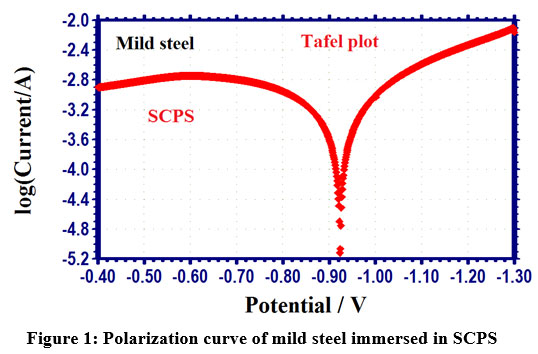 |
Figure 1: Polarization curve of mild steel immersed in SCPS |
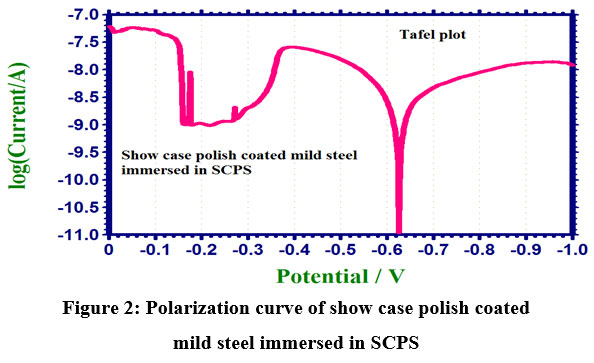 |
Figure 2: Polarization curve of show case polish coated mild steel immersed in SCPS. |
Influence of show case polish on the corrosion resistance of mild steel engrossed (immersed) in SCPS
Coating of show case polish shifts the corrosion potential from -923 to -626 V vs SCE. The corrosion potential is shifted to anodic side (less negative). This reveals that the anodic reaction is controlled mainly. The LPR value increases from 89 to 11557821 Ohmcm2 (Table 1) and the corrosion current decreases from 5.097x10⁻⁴ to 4.677×10⁻⁹A/cm2. This marvelous decrease in corrosion current value suggests that a protecting film is formed on the metal surface and most likely the protective film consists of Fe2+complex formed between Fe 2+ and the constituents of the Show case polish apart from CaCO3 and CaO. It is observed from Figure 2 that, the protective film is less stable upto -400 mV vs SCE. At -400 mV a very stable passive film is formed. So corrosion current decreases. This film is stable upto -150 mV. Then film breaks and corrosion current increases.
Analysis of AC Impedance spectra
AC impedance spectra have been used to detect the formation of the film on the metal surface AC impedance spectra have been used. If a shielding film is formed, the charge transfer resistance (Rt) increases and double layer capacitance (Cdl) value decreases. The impedance value increases and phase angle increases
The AC Impedance spectra of mild steel immersed in various solutions are shown
In Figures 3 to 6 he AC Impedance spectra of mild steel immersed in various solutions are shown.
In Figures 3 and 5The Nyquist plots are shown. In Figures 4 and 6 the Bode plots are shown. The AC impedance parameters, namely, charge transfer resistance (Rt) and double layer capacitance (Cdl) are given in Table 2. When mild steel is immersed in simulated concrete pore (SCPS) solution, Cdl value is 5.65×10⁻⁸ F/cm2 and the Rt value is 90.13 Ohmcm2. The impedance value is 2.251. The phase angle value is 31.58°.
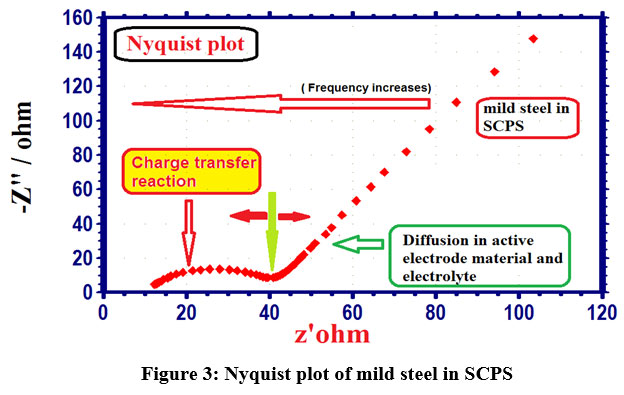 |
Figure 3: Nyquist plot of mild steel in SCPS. |
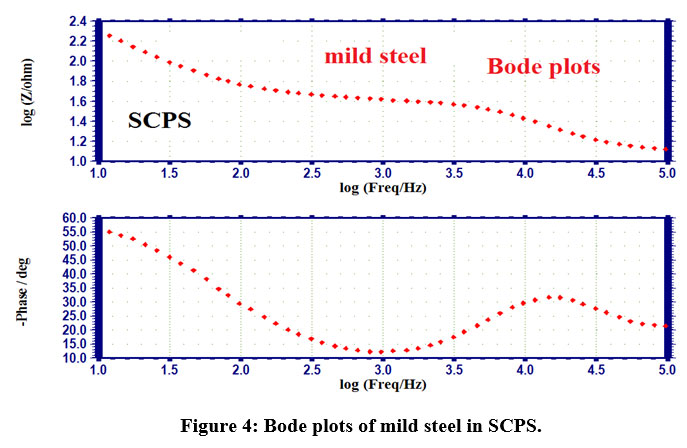 |
Figure 4: Bode plots of mild steel in SCPS. Click here to view Figure |
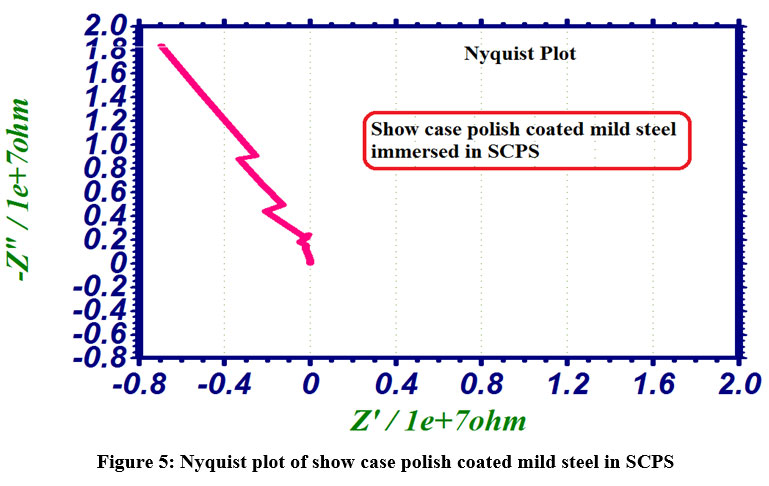 |
Figure 5: Nyquist plot of show case polish coated mild steel in SCPS. Click here to view Figure |
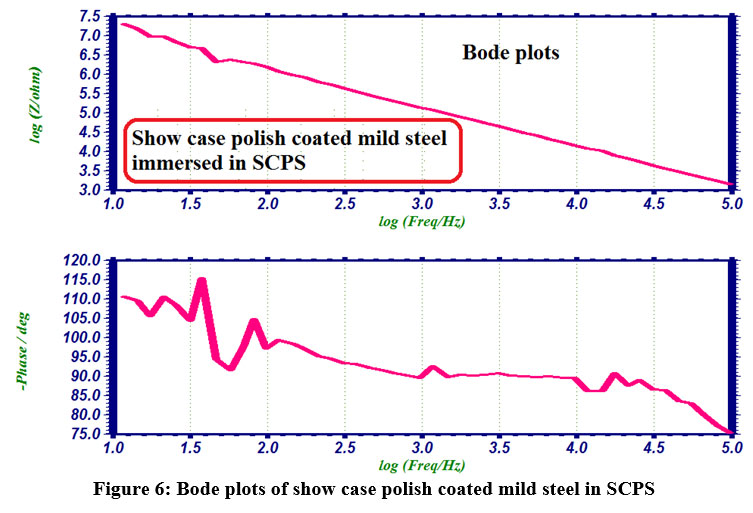 |
Figure 6: Bode plots of show case polish coated mild steel in SCPS. |
When the show case polish coated mild steel electrode is immersed in SCPS, the Rt value increases from 90.13to 6925400 Ohmcm2and Cdl value decreases from 5.65×10⁻⁸ to 0.736×10⁻¹² F/cm2. The phase angle increases 31.58 to 115°. The impedance value increases from 2.251 to 7.278. These observations indicate that the coated film is very strong and it is not broken by the ions present in SCPS medium.
Table 2: AC impedance parameters of mild steel immersed in various solutions obtained from AC impedance spectra
|
SYSTEM |
Rt Ohmcm2
|
Cdl F/cm 2 |
Impedance log (Z/ohm) |
Phase angle° |
|
mild steel in SCPS |
90.13
|
5.65×10⁻⁸ |
2.251 |
31.58 |
|
show case polish coated mild steel in SCPS
|
6925400 |
0.736×10⁻¹² |
7.278 |
115.0 |
Equivalent circuit diagrams for the present study
In the present investigation the AC impedance spectra of mild steel immersed in SCPS before and after show case polish coating were recorded. The equivalent circuit diagram is assigned based on the Nyquist plot.
The equivalent circuit for mild steel immersed in SCPS
The shape of the Nyquist plot indicates that this system consists of two processes namely, charge transfer process and diffusion controlled process. The equivalent circuit for this system is shown in Figure7.
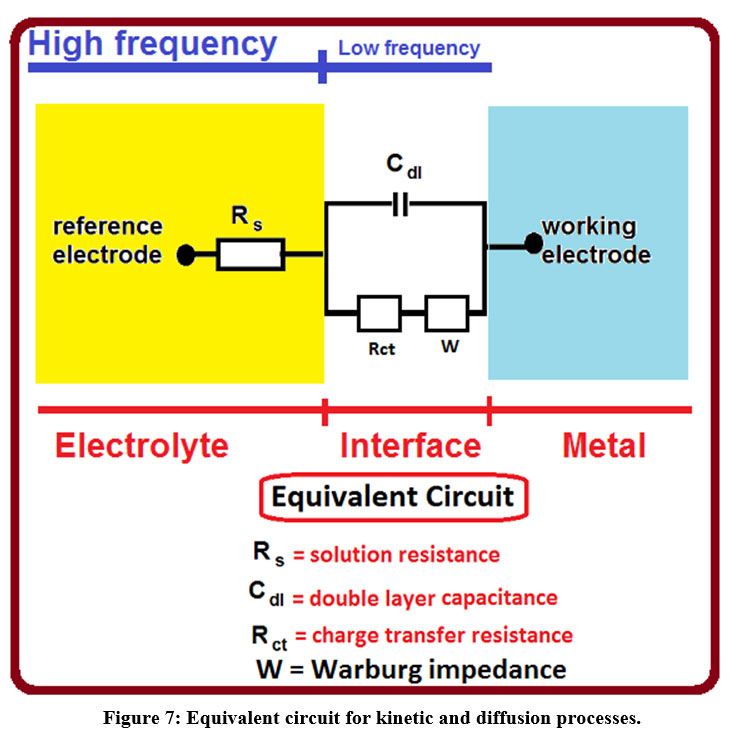 |
Figure 7: Equivalent circuit for kinetic and diffusion processes. |
Implication
A mild steel rebar coated with show case polish is immersed SCPS. It is observed that the corrosion resistance of the rebar increases. This is owing to the fact that the coating of the film prevents the corrosion of mild steel in SCPS. Therefore, it is suggested that the mild steel rebars used in concrete technology may be coated with the show case polish.
The conclusions are summarized in Figure 8 and Table 3.
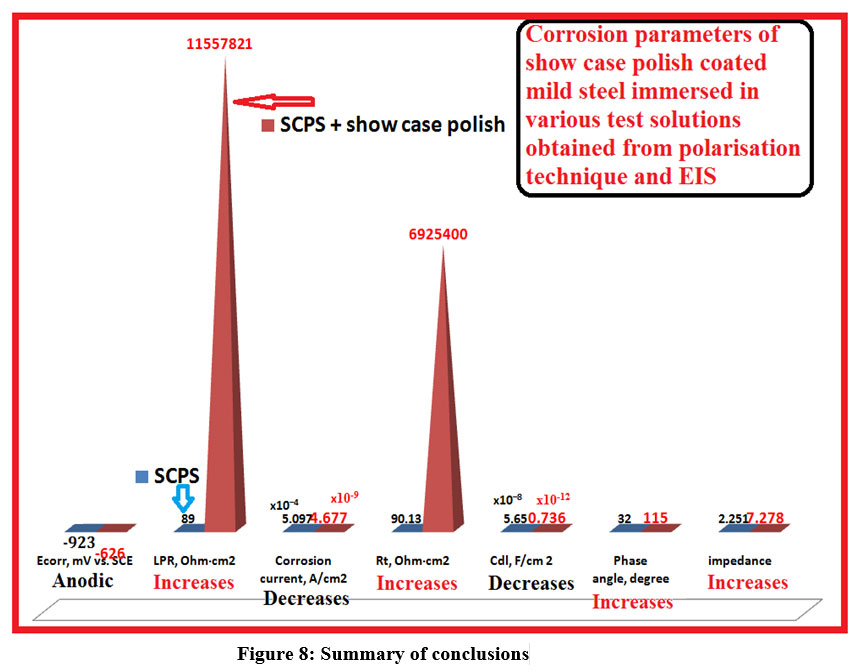 |
Figure 8: Summary of conclusions. |
Table 3: Summary of the main results
Corrosion parameters of show case polish coated mild steel immersed in various test solutions obtained from Polarization technique and EIS
|
Parameters |
SCPS |
SCPS + show case polish |
Inference |
|
Ecorr, mV vs SCE |
–923 |
-626 |
anodic |
|
LPR, Ohmcm2 |
89 |
11557821 |
increases |
|
Corrosion current, A/cm2 |
5.097x10⁻⁴ |
4.677x10⁻⁹ |
decreases |
|
Rt Ohmcm2 |
90.13 |
6925400 |
increases |
|
Cdl, F/cm 2 |
5.65?10–8 |
0.736×10⁻¹² |
decreases |
|
Phase angle, degree |
32 |
115 |
increases |
|
Impedance |
2.251 |
7.278 |
increases |
Conclusions
Mild steel is relatively less expensive. So in reinforced cement concrete (RCC), mild steel can be used as rebars. Mild steel in concrete structures may experience corrosion. Several inhibitors are used along with concrete admixtures to prevent corrosion of mild steel. In this sort of research, saturated calcium hydroxide solution, which is well thought-out as simulated concrete pore solution (SCPS) is used. Countless corrosion inhibitors have been used in this field all along with organic coatings.
- The present investigation show case polish coated mild steel has been used in concrete. In the place of concrete, simulated concrete pore solution (SCPS) has been used.
- The corrosion resistance has been calculated by electrochemical studies such as Polarization study and AC impedance spectra.
- In the presence of show case polish coating the corrosion resistance of mild steel engrossed in simulated concrete pore solution (SCPS) increases.
- This is established by the details that in the presence of show case polish coating the corrosion resistance of mild steel immersed in simulated concrete pore solution (SCPS), the linear Polarization resistance value increases, corrosion current value decreases, charge transfer resistance increases, double layer capacitance decreases, impedance increases and phase angle increases.
- The defensive layer functions as anodic inhibitor and reins the anodic reaction principally.
The authors are thankful to their Management for their help and support. They are also thankful to Professor Dr. V Velkannan of Thiagarajar College of Engineering, Madurai, for his help during electrochemical studies.
Conflict of Interest
There is no conflict of interest
Funding Sources
There is no funding or financial support for this research work.
References
- Aleksandar Petri?evi?, Vladimir D. Jovi?, Mila N. Krstaji? Paji?, Piotr Zabinski, Nevenka R. Elezovi?, Oxygen reduction reaction on electrochemically deposited sub-monolayers and ultra-thin layers of Pt on (Nb-Ti)2AlC substrate, Zastita Materijala 2022, 63 (2), 153 - 164
- 19. A.S. Fouda, M.A. El-Morsy, A.A. El-Barbary and L.E. Lamloum, Study on corrosion inhibition efficiency of some quinazoline derivatives on stainless steel 304 in hydrochloric acid solutions, Int. J. Corros. Scale Inhib., 2016, 5, no. 2, 112–131. doi: 10.17675/2305-6894-2016-5-2-2
CrossRef - A. Anandan, S. Rajendran, J. Sathiyabama and D. Sathiyaraj, Influence of some tablets on corrosion resistance of orthodontic wire made of SS 316L alloy in artificial saliva, Int. J. Corros. Scale Inhib., 2017, 6, no. 2, 132–141. Doi: 10.17675/2305-6894-2017-6-2-3
CrossRef - A.C.C. Mary, S. Rajendran, H. Al-Hashem, R.J. Rathish, T. Umasankareswari and J. Jeyasundari, Int. J. Nano Corr. Sci. Eng., 2015, 1, 42.
- A. Nithya, P. Shanthy, N. Vijaya, R.J. Rathish, S.S. Prabha, R.M. Joany and S. Rajendran, Int. J. Nano Corr. Sci. Eng., 2015, 2, 1.
- A.S. Fazayel, M. Khorasani, A.A. Sarabi, The effect of functionalized polycarboxylate structures as corrosion inhibitors in a simulated concrete pore solution, Applied Surface Science, 2018, 441, pp. 895-913
- B.P. Maliekkal, J.T. Kakkassery, V.R. Palayoor, Efficacies of sodium nitrite and sodium citrate–zinc acetate mixture to inhibit steel rebar corrosion in simulated concrete interstitial solution contaminated with NaCl, International Journal of Industrial Chemistry, 2018, 9(2), pp. 105-114
- C. Basha Nusrath Unnisa, G. Nirmala Devi, V. Hemapriya, (...), S.-H. Kim, M. Prabakaran, Linear polyesters as effective corrosion inhibitors for steel rebars in chloride induced alkaline medium – An electrochemical approach, Construction and Building Materials, 2018, 165, pp. 866-876
- C.O. Akalezi, C.E. Ogukwe, E.A. Ejele and E.E. Oguzie, Mild steel protection in acidic media using Mucuna pruriens seed extract, Int. J. Corros. Scale Inhib., 2016, 5, no. 2, 132–146. doi: 10.17675/2305-6894-2016-5-2-3
CrossRef - Dorothy Rajendran, Thankappan Sasilatha, Susai Santhammal Rajendran, Abdulhameed Al-Hashem, Caslav Lacnjevac,Gurmeet Singh, Inhibition of corrosion of mild steel hull plates immersed in natural sea water by sandalwood oil extract of some natural products, Zastita Materijala 2022, 63 (1), 23 - 36.
- Dorothy Rajendran, Thankappan Sasilatha, Suvakeen Amala Doss Hebciba Mary, Susai Santhammal Rajendran, Caslav Lacnjevac,Gurmeet Singh, Deep learning based underwater metal object detection using input image data and corrosion protection of mild steel used in underwater study - A case study, Part B - Corrosion protection of mild steel used in underwater study, Zastita Materijala, 2022, 63 (1), 15 - 22
- Dejana Kasapovi?, Fehim Kora?, Farzet Biki?, Testing the effectiveness of raspberry flower extract as an inhibitor of copper’s corrosion in 3% NaCl, Zastita Materijala 2022, 63 (2), 115 - 121
- D.B. Left, M. Zertoubi, S. Khoudali, Azzi, New application of chamaerops humilis l. Extract as a green corrosion inhibitor for reinforcement steel in a simulated carbonated concrete pore solution, Portugaliae Electrochimica Acta 2018, 36(4), pp. 249-257
- H. Ben Mansour, L. Dhouibi, H. Idrissi, Effect of Phosphate-based inhibitor on prestressing tendons corrosion in simulated concrete pore solution contaminated by chloride ions, Construction and Building Materials, 2018, 171, pp. 250-260.
- H.-S. Lee, H.-M.Yang, J.K. Singh, S.K. Prasad, B. Yoo, Corrosion mitigation of steel rebars in chloride contaminated concrete pore solution using inhibitor: An electrochemical investigation, Construction and Building Materials, 2018, 173, pp. 443-451.
- Ifeyinwa Calista Ekeke, Steve Efe, Felix Chigozie Nwadire, Plant materials as green corrosion inhibitors for select iron alloys: a review, Zastita Materijala 2022, 63 (2) ,183 - 202
- I.M. Zin1, S.A. Korniy1, A.R. Kytsya1, L. Kwiatkowski2, P.Ya. Lyutyy1 and Ya.I. Zin1 Aluminium alloy corrosion inhibition by pigments based on ion exchanged zeolite, Int. J. Corros. Scale Inhib., 2021, 10, no. 2, 541-550 PDF (463 K) doi: 10.17675/2305-6894-2021-10-2-3
CrossRef - J. Xu, Y. Song, Y. Zhao, (...), Y. Mei, P. Chen, Chloride removal and corrosion inhibitions of nitrate, nitrite-intercalated Mg–Al layered double hydroxides on steel in saturated calcium hydroxide solution, Applied Clay Science, 2018, 163, pp. 129-136.
- K.A.A. Al-Sodani, O.S.B. Al-Amoudi, M. Maslehuddin, M. Shameem, Efficiency of corrosion inhibitors in mitigating corrosion of steel under elevated temperature and chloride concentration, Construction and Building Materials, 2018, 163, pp. 97-112
- L.G. Knyazeva, L.E. Tsygankova, A.V. Dorokhov and N.A. Kur’yato, Protective efficiency of oil compositions with Cortec VpCI-368D Int. J. Corros. Scale Inhib., 2021, 10, no. 2, 551-561 PDF (343 K) doi: 10.17675/2305-6894-2021-10-2-4s
- N. Kavitha and P. Manjula, Corrosion Inhibition of Water Hyacinth Leaves, Zn2+ and TSC on Mild Steel in neutral aqueous medium, Int. J. Nano Corros. Sci. Eng., 2014, 1, 31–38.
- P.N. Devi, J. Sathiyabama and S. Rajendran, Study of surface morphology and inhibition efficiency of mild steel in simulated concrete pore solution by lactic acid–Zn2+ system, Int. J. Corros. Scale Inhib., 2017, 6, no. 1, 18–31. Doi: 10.17675/2305-6894-2017-6-1-2
CrossRef - S. Dong, Y. Gao, Z. Guan, (...), R. Du, G. Song, Inhibition Effect of Polyvinyl pyrrolidone on Corrosion of Reinforcing Steel in Simulated Concrete Pore Solutions, Gaodeng Xuexiao Huaxue Xuebao/Chemical Journal of Chinese Universities, 2018, 39(6), pp. 1260-1266.
- S.Y. Al-Nami and A.E.-A.S. Fouda, Corrosion inhibition effect and adsorption activities of methanolic myrrh extract for cu in 2 M HNO3, Int. J. Electrochem. Sci., 2020, 15, no. 2, 1187-1205.
- T.A. Onat, D. Yi?it, H. Naz?r, M. Güllü and G. Dönmez, Biocorrosion inhibition effect of 2-aminopyrimidine derivativeson SRB, Int. J. Corros. Scale Inhib., 2016, 5, no. 3, 273–281. doi: 10.17675/2305-6894-2016-5-3-7
CrossRef - T.Ji, F. Ma, D. Liu, (...), X. Zhang, Q. Luo, Effect of diamino((2-((2-aminoethyl)amino)ethyl)amino) methanethiol on the corrosion resistance of carbon steel in simulated concrete pore solutions, International Journal of Electrochemical Science, 2018, 13(6), pp. 5440-5451.
- V.I. Vigdorovich, L.E. Tsygankova, E.D. Tanygina, A.Yu. Tanygin and N.V. Shel, Preservativematerials basedon vegetable oils for steel protection against atmospheric corrosion. I. Colza oil, Int. J. Corros. Scale Inhib., 2016, 5, no. 1, 59–65. doi: 10.17675/2305-6894-2016-5-1-5
CrossRef - V.D.A.M. Jeslina, S.J. Kirubavathy, A. Al-Hashem, S Rajendran, R.M. Joany and C. L acnjevac, Inhibition of corrosion of mild steel by an alcoholic extract of a seaweed Sargassum muticum, Materials Protection, 2021, 62, no. 4, 304-315.
- Vladimir D. Jovi?, Calculation of a pure double layer capacitance from a constant phase element in the impedance measurements, Zastita Materijala 2022, 63 (1), 50 - 57 .
- https://en.wikipedia.org/wiki/Concrete
- https://www.britannica.com/technology/concrete-building-material

This work is licensed under a Creative Commons Attribution 4.0 International License.