
Weak Intermolecular Interactions and Molecular Cluster in Ionic Liquids
Sumit Kumar Panja* 
1Tarsadia Institute of Chemical Science, Uka Tarsadia University, Maliba Campus, Gopal Vidyanagar, Bardoli, Mahuva Road, Surat, Gujrat, India .
http://dx.doi.org/10.13005/OJPS06.01-02.02
Copy the following to cite this article:
Panja S. K. Weak Intermolecular Interactions and Molecular Cluster in Ionic Liquids. Oriental Jornal of Physical Sciences 2021; 6(1,2). DOI:http://dx.doi.org/10.13005/OJPS06.01-02.02
Copy the following to cite this URL:
Panja S. K. Weak Intermolecular Interactions and Molecular Cluster in Ionic Liquids. Oriental Jornal of Physical Sciences 2021; 6(1,2). Available From: https://bit.ly/36VFoFn
Download article (pdf) Citation Manager Publish History
Introduction
Ionic liquids (ILs) are designer ionic materials and influence on scientific interests due to their several applications in different research fields.1,2 Tunable chemical and physical properties of ILs can be achieved considering different intermolecular interactions among cations and anions. In structure of imidazolium ILs, strong interionic coulombic interaction is observed with different anions.3,4 Significant contribution from three-dimensional H-bonding network between the counter-ions, dispersion interaction and self-assembly of ILs is observed at a microscopic level for explaining mesoscopic heterogeneity.5,6 several reports aiming on H-bonding and intermolecular interaction as decisive subject, but it is not clearly understood at the molecular level. Relative interaction energy from H-bonding interaction, hydrophobic interaction and molecular orientation, plays a decisive role to generate micro/mesoscopic local domains in ILs.7,8 Studying ILs with functionalized side chains is alternative exceedingly active area of research that targets at understanding structure-property relationships and number of interesting applications.9-11 Most research efforts are focused on primarily on intermolecular interactions between cation and anion. The aliphatic H-bonding is considered as non-covalent interactions & plays significant role on physical behavior of imidazolium-based ILs.12
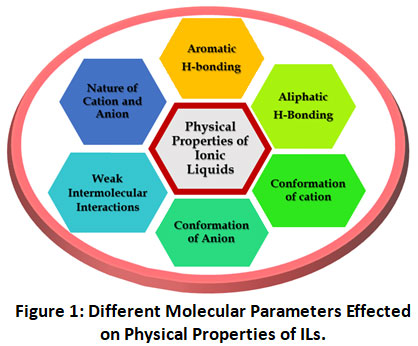 |
Figure 1: Different Molecular Parameters Effected on Physical Properties of ILs. Click here to view Figure |
Although aliphatic H-bonding is weaker than aromatic H-bonding, it has severe impact on physical properties.13 Aliphatic H-bonding interaction is considered by intra and inter-cation-anion interaction in ILs. The impact of weak intermolecular interactions on the physical properties of ILs has been investigated on basis of strength cation-anion.14,15 Due to the nonexistence of suitable structural-properties relationship, & inadequate experimental information, there are open changes and wide scope to explore the ILs research fields.
Conclusion
In our lab, we pragmatic the existence of several aromatic, aliphatic H-bonding & π-π stacking interactions in imidazolium and piperidinium-based ILs. Detail analysis of all these interactions shows that inconsequential variation of relatively weaker interaction (π-πstacking interaction) can lead to robust packing of constituent ions. In addition, numerous diverse types of π-π stacking interactions have been recognized in these ILs. These outcomes recommend that the physical properties of ILs can be altered radically by amendment these weak interactions alone. It is consequently quite likely that multiple interactions (weak & strong interionic interaction) along with exceedingly estimated mesoscopic structure provide this stability to ILs.
References
- T. Welton, Room-Temperature Ionic Liquids. Solvents for Synthesis and Catalysis, Chem. Rev. 99 (1999) 2071–2084.
CrossRef - S. K. Panja, S. Saha, Recyclable, magnetic ionic liquid bmim[FeCl4]-catalyzed, multicomponent, solvent-free, green synthesis of quinazolines, RSC Adv. 3 (2013) 14495-14500.
CrossRef - M. Shukla, N. Srivastav, S. Saha, Theoretical and spectroscopic studies of 1-butyl-3-methylimidazolium iodide room temperature ionic liquid: Its differences with chloride and bromide derivatives, J. Mole. Struct., 975 (2010) 349-356.
CrossRef - K. Wendler, S. Zahn, F. Dommert, R. Berger, C. Holm, B. Kirchner, L. Delle Site, Locality and Fluctuations: Trends in Imidazolium-Based Ionic Liquids and Beyond, J. Chem. Theory Comput. 7 (2011) 3040-3044.
CrossRef - K. Fumino, T. Peppel, M. Geppert-Rybczynska, D. H. Zaitsau, J. K. Lehmann, S. P. Verevkin, M. Kockerling, R. Ludwig, The influence of hydrogen bonding on the physical properties of ionic liquids, Phys. Chem. Chem. Phys. 13 (2011) 14064-14075.
CrossRef - P. A. Hunt, C. R. Ashworth, R. P. Matthews, Hydrogen bonding in ionic liquids, Chem. Soc. Rev. 44 (2015) 1257-1288.
CrossRef - K. Iwata, H. Okajima, S. Saha, H. Hamaguchi, Local structure formation in alkyl-imidazolium-based ionic liquids as revealed by linear and nonlinear Raman spectroscopy, Acc. Chem. Res. 40 (2007) 1174–1181.
CrossRef - S. K. Panja, S. Saha, Microheterogeneity in imidazolium and piperidinium cation-based ionic liquids: 1D and 2D NMR studies, Magn. Reson. Chem. 56 (2018) 95-102.
CrossRef - S. Zhang, X. Qi, X. Ma, L. Lu, Y. Deng, Hydroxyl ionic liquids: the differentiating effect of hydroxyl on polarity due to ionic hydrogen bonds between hydroxyl and anions, J. Phys. Chem. B. 114 (2010) 3912–3920.
CrossRef - S. K. Panja, B. Haddad, M. Debdab, J. Kiefer, Y. Chaker, S. Bresson, A. Paolone, ChemPhysChem 20 (2019), 936 –940.
CrossRef - S. K. Panja, B. Haddad, J. Kiefer, Clusters of the Ionic Liquid 1?Hydroxyethyl?3?methylimidazolium Picrate: From Theoretical Prediction in the Gas Phase to Experimental Evidence in the Solid State, ChemPhysChem. 19 (2018) 3061-3068.
CrossRef - A. Khrizman, H. Y. Cheng, G. Bottoni, G. Moyna, Observation of aliphatic C–H? X hydrogen bonds in imidazolium ionic liquids, Chem. Commun. 51 (2015) 3193-3195.
CrossRef - S. K. Panja, N. Srivastava, J. Srivastava, N. E. Prasad, H. Noothalapati, S. Sigeto, S. Saha, Evidence of C--F-P and aromatic π--F-P weak interactions in imidazolium ionic liquids and its consequences, Spectro. Chem. Acta, 194 (2018) 117-125.
CrossRef - S. K. Panja, N. Dwivedi, H. Noothalapati, S. Shigeto, A. K. Sikder, A. Saha, S. S. Sunkari, S. Saha, Significance of weak interactions in imidazolium picrate ionic liquids: spectroscopic and theoretical studies for molecular-level understanding, Phys. Chem. Chem. Phys. 17 (2015) 18167-18177.
CrossRef - S. K. Panja, Influence of Anion on Physical and Electronic Property of Imidazolium Ionic Liquids: Role of Weak Interactions, ChemistrySelect, 5 (2020) 2805–2809.
CrossRef

This work is licensed under a Creative Commons Attribution 4.0 International License.