
The corrosion characteristics of Containers Intended for Beverage Storage
T Umamathi1  , D Delphin2 , M Harthika2 , P Arul Deepa2 , V Pappathi2 , A Preethi Christina2 , T Priyadharshini2 , R Yuasri2 , Anitha Nilavan2 , Susai Rajendran2,3* , Caslav Lacnjevac4 and Abdulhameed Al-Hashem5
1Department of Chemistry, Sri Meenakshi Government Arts College for Women (A), Madurai, Tamil Nadu India .
2Department of Chemistry, St Antony’s College of Arts and Sciences, Mother Teresa Women’s University, Kodaikanal, Tamil Nadu India .
3Centre for Nanoscience and Technology, Puducherry University, Puducherry, India .
4Faculty of Agriculture, University of Belgrade, Belgrade, Serbia .
5Petroleum Research Centre, Kuwait Institute for Scientific Research, Kuwait .
http://dx.doi.org/10.13005/OJPS10.02.03
A beverage can, commonly referred to as a drink can, is a metal container that features a polymer lining, specifically designed to hold a defined quantity of liquids such as carbonated soft drinks, alcoholic beverages, fruit juices, teas, herbal infusions, energy drinks, and other types of liquids. Extensive research has been conducted in this field. This study examines the potential of using Ever Silver cans for storing apple juice that includes sugar and ice. It evaluates the corrosion resistance under various conditions, including a water system, an apple juice system, an apple juice system with sugar (5000 ppm), and an apple juice system that contains both sugar (5000 ppm) and ice (1 g). A study on polarization has been carried out to assess the corrosion resistance of Ever Silver under specific conditions. The findings indicate that apple juice containing added sugar is unsuitable for storage in Ever Silver containers. It is recommended that sugar be added only immediately before consumption.
Copy the following to cite this article:
Umamathi T, Harthika M, Deepa P. A, Pappathi V, Christina A. P, Priyadharshini T, Yuasri R, Nilavan A, Rajendran S, Lacnjevac C, Al-Hashem A. The corrosion characteristics of Containers Intended for Beverage Storage. Oriental Jornal of Physical Sciences 2025; 10(2).
DOI:http://dx.doi.org/10.13005/OJPS10.02.03Copy the following to cite this URL:
Umamathi T, Harthika M, Deepa P. A, Pappathi V, Christina A. P, Priyadharshini T, Yuasri R, Nilavan A, Rajendran S, Lacnjevac C, Al-Hashem A. The corrosion characteristics of Containers Intended for Beverage Storage. Oriental Jornal of Physical Sciences 2025; 10(2).Available here: https://bit.ly/4lIZ14I
Download article (pdf) Citation Manager Publish History



Introduction
A beverage can, commonly referred to as a drink can, is a metal container that features a polymer lining and is intended to hold a defined volume of liquids, including carbonated soft drinks, alcoholic beverages, fruit juices, teas, herbal infusions, energy drinks, and more. The exterior of these cans is primarily made of aluminum, accounting for 75% of global production, with the remaining 25% composed of tin-plated steel.
The internal surfaces are treated with a layer of epoxy resin or polymer. It is estimated that the worldwide output of beverage cans amounts to around 370 billion units annually. A variety of studies have been carried out on this topic, with the main results presented in Table 1.
Table 1. Containers designed for the storage of beverages
SNo | Title | Methods | Findings | Ref. |
1 | Critical review on weldability of 316 austenitic and 410 martensitic stainless steel | Welding 316 stainless steel to 410 martensitic stainless steel can be accomplished through several welding techniques, such as TIG, MIG, electron beam welding (EBW), shielded metal arc welding (SMAW), and submerged arc welding (SAW). | The fusion of 316 austenitic stainless steel and 410 martensitic stainless steel is expected to enhance corrosion resistance. This paper aims to deliver an in-depth analysis of the weld joint between 316 ASS and 410 MSS, focusing on its mechanical properties. It will encompass the aspects of mechanical characteristics and cold metal transfer (CMT) welding techniques for both 316 ASS and 410 MSS. | 1 |
2 | Storage vats, vessels, and tanks | To enhance comprehension of these containers, schematics illustrating various types of vats, vessels, and tanks are also provided. | The utilization of innovative technologies in storage tanks and vessels, encompassing methods for determining levels and compositions, is elucidated. | 2 |
3 | Compatibility of Phase Change Materials and Metals: Experimental Evaluation Based on the Corrosion Rate | Various types of metal containers have been designed and evaluated for their thermal conductivity and durability against mechanical damage, thereby improving the efficiency of these latent heat thermal energy storage (LHTES) systems. | Aluminum is the most appropriate material for containers used with the tested phase change materials (PCMs), as it exhibits the least mass loss and shows minimal visual alterations on its surface following extended exposure to the chosen PCMs. | 3 |
4 | Investigation of thin sheet stainless steel resistance spot welds: Effect of weld current on nugget failure and microstructure | Thin stainless-steel sheets, frequently utilized in the food and beverage sector, are joined through resistance spot welding during the fabrication of leak-proof containers. The parameters for spot welding are fine-tuned to achieve the largest possible nugget size and optimal weld strength. | The influence of weld current on the morphology of delta ferrite developed in the weld zone is examined in this study utilizing a pseudo-binary phase diagram. This research aims to establish a relationship between local chromium depletion and the resulting microstructure and defect formation. | 4 |
5 | Wear characteristics on the can opener of sus 420j2 | In this study, experiments were carried out using a self-developed friction tester and its measurement system to examine the wear characteristics of the SUS 420J2 stainless steel can opener. | The influence of contact stress and sliding velocities on the wear characteristics of cutlery used in openers can be elucidated. | 5 |
6 | Effect of crystal structural changes of pet in can-making process on properties of film laminated steel for containers | This research examined how the crystallinity of PET film influences several properties essential for food can applications. | The alteration of the crystal structure of the PET film during the can manufacturing process had a considerable impact on both impact resistance and corrosion resistance. The regulation of the crystallinity of the PET emerged as a crucial factor in achieving superior properties. | 6 |
7 | Electrochemical studies on the stability and corrosion resistance of two austenitic stainless steels for soft drinks containers | The study examined the impact of three carbonated soft drinks on the stability of FeCrNi and FeCrNiMo alloys through the application of two electrochemical methods: linear potentiodynamic polarization (LPP) and electrochemical impedance spectroscopy (EIS), conducted at a temperature of 25 °C. | The excellent corrosion resistance exhibited by austenitic stainless steel alloys in soft drinks is attributed to the development of a relatively stable passive film composed of metal oxides. | 7 |
8 | Metallic corrosion in industry (case studies) | Two case studies were undertaken to examine the behavior of stainless steel across different industrial applications, with the aim of identifying the underlying causes of corrosion phenomena. | Acidic rain significantly contributed to the formation of concentration cells, which, along with thermal stresses, initiated corrosion processes. This combination ultimately led to the development of cracks as a result of Stress Corrosion Cracking (SCC). | 8 |
9 | Electrochemical characterisation of protective organic coatings for food packaging | An electrochemical characterization is frequently employed to examine the protective efficacy of organic coatings applied to metal substrates across a range of applications. | Coatings that incorporate pigments, such as titanium dioxide (TiO2), demonstrate superior performance compared to clearcoats. Furthermore, when evaluating various polymers, epoxy-phenolic coatings provide enhanced corrosion protection in comparison to epoxy-melamine coatings. | 9 |
10 | Corrosion phenomena and shelf life prediction of steel beverage cans with the polarization resistance technique | The corrosion rates of various can systems were examined through the polarization resistance method. Measurements of polarization resistance were conducted while these cola-filled cans were stored for various durations. | The polarization resistance method serves as a valuable predictive instrument for assessing metal pick-up following storage, thereby aiding in shelf life predictions. | 10 |
Apple juice
Apple juice is composed of roughly 88% water and 11% carbohydrates, with sugars accounting for 9% of that total. A typical serving of 100 ml of unsweetened apple juice contains 46 calories and does not provide significant amounts of micronutrients. Furthermore, the juice contains very low levels of protein and fat. The chemical makeup of apple juice can be evaluated by analyzing various elements, such as soluble solids, total sugars, sucrose, glucose, fructose, sorbitol, pH, titratable acidity, total acidity, citric acid, galacturonic acid, malic acid, quinic acid, succinic acid, pectin, and turbidity.
Apple juice typically has a pH level between 3.5 and 4.4, which classifies it as moderately acidic. This acidity is vital for inhibiting the growth of harmful microorganisms in the juice. It is important to keep the pH below 4.0 to guarantee the safety of apple juice and reduce the likelihood of spoilage11.
Aim and scope of the study
This research explores the practicality of using Ever Silver cans for storing apple juice with the addition of sugar and ice. It evaluates the corrosion resistance across various systems, including a water system, an apple juice system, a system with apple juice and sugar (5000 ppm), and a system containing apple juice with sugar (5000 ppm) and ice (1 g). A polarization study has been performed to determine the corrosion resistance of Ever Silver in these defined systems.
Methods and Materials
This section details the experimental techniques and materials utilized in the research. The objective of this study is to evaluate the viability of storing apple juice in an Ever Silver container.
Preparation of apple juice
Fifty grams of apple slices were blended with drinking water obtained from the Dindigul Corporation in Tamil Nadu, India, utilizing a mixer. The resulting mixture was then filtered to remove any suspended particles, and the final volume was calibrated to 500 milliliters in a standard measuring flask.
Ever Silver Composition
Ever Silver, commonly referred to as SS 304, was obtained from the vessel markets 12-14.
Composition: SS 304 lacks molybdenum, whereas SS 316 includes 2-3% molybdenum, along with a lower chromium content and a higher nickel content. The composition of SS 304 is detailed in Table 2.
Table 2: SS 304 Composition (%)
Stainless Steel | C, ? | Si ? | Mn ? | P ? | S ? | Cr | Ni | Mo | Fe |
304 | 0.03 | 1.00 | 2.00 | 0.035 | 0.030 | 18.0-20.0 | 8.0-12.0 | – | Rest (64.905) |
Electrochemical study
Polarization study
This research investigates the corrosion resistance of various systems, which encompass a water system, an apple juice system, an apple juice system with sugar added, and an apple juice system that incorporates both sugar and ice. To evaluate the corrosion resistance of Ever Silver within these defined systems, a polarization study was performed. A three-electrode cell configuration was employed to produce polarization curves.
The polarization curves were produced using a CHI 660A electrochemical workstation. In order to assess the corrosion resistance of the Ever Silver electrode, it was submerged in different test solutions. The experimental configuration comprised an Ever Silver working electrode, a saturated calomel electrode (SCE) serving as the reference electrode, and a platinum counter electrode, as depicted in Figure 1.
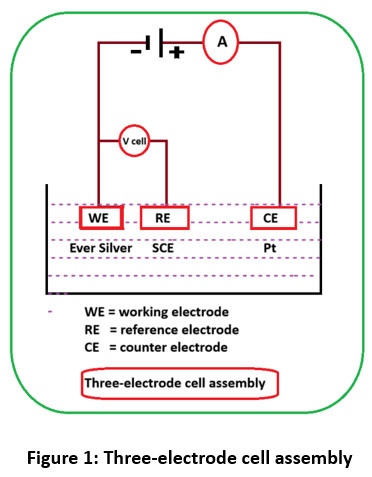 | Figure 1: Three-electrode cell assembly
|
Results
The polarization curves for Ever Silver, obtained from immersion in different test solutions such as a water system, an apple juice system, an apple juice with sugar (5000 ppm) system, and an apple juice with sugar (5000 ppm) plus 1 gram of ice system, are illustrated in Figures 2-5.
The corrosion parameters derived from the polarization curves, including corrosion potential (Ecorr), Tafel slopes (?c, ?a), Linear Polarization Resistance (LPR), and corrosion current values (Icorr), are presented in Table 3. Reference strarts from 15
A comparative examination of the corrosion parameters is presented in Figures 6-8. It is widely acknowledged that a decline in a material's corrosion resistance is associated with a lower LPR value and a higher corrosion current, as depicted in Figure 915-19.
Table 3: Corrosion parameters of Ever Silver immersed in various test solutions obtained from Polarization study
The corrosion characteristics of Ever Silver subjected to different test solutions, as determined through a polarization study
System | Ecorr V vs SCE | Bc V/decade | Ba V/decade | LPR Ohmcm2 | Icorr A/cm2 |
water | -0.567 | 5.957 | 2.202 | 61698 | 8.638 x 10⁻⁷ |
AJ | -0.529 | 6.149 | 4.574 | 46313 | 8.755 x 10⁻⁷ |
AJ + sugar | -0.344 | 6.340 | 3.972 | 38965 | 10.82 x 10⁻⁷ |
AJ + sugar + ice | -0.705 | 6.588 | 3.073 | 44475 | 10.12 x 10⁻⁷ |
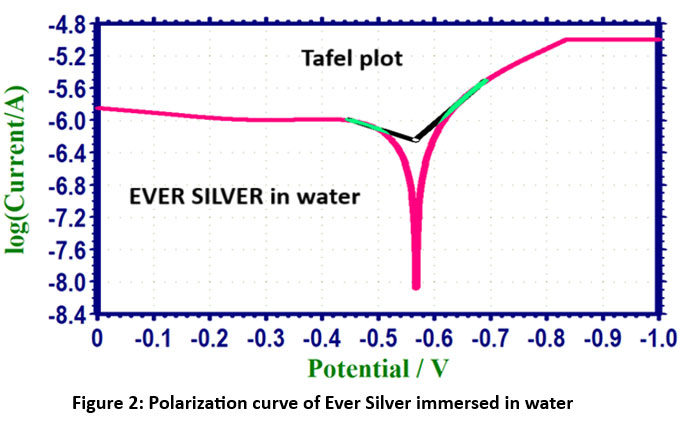 | Figure 2: Polarization curve of Ever Silver immersed in water |
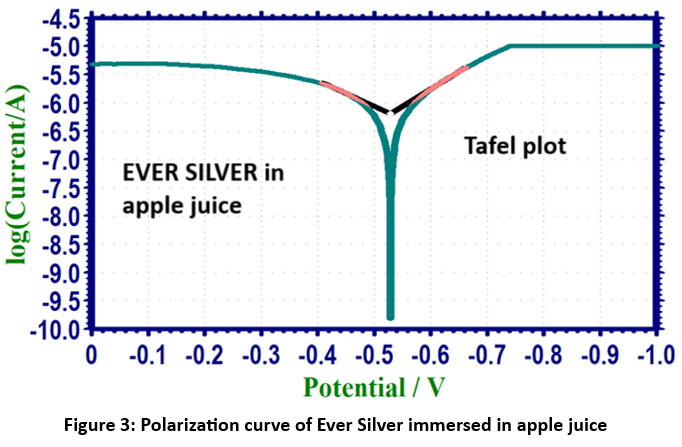 | Figure 3: Polarization curve of Ever Silver immersed in apple juice |
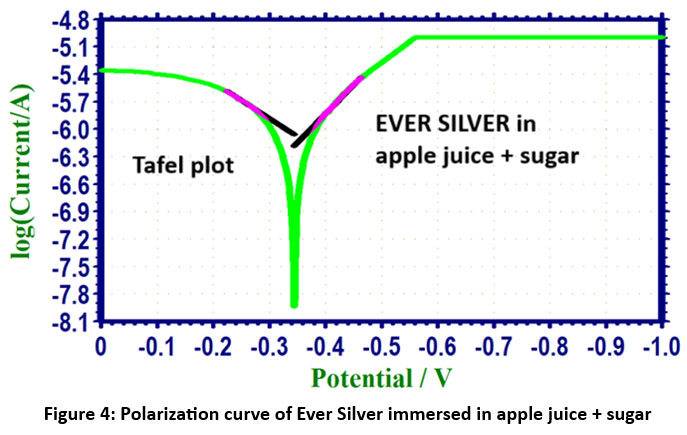 | Figure 4: Polarization curve of Ever Silver immersed in apple juice + sugar |
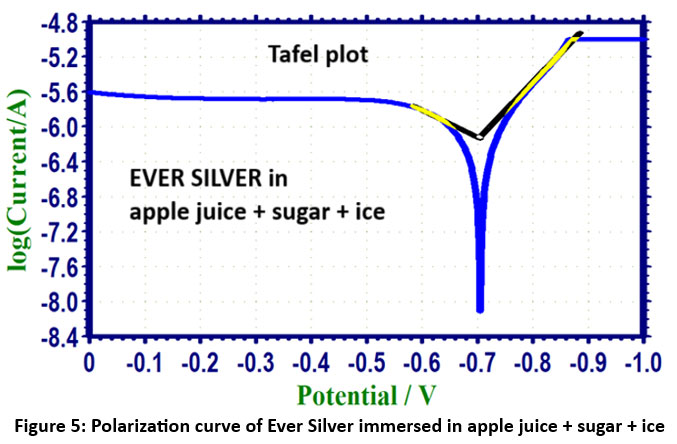 | Figure 5: Polarization curve of Ever Silver immersed in apple juice + sugar + ice |
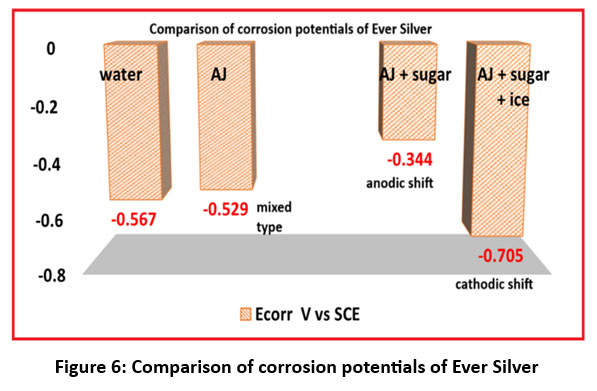 | Figure 6: Comparison of corrosion potentials of Ever Silver |
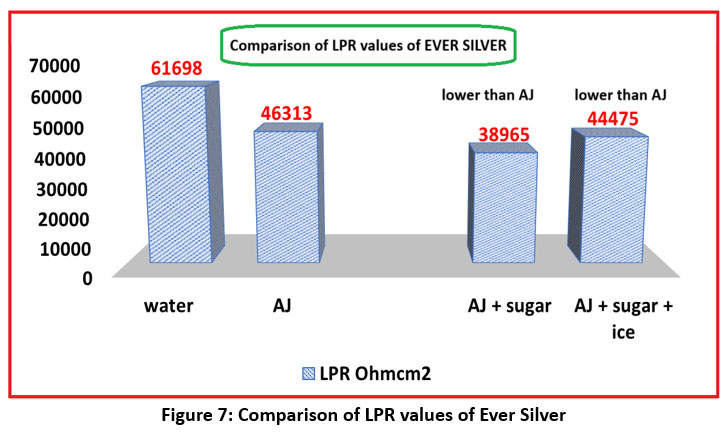 | Figure 7: Comparison of LPR values of Ever Silver |
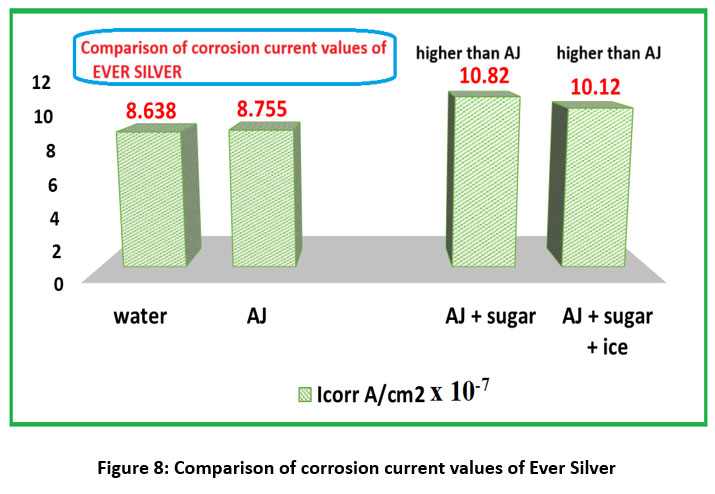 | Figure 8: Comparison of corrosion current values of Ever Silver |
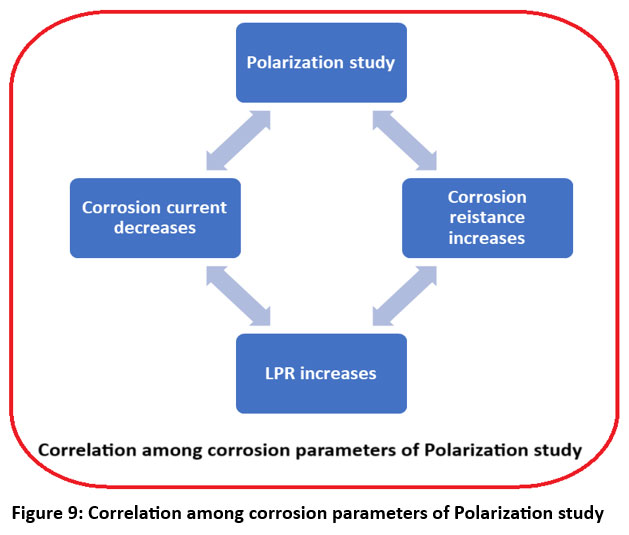 | Figure 9: Correlation among corrosion parameters of Polarization study |
Discussion
In the present study, polarization analysis has been employed to evaluate the corrosion resistance of Ever Silver when immersed in various test solutions. The primary parameters considered in the polarization analysis are corrosion potential (Ecorr), corrosion current (Icorr), linear polarization resistance (LPR), and Tafel slopes, which are comprised of anodic (?a) and cathodic (?c) components.
Corrosion potential
Corrosion potential refers to the ability of both metallic and non-metallic surfaces to undergo electron loss when they come into contact with an electrolyte. This corrosion process inherently creates two electrodes: a cathode and an anode. The electrode potential of a metal serves as a measure of its tendency to dissolve and corrode in a specific electrolyte.
Frequently referred to as Ecorr, the corrosion potential of a metal is regarded as one of the most essential elements assessed in corrosion research and in monitoring corrosion in intricate field environments.
Corrosion potential is defined as a mixed potential, often referred to as open-circuit potential or rest potential, where the rate of anodic dissolution of the electrode matches the rate of cathodic reactions. This balance results in no net current entering or exiting the electrode. The corrosion current is characterized as the dissolution current that takes place at this specific corrosion potential 20,21.
Corrosion current
Corrosion current density measures the rate at which metal degrades in a given environment. It reflects the flow of electrons from the metal to the surrounding electrolyte during the corrosion process 22,23.
Linear polarization resistance
A linear polarization resistance (LPR) test is utilized to assess corrosion rates and offers valuable information regarding the corrosion resistance of materials in aqueous settings. These tests can be performed under static conditions as well as during reciprocating motion.
The linear polarization resistance method entails the use of small voltage variations, typically under 30 mV, applied to the metal, both above and below its corrosion potential. Within this narrow range around the corrosion potential, the current response remains linear.
Within a narrow range around the corrosion potential, the current response remains linear. Polarization resistance (Rp) measurements are employed to assess the protective efficacy of electrodeposited coatings, as the Rp values obtained are inversely proportional to the corrosion current (indicating that an increase in polarization resistance corresponds to a decrease in corrosion current). Polarization resistance is characterized as the specimen's resistance to oxidation when exposed to an external potential. The corrosion rate is directly associated with Rp and can be derived from it 24.
Tafel slopes
Tafel slopes are a well-established metric for assessing the rates and mechanisms of electrocatalytic reactions. Fundamentally, the Tafel slope quantifies the millivolts (mV) required for a tenfold increase in current, represented in mV/dec. Therefore, a lower Tafel slope indicates a more efficient catalyst, as it reflects the need for a smaller overpotential to achieve a higher current density (Figure 10). Furthermore, under certain conditions, the Tafel slope can provide kinetic insights, including the identification of the rate-determining step 25-28.
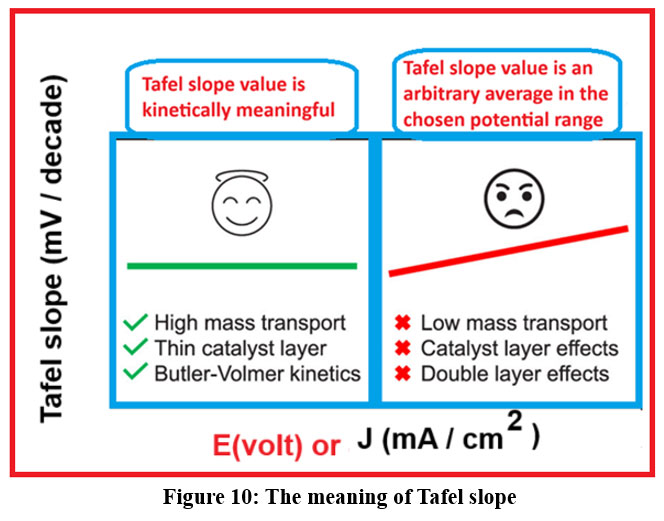 | Figure 10: The meaning of Tafel slope |
Corrosion resistance of an apple juice system
The corrosion resistance of an apple juice system is inferior to that of a water system. This conclusion is drawn from the observation that in the apple juice system, the LPR value diminishes while the corrosion current value rises.
Corrosion resistance of an apple juice + sugar system (30ºC)
The corrosion resistance of a system comprising apple juice and sugar is lower to that of a water system. This conclusion is drawn from the observation that, in the apple juice system, the LPR value diminishes while the corrosion current value rises.
The corrosion resistance of a system comprising apple juice and sugar is inferior to that of a pure apple juice system. This phenomenon may be attributed to the interaction between sugar molecules and the active components of apple juice. Consequently, the quantity of these active components that reach the Ever Silver surface is reduced, leading to a decrease in corrosion resistance.
Corrosion resistance of an apple juice + sugar + ice system
The corrosion resistance of a system comprising apple juice, sugar, and ice is inferior to that of a water system. This conclusion is drawn from the observation that in the apple juice system, the LPR value diminishes while the corrosion current value escalates.
The corrosion resistance of a system comprising apple juice, sugar, and ice surpasses that of a system containing only apple juice and sugar. This improvement may be attributed to the presence of ice at 20ºC, which diminishes the desorption of the protective film on the Ever Silver surface, in contrast to the apple juice and sugar system at 30ºC.
Inference
The corrosion resistance of Ever Silver varies across different systems, decreasing in the following order.
Water > Apple juice > Apple juice + Sugar + ice > Apple juice + Sugar
Implication
The current study suggests that apple juice with added sugar should not be stored in Ever Silver containers. It is advisable to add sugar immediately prior to consumption.
Conclusion
The present study investigates the feasibility of utilizing Ever Silver cans for the storage of apple juice that contains sugar and ice. It assesses the corrosion resistance under different conditions, including a water system, an apple juice system, an apple juice system with sugar (5000 ppm), and an apple juice system that incorporates both sugar (5000 ppm) and ice (1 g). A polarization study has been conducted to evaluate the corrosion resistance of Ever Silver under particular conditions. The results suggest that apple juice with added sugar is not suitable for storage in Ever Silver containers. It is advised that sugar be added only just prior to consumption.
Acknowledgement
The authors are thankful to their respective managements for their help and support.
Funding Sources
The author(s) received no financial support for the research
Conflict of Interest
The authors do not have any conflict of interest.
Data Availability Statement
This statement does not apply to this article.
Ethics Statement
This research did not involve human participants, animal subjects, or any material that requires ethical approval.
Informed Consent Statement
This study did not involve human participants, and therefore, informed consent was not required.
Author Contributions
Susai Santhammal Rajendran, Caslav Lacnjevac : Conceptualization, Methodology, Writing – Original Draft.
P Arul Deepa, D Delphin, M Harthika, V Pappathi, A Preethi Christina, T Priyadharshini, R Yuasri, Anitha Nilavan: Data Collection, Analysis, Writing – Review & Editing.
Abdulhameed Al-Hashem, T Umamathi: Visualization, Supervision, Project Administration.
References
- Thaware, A., Ambade, S., Gawande, P., Radhika, K., Josh, T., Shelare, S., Critical review on weldability of 316 austenitic and 410 martensitic stainless steel, Recent Advances in Materials Manufacturing and Machine Learning, 2024; 741–747.
CrossRef - Baeghbali, V., Hedayati, S., Jafari, S.M., Storage vats, vessels, and tanks Transporting Operations of Food Materials within Food Factories: Unit Operations and Processing Equipment in the Food Industry, 2022; 15–30. https://doi.org/10.1016/B978-0-12-818585-8.00012-X
CrossRef - Ostry, M., Bantova, S., Struhala, K., Compatibility of Phase Change Materials and Metals: Experimental Evaluation Based on the Corrosion Rate, Molecules, 2020; 25(12): 2823. https://doi.org/10.3390/molecules25122823
CrossRef - Bhat, S.D., Vijeesh, V., Acharya, P., Rao, M., Investigation of thin sheet stainless steel resistance spot welds: Effect of weld current on nugget failure and microstructure, Materials Today: Proceedings, 2019; 35: 361–365. http://dx.doi.org/10.1016/ j.matpr.2020.02.350
CrossRef - Chang, Y.P., Chu, L.M., Wang, H.Y., Wang, J.C., Wear characteristics on the can opener of sus 420j2, Key Engineering Materials, 823 KEM, 2019; 111–116. http://dx.doi.org/10.4028/www.scientific.net/KEM.823.111
CrossRef - Yamanaka, Y., Kitagawa, J., Kojima, K., Nakano, H., Effect of crystal structural changes of pet in can-making process on properties of film laminated steel for containers, ISIJ International, 2018; 58(12): 2330–2337. https://doi.org/10.2355/ isijinternational.ISIJINT-2018-519
CrossRef - Mareci, D., Trinca, L.C., Cotea, V.V., Souto, R.M., Electrochemical studies on the stability and corrosion resistance of two austenitic stainless steels for soft drinks containers, International Journal of Electrochemical Science, 2017; 12(6): 5438–5449 . http://dx.doi.org/10.20964/2017.06.35
CrossRef - 8. Saeed, F.M., Odeh, A.A., Metallic corrosion in industry (case studies), 12th International Conference on Fracture 2009 ICF-12, 2009; 5: 3429–3438.
- Deflorian, F., Rossi, S., Vadillo, M.D.C., Fedel, M., Electrochemical characterisation of protective organic coatings for food packaging, Journal of Applied Electrochemistry, 2009; 39(11): 2151–2157. http://dx.doi.org/10.1007/s10800-009-9818-1
CrossRef - Dolfing, J., Corrosion phenomena and shelf life prediction of steel beverage cans with the polarization resistance technique, Materials Science Forum, 1995; 192-194(pt 1): 497–510.
CrossRef - chemical composition of apple juice - Search https://www.bing.com/search?q=chemical+composition+ of+apple+juice& form=ANNTH1&refig =d37e823cff774a1dbedf1e0efd4c6a56&pc =HCTS&pq=apple+juice&pqlth=11&assgl=35&sgcn =chemical+composition+of+apple+juice&qs =HS&smvpcn=0&swbcn=10&sctcn=0&sc= 1011&sp=2&ghc=0&cvid=d37e 823cff774a1dbedf1e0efd4c6a56&clckatsg=1&hsmssg=0
- Ever Shine Ever Silver | 304 Grade Stainless Steel | ??????? ????? ??????????? https://www.youtube.com/watch?v=zmBYmMZugmY (video)
- 304 vs 316 Stainless Steel: Difference between 304 and 316 Stainless Steel – What Is Piping https://whatispiping.com/304-vs-316-stainless-steel/#:~:text=316-grade%20stainless%20steel%20has%20slightly% 20greater%20strength% 2C%20hardness% 2C, reduces%20the%20weldability%20and%20formability%20of%20316%20grade.
- https://www.bing.com/search?q=difference+between+ss+316l+and+ever+silver +304+grade&qs=GS&pq =difference+between +ss +316l+and+ever+silver+304&sk=GS1&sc=12-46&cvid=72B38853BA11461F8 C5202F2799807D3&FORM =QBRE&sp=2&l q=0&ntref=1 difference between ss 316l and ever silver 304 grade – Search
- Praveen, B.M., Jeevan Chakravarthy, A.S., Prasanna, B.M., Shabanbanu, Devendra, B.K., Pavithra, M.K., Fasiulla, Experimental and theoretical investigation of cyclohexanone derivative (CHD) as a corrosion inhibitor for mild steel in 1 M HCl, Scientific Reports, 2025; 15(1): 720. http://dx.doi.org/10.1038/s41598-024-83054-7
CrossRef - Soedarsono, J.W., Andoko, A., Diharjo, K., Gapsari, F., Rangappa, S.M., Siengchin, S., Biodegradable PLA/HEC-ZNO Nanocomposite for corrosion protection of ASTM A36 steel: A combined quantum and electrochemical analysis, Case Studies in Chemical and Environmental Engineering, 2025; 11: 101039. https://doi.org/10.1016/j.cscee.2024.101039
CrossRef - Ruoying, Z., Deqing, C., Zhefeng, L., Study on corrosion inhibition properties of disulfide derivatives with different hydrophobicity in sulfuric acid, Journal of Molecular Structure, 2025; 1328: 141320. https://ssrn.com/abstract=4915000
CrossRef - Bedair, M.A., Yousif, Q.A., Fadel, Z., Melhi, S., Al-Odail, F., Al-Odail, F.A., Abuelela, A.M., Experimental and theoretical analyses of the corrosion inhibition efficacy of new penicillanic acid derivatives for carbon steel in hydrochloric acid environment, Journal of Molecular Structure, 2025; 1328: 141282.https://linkinghub.elsevier.com/retrieve/pii/S0022286024037876
CrossRef - Zgueni, H., Mesky, M.E., Moussaif, A., Salah, M., Matine, A., Oubair, A., Znini, M., Mabrouk, E.H., Echihi, S., Chebabe, D., Theoretical and experimental study of the corrosion inhibition of carbon steel in 1M HCl solution by a new synthesized organic compound derived from carbendazim, Journal of Molecular Structure, 2025;1327: 141230. http://dx.doi.org/10.1016/j.molstruc.2024.141230
CrossRef - Corrosion Potential and Corrosion Current | SpringerLink
- https://link.springer.com/chapter/10.1007/978-1-4757-9877-7_5
- corrosion current density - Search
- https://www.bing.com/search?q=corrosion+current+density&qs=LT&pq=corrosion+current&sk=LT1&sc=11-17&cvid=6BE7CF2C5FC6420DA9BB73F7365C776D&FORM=QBRE&sp=2&ghc=1&lq=0
- Anita, N., Joany, R.M., Dorothy, R., Aslam, J., Rajendran, S., Subramania, A., Singh, G., Verma, C., Electrochemical and Analytical Techniques for Sustainable Corrosion Monitoring, Advances, Challenges and Opportunities, 2023; 4: 59-80,https://doi.org/10.1016/B978-0-443-15783-7.00005-0
CrossRef - Tafel, J. Uber Die Polarisation Bei Kathodischer Wasserstoffentwicklung, Zeitschrift für Phys. Chemie, 1905; 50 (1): 641– 712. DOI: 10.1515/zpch-1905-5043
CrossRef - Anantharaj, S., Noda. S., How Properly Are We Interpreting the Tafel Lines in Energy Conversion Electrocatalysis?. Mater. Today Energy 2022, 29, 101123 DOI: 10.1016/j.mtener.2022.101123
CrossRef - Tafel Slope Plot as a Tool to Analyze Electrocatalytic Reactions | ACS Energy Letters
- https://pubs.acs.org/doi/10.1021/acsenergylett.4c00266

This work is licensed under a Creative Commons Attribution 4.0 International License.