
Volume Fraction Measurement in Crude Oil-Water Two-Phase Mixture Using A Neutron Beam
Abdullah A. Kendoush 1 , Hameed B. Mahood 2 * and Ibrahim G. Fiadh 3
1Department of Nuclear Engineering Technology, Augusta Technical College, Augusta, Nuclear Engineering Technology, Augusta, 30906 USA .
2University of Miasa, University of Miasan, Iraq, Iraq .
3Center of Engineering Physics, Ministry of Sciences & Technology, Center of Engineering Physics Ministry of Sciences & Technology, Baghdad, Iraq .
http://dx.doi.org/10.13005/OJPS02.02.02
A neutron beam has been used to measure the volume fraction of crude oil in water of non- flow two-phase mixture experimentally.241Am-Be neutron source were used with an activity of 3.7x10⁴ MBq. The volume fraction was simulated by using small plastic tubes filled with oil and immersed in non-flow water tube. The results show that it is feasible to measure the volume fraction of crude oil in a crude oil-water mixture.
Copy the following to cite this article:
Kendoush A. A, Mahood H. B, Fiadh I. G. Volume Fraction Measurement in Crude Oil-Water Two-Phase Mixture Using A Neutron Beam. Orient J Phys Sciences 2017;2(2).
DOI:http://dx.doi.org/10.13005/OJPS02.02.02Copy the following to cite this URL:
Kendoush A. A, Mahood H. B, Fiadh I. G. Volume Fraction Measurement in Crude Oil-Water Two-Phase Mixture Using A Neutron Beam. Orient J Phys Sciences 2017;2(2). Available from: https://bit.ly/3pPO2t1
Download article (pdf) Citation Manager Publish History
Introduction
The subject of two-phase flow is important in many industrial fields; such as oil and gas pipeline, process pipeline, column flotation of minerals, fluidized bed combustion, heat exchangers and certain type of nuclear reactor.
The nuclear attenuation is one of important methods that has been used for measurement of void/volume fraction and are considered non- intrusive as they do, not cause perturbation at the local structure of the two-phase flow and a relative easiness of calibration. The method is essentially based on allowing a beam of radiation (beta, gamma, neutron and X-ray) to traverse the cross-section of the pipe where it is detected. The using of neutron beam technique for the volume fraction measurement offers the following advantage: relatively good accuracy and the neutrally charged neutrons easily penetrate thick walled steel pipe.
The radiation attenuation technique has been used by various investigators for determining the volume fraction in two-phase flow such as Foglia et al. (1961) used β-particles to measure the void distribution and slip ratio in heated channels. Perkins et al. (1961) used monoenergetic β-particles to measure the void fraction in a two-phase channel. Schrock (1969) used γ-rays for the measurement of void fraction. Slug flow was identified in this study. Harms and Forrest (1971) and Harms and Lavatta (1974) observed a "dynamic-bias" in the estimation of the average hold-up. It was attributed to the time variation of hold-up during the time interval of radiation transmission measurement. Heywood and Richardson (1978) used γ-ray absorption to measure the liquid hold-up in a pipe of circular cross-section. Banerjee et al. (1979) made a simulation of a neutron scattering method of measuring void fraction in two-phase flow. Perez-Griffo et al. (1982) used pulsed neutron activation method to measure the rate of two-phase flow in large pipe. Kniodic et al. (1983) used γ-ray scattering techniques for phase distribution measurements. Kendoush (1992) found that the uncertainty in void fraction measurement was the least when using beta particles, neutrons and gamma rays consecutively, while x-ray exhibited a behavior between gamma and beta.
Other investigators used a non-radiative technique to measure the volume fraction such as Wamsteker et al. (1964) who used the capacitance method for transient void fraction measurement and presented a comparison with γ- ray attenuation technique. Cimorelli et al. (1966) used the impedance gauge (capacitance) to measure the void fraction. Gregory et al. (1973) used capacitance sensors with different electrode configurations to measure the void fraction. Abulwafa and Kendall (1979) showed that the relation between the capacitance and the void fraction is linear and independent of the flow pattern and relative permittivity of the media. Geraetes and Borst (1987) developed the capacitance sensor for measuring time average void fraction in two-phase pipe flow. Kendoush and Sarkis (1996) proved experimentally the auto-transformer method as a new method used for measuring void fraction of two-phase medium inside the tube. In the present work a non-intrusive method using a neutron beam was used to measure the volume fraction of non- flow oil-water, water-oil, water-air and oil-air mixtures.
Experimental Measurements and Procedure
A PVC tube of 4.5 cm inside diameter and 0.6 cm thickness was used as a container of oil-water mixture. The tube was filled with tap water. Small diameter (0.375 cm), plastic tubes ( straw tubes used for drinking beverages ) filled with crude oil were used for volume fraction simulation by inserting them into the PVC tube . Detector readings were taken with empty plastic tubes immersed in the water filled PVC tube. This was done for every time a certain number of plastic tubes were used to get the actual value of volume fraction from mock-up arrangement. This method ensures that the thickness of the small plastic tubes was canceled. The crude oil was brought from Doura Petroleum Refinery near Baghdad.
The experimental arrangement for measuring the volume fraction (Fig.1) consists of an 241Am- 9Be neutron source of 3.7x10⁴ MBq activity and a 3He proportional counter of 2.54 cm outside diameter, 25.4 cm active length and 10 bar gas pressure. The sensitivity of this counter was 45 count/s per neutrons/cm2 s.
The volume fraction measurements based on allowing a collimated beams of nuclear radiation (neutron beams) to traverse the cross section of the pipe. The neutron source is positioned diametrically on the opposite side of the detector. The attenuation of the beam of radiation (neutron) when passing through oil-water mixture medium of bath length (L) is given by:
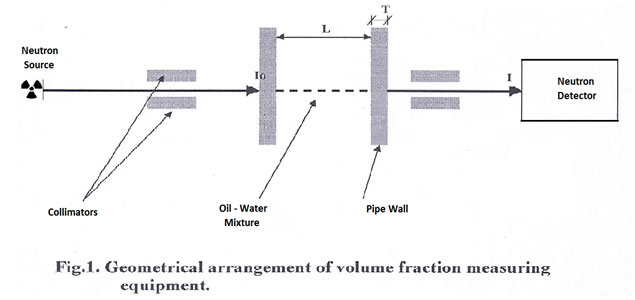 |
Figure 1
|

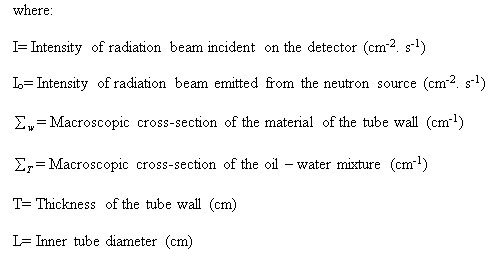
The total macroscopic cross-section of neutron interaction with oil – water mixture is:

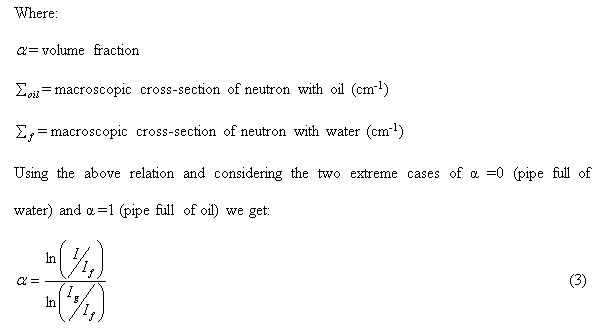
where:
Ig = intensity of neutron radiation passing through a pipe full of oil,
If = intensity of neutron radiation passing through a pipe full of liquid (water).
Results and discussion
The neutron attenuation technique for measuring void volume fraction is more accurate than other nuclear or non-nuclear techniques except β- rays as was demonstrated by Kendoush (1992). This technique is based on the intensity of radiation passing through the two-phase mixture. The attenuation of the neutron beam is done by absorption or scattering from the nuclei of the two-phase mixture. The degree of attenuation depends on the nature of the mixture.
Different two-phase mixtures were tested in the present experiments namely air-water, air-oil, water-oil and oil-water. The volume fraction of the particular phase is simulated by using small plastic tubes filled with that phase and immersed in the large tube filled with the continuous phase. The actual volume fraction in these cases calculated from the total volume occupied by the small immersed tubes.
Figure 2 shows the relationship between the volume fraction of air in water and the neutron count rate. A linear relationship was found and a high void fraction was recorded but it is not exceeding 0.7 due to geometrical limitations, as this value is approximately equal to the maximum packing of spheres. Figure 3 shows the relationship between the air volume ratio in oil and the neutron count rate. A linear relationship was seen and a low void fraction was recorded. Figure 4 denotes the relation between the water volume ratio in oil and the neutron count rate. A linear relationship was demonstrated and the water volume ratio recorded is limited to that recorded in Fig.3.
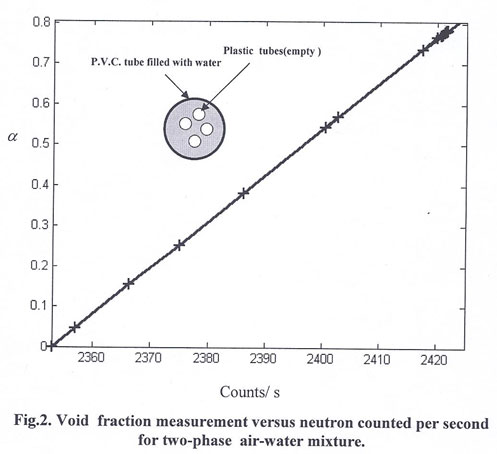 |
Figure 2
|
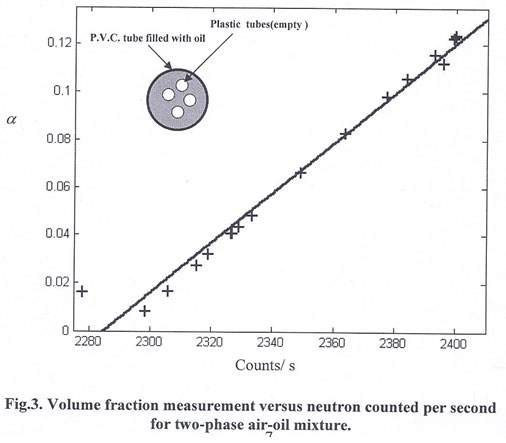 |
Figure 3
|
Figure 5 shows the relationship between the volume fraction of oil in water. The behavior is not different from other figures and the volume fraction recorded is similar to those found in Figs. 3 and 4.
Figure 6 shows a typical percentage error versus the volume fraction. At very low volume fraction the percentage error seems to have a high value but it becomes acceptable at a value near to the value of 0.1. The percentage error is obtained as follows
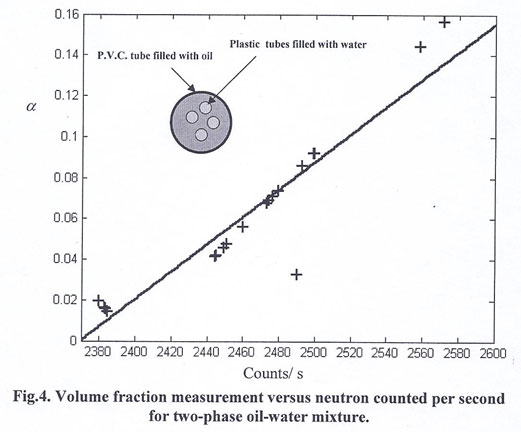 |
Figure 4
|

Figure 7 shows a comparison between the present percentage error and that given by Kendoush et al. (2005) using auto-transformer technique. At low values of volume fraction the present technique is more accurate than the auto-transformer one.
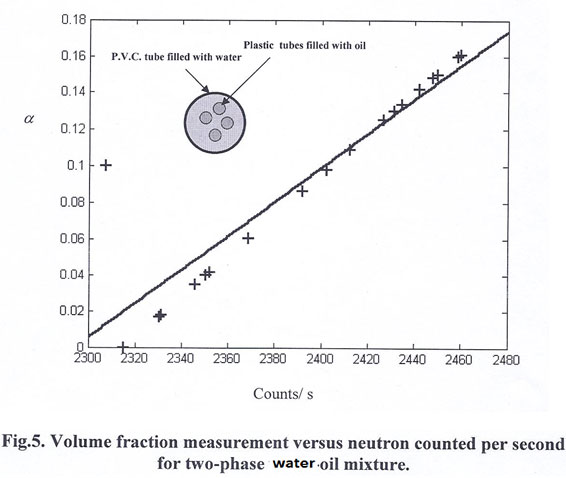 |
Figure 5
|
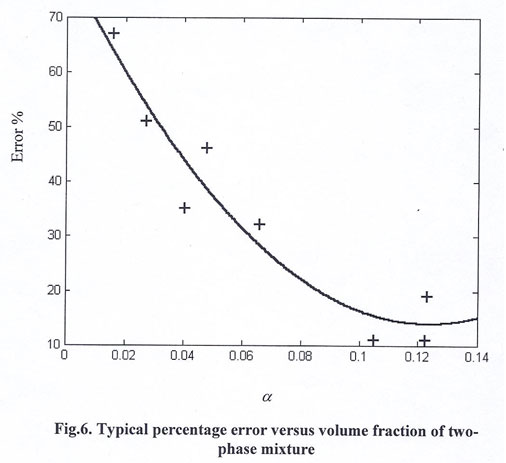 |
Figure 6
|
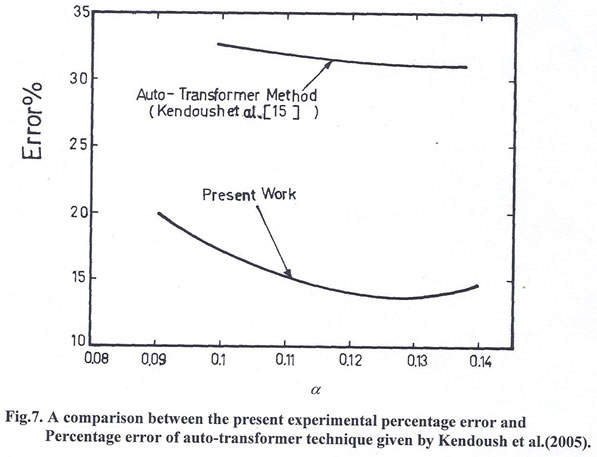 |
Figure 7
|
Concluding remarks
The following conclusions are drawn from the present study:
- The neutron attenuation technique is useful for measuring the volume fraction of oil in water especially at low volume ratios.
- Using this technique for measuring volume fraction of air in air-water mixture leads to higher percentage errors.
- The present technique is more suitable for steel walled test section or pipelines because of the ability of neutrons to pass through.
Nomenclature
I neutron intensity after passing the two-phase mixture
Io initial neutron intensity
L inner tube diameter
T thickness of the tube wall
Greek Letters
Σ macroscopic cross-section
α void/ volume fraction
Subscript
f fluid (liquid)
g gas or little liquid phase in mixture
w wall
T total
Oil oil
References
- Abulwafa, M.S.A., Kendall, E.J.M., 1979. Determination of the theoretical capacitance of the concave sensor. Rev. Sci. Instrum. 50, 1158.
- Banerjee, S., Hussain, E, Meneley, D.A., 1979. Simulation of a neutron scattering method of measuring void fraction in two-phase flow. Nucl. Eng. Design, 53, 393.
- Cimorelli, L. , Evanglistti, R. 1966. The application of the capacitance method for void fraction measurement in bulk boiling. Int. J. Heat Mass Transfer, 10, 277.
- Foglia, J.J., Peter, F.G., Epstein, H.M. Wooten, D.A., Chastain, J.W., 1961. Report BMI-1517.
- Gregory, G.A., Scott, D.S., 1973. Correlation of liquid slug velocity and frequency in horizontal concurrent gas-liquid slug flow. AIChE. 15, 933-.
- Geraets, J.J.M., Borst, J.C., 1987. A capacitance sensor for two-phase void fraction measurements and flow pattern identification. Int. J. Multiphase flow. 14, 305.
- Harms, A.A., Forest, C.F., 1971. Dynamic effects in radiation diagnosis of fluctuating
- voids. Nucl. Sci. Eng. 46, 408.
- Harms, A.A., Laratt, F.A.R., 1974. A reduced formula for the dynamic-bias in radiation interrogation of two-phase flow. Int. J. Heat Mass Transfer. 17, 464.
- Heywood, N.I., Richardson, J.G., 1978. Slug flow air-water mixtures in a horizontal pipe; determination of liquid hold-up by γ-ray absorption. Int. J. Multiphase Flow. 5,17.
- Kendoush, A.A., 1992. A comparative study of the various nuclear radiations used for void fraction measurements. Nucl. Eng. Des., 137, 249-257.
- Kendoush, A.A., Sarkis, Z. A., 1996. A nonintrusive auto-transformer technique for the measurement of void fraction. Exp. Thermal and Fluid Sci. 13, 92-97.
- Kondic, N., Jacobs,A., Ebert,D., 1983. Three dimensional density field determination by electrical stationary detectors and gamma sources using selectivity scattering. Proc. 2nd Int. Topical meeting on nuclear Reactor Thermal-hydraulics (edited by M.Merilo), 1443-1462.
- Jones, O.C., Zuber, N, 1973. The interaction between void fraction fluctuation and flow patterns in two-phase flow. Int. J. Multiphase Flow. 2, 273.
- Perez-Griffo, M. L., Block, R.C., Lahey, R. T., 1982. Meaurement of flow in large pipes by pulsed neutron activation method. Nucl. Sci. Eng. , 82,19.
- Perkins, H.C., Yusuf, Z.L., Leppert, R.J., 1961. A void measurement technique for local boiling. Nucl. Sci. Eng. 11,103.
- Schrock, V.E., 1969. 11th National Heat Transfer Conference Two-phase Flow Instrumentation, Minneapolis.
- Wamsteker, A. J. Vondaardingen, A.F. , Spigt, C.L., 1964. The capacitance of impedance method for transient void fraction measurement and comparison with gamma-ray attenuation technique. Symposium on In-Core Instrumentation, Oslo, 15-19 June, Paper D-2.

This work is licensed under a Creative Commons Attribution 4.0 International License.