
Suitability of Groundwater Quality for Irrigational Use between Silkanth and Kundgaon, North of River Narmada in the Upper Alluvial plains of Narmada valley, District Sehore and Dewas, M. P., India
V.K. Parashar * and Sunil Kumar Sharma
1Department of Geology, Indore (M.P.), Govt. Holkar Science College, Indore, M.P India .
2Department of Civil Engineering, Bhopal (M.P.), AISECT University, Bhopal, M.P India .
http://dx.doi.org/10.13005/OJPS02.02.12
Groundwater is one of the earth’s most widely distributed resources and is consistently catering to the requirement of the agricultural irrigation. In the present study, an attempt has been made to understand the hydrochemistry and its agricultural water quality of groundwater between Silkhanth and Kundgaon, North of river Narmada, Madhya Pradesh. During the course of water quality studies of the area, 17 groundwater samples were collected and chemically analysed. Results obtained from water chemistry were used in the determination of different irrigational specifications to appraise the agricultural quality of groundwater. Important specifications like Sodium Adsorption Ratio (SAR) Residual Sodium Carbonate (RSC), Soluble Sodium Percentage (SSP) and Kelly’s Ratio (KR) are used for decisive the appropriateness of groundwater for the agricultural purposes. Result shows that the majority of groundwater belongs to Medium to - High Saline and Low sodium water. As per the magnesium ratio classification, the groundwaters of the study area has no magnesium hazards. Kelly’s ratio shows that majority of groundwater belongs to suitable class. As per the classification based on RSC the groundwater belongs to Safe class. As per the guidelines of Ayers and Westcot, majority of water have slight to moderate toxicity with respect to Nitrate and their use is restricted for semitolerant crops.
Copy the following to cite this article:
Parashar V. K, Sharma S. K. Suitability of Groundwater Quality for Irrigational Use between Silkanth and Kundgaon, North of River Narmada in the Upper Alluvial plains of Narmada valley, District Sehore and Dewas, M. P., India. Orient J Phys Sciences 2017;2(2).
DOI:http://dx.doi.org/10.13005/OJPS02.02.12Copy the following to cite this URL:
Parashar V. K, Sharma S. K. Suitability of Groundwater Quality for Irrigational Use between Silkanth and Kundgaon, North of River Narmada in the Upper Alluvial plains of Narmada valley, District Sehore and Dewas, M. P., India. Orient J Phys Sciences 2017;2(2). Available from: https://bit.ly/2XcLg56
Download article (pdf) Citation Manager Publish History
Introduction
Groundwater is an important natural resource for the growth of any civilization and dependable and cost-effective condition of agricultural water supply in the country. It thus plays a imperative role in human being, aquatic and global ecosystems
Excellent quality of irrigation water is quite essential for achieving maximum crop efficiency. During recent past, studies on agricultural water quality have been reported by various workers in the alluvial plains of Narmada valley in India like Dhiman, (2014), Maghanga et al., (2013), Jhariya et al., (2012), Ravikumar et al., (2011), Sharma et al., (2011), Jayalakshmi Devi et al.,(2009), Jain (1993) and Parashar, (1994, 2001)
Study Area
The study area lies between Silkhant to Kundgaon, North of river Narmada. The area covers parts of Sehore and Dewas districts of Madhya Pradesh, India. The study area lies between latitude 22o30’0’’ to 22o40’0’’ N and longitudes 77o0’0’’ and 77o20’0’’ East. The area of present investigation falls on the Survey of India toposheet Nos. 55F/2, 55F/6, 55B/14 and 55B/15.
Material and Methods
The hydrochemistry of collected groundwater samples from both during the pre- monsoon and post-monsoon period are presented in Table -1. The samples were collected in pre cleaned polyethylene containers of one liter capacity. The samples were collected from those wells only which are widely used for drinking and irrigational purposes. The study of water samples was carried out by using Flame photometer, Hach Spectrophotometer and titration methods. The physical properties like colour, temperature, odour, and taste of water samples were recorded at the sampling stations during field work. The pH of the water samples was determined by pH meter. Conductivity is measured in micro mohs per cm at 25o C by conductivity meter. The carbonate alkalinity was determined by titrimetric method using phenolphthalein as indicator. The bicarbonate was determined by titrating sample with standard acid solution using methyl orange indicator. Total hardness as CaCO3 was determined by EDTA titrimetric method using Erichrome Black-T indicator. Ca content was calculated from Ca hardness by multiplying with a factor 0.432 and the results were expressed in mg/l. Magnesium content was calculated from Mg hardness by using a formula and results expressed in mg/l. Chloride concentration was determined by titration method involving formation of reddish brown complex by adding potassium chromate which is titrated against silver nitrate solution. Nitrate is determined by phenol disulphuric acid method as per APHA (1995) using Hach DR-4000 UV-Vis Spectrophotometer.
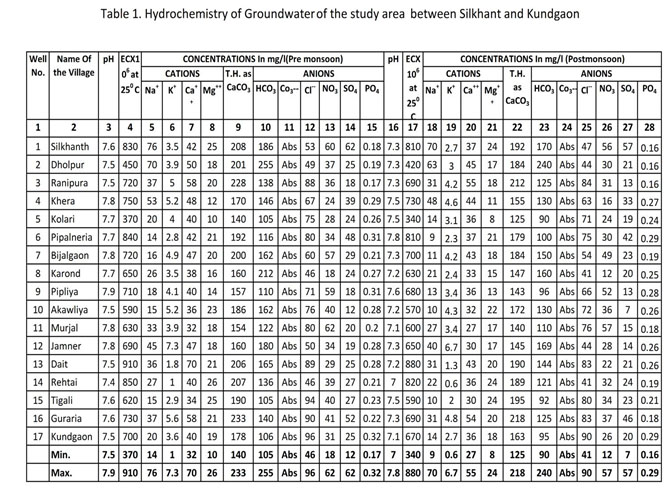 |
Table 1
|
Hydrochemistry of Study Area
The pH value of groundwater of the study area varies from 7.5 to 7.9 in pre-monsoon and 7.0 to 7.8 in post-monsoon period which shows that water is slightly alkaline in nature. The Electrical conductivity (EC) values in groundwater vary from 370 µmohs/cm to 910 µmohs/cm and 340 µmohs/cm to 880 µmohs/cm in pre-monsoon post-monsoon period respectively.
Calcium content in groundwater varies from 32 mg/l to 70 mg/l in pre-monsoon and 27 mg/l to 55 mg/l in post-monsoon periods. The Magnesium concentration in groundwater varies from 10 mg/l to 26 mg/l in pre-monsoon and 08 mg/l to 24 mg/l in post-monsoon period. The sodium content in groundwater varies from 14 mg/l to 76 mg/l in pre-monsoon and 9 mg/l to 70 mg/l in post-monsoon period. The Potassium content in groundwater is varies from 1 mg/l to 7.3 mg/l in pre-monsoon and 0.6 mg/l to 6.7 mg/l in post-monsoon period. The total hardness in terms of CaCO3 ranges from 140 mg/l to 233 mg/l in pre-monsoon and 125mg/l to 218 mg/l in post-monsoon period. |
Table 2
|
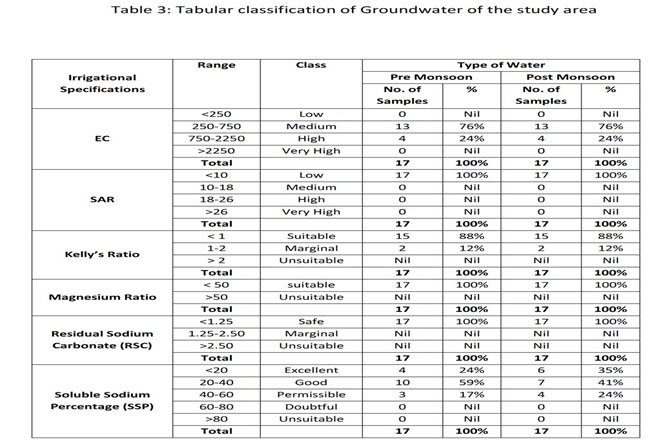 |
Table 3
|
Irrigational Water Quality
Various specifications have been proposed from time to time by different workers to evaluate the agricultural water quality. In the present study the specifications as proposed by Kelley et al., (1940); Eaton, (1950); US Soil Salinity Laboratory Staff (1954); Wilcox (1955); Paliwal, (1972) and Ayers and Westcot (1994) have been used to assess the suitability of groundwater for agricultural purposes.
Soluble Sodium Percentage (SSP), Sodium Adsorption Ratio (SAR), Residual Sodium Carbonate (RSC), Kelly’s Ratio and Magnesium hazard are the distinguished specifications for determining the suitability of groundwater for agricultural purposes and are presented in Table-2. The suggested classification of irrigation water quality with respect to EC, SAR, Kelly’s Ratio, Mg. Ratio, RSC and Na% are presented in Table -3.
Sodium concentration is very important in classifying the irrigation waters because sodium by the process of base exchange may replace calcium in the soil and thereby reduce the permeability of soil to water. Sodium or alkali hazard is measured on the basis of SAR. The relativity of sodium ion in the exchange reaction with soil is expressed in terms of a ratio known as Sodium Adsorption Ratio (SAR). As per the classification based on SAR, the sodium hazard is Low, if SAR content is less than 10; Medium, if SAR content is in between 10 to 18; High, if SAR content is in between 18 to 26 and Very High if SAR content is more than 26. The SAR values of the groundwater of the study area varies from 0.44 to 2.29 and 0.320to 2.2 in pre and post-monsoon period respectively. When the groundwater samples compared with this classification as shown in Table-3, it clearly indicates that the groundwater belongs to Low Sodium waters.
Kelly et al., (1940) have proposed that the potential sodium problem in irrigation water is evaluated on the basis of the following ratio:
Kellys Ratio = Na/ Ca+ Mg ( where all the conc. are expressed in epm)
Kellys et al., 1940 that if this ratio is less than unity, the water is suitable; more than two the water is unsuitable and in between one and two the water is marginal for irrigational purposes. It is seen from the Table 2, the Kelly’s ratio varies from 0.22 to 1.13 in pre-monsoon and 0.15 to 1.15 in post-monsoon period. Table-3 shows that 88% of groundwater in pre and post monsoon belongs to suitable class and 12% belongs to marginal class in pre and post monsoon period. Thus the majority of groundwater is suitable for agricultural purposes.
Wilcox (1955) has proposed a classification based on specific Conductance, Soluble, Sodium Percentage and Concentration Soluble Sodium Percentage is calculated by the following formula:
Na % = (Na+ K) x 100/ Ca+ Mg+Na+K (where all the conc. are expressed in epm)
Table 2 shows that the Na% varies from 17.54 to 51.87 in pre-monsoon and 12.98 to 52.35 in post-monsoon period. Table-3 shows that 59% of groundwater in pre-monsoon period and 41% in post-monsoon period belong to Good class and 17% of groundwater in pre-monsoon period and 24% in post-monsoon period belongs to Permissible class which shows that the majority of groundwater is quite suitable for agricultural purposes.
Salinity hazard is assessed on the basis of Electrical conductivity (EC) and it also reflects the total dissolved solids (TDS) in groundwater. Soil structure, permeability and plant growth is affected by high salt content in irrigation water. On the basis of Richards (1954) classification, the water is low (if EC below 250 µmohs /cm), the water is medium (if EC between 250 to 750 µmohs/cm), the water is high (if EC content between 750 to 2250 µmohs/cm), the water is very high (if EC is more than 2250 µmohs/cm) with respect to salinity in water. When the groundwater samples compared with this classification, Table-1 clearly indicates that the groundwater varies from 370 to 910 µmohs/cm in pre monsoon period and 340 to 880 µmohs/cm in post monsoon period respectively and thus they belongs to Medium to High Salinity class. Table-3, further shows that 76% of groundwater in pre-monsoon and post-monsoon period belongs to Medium salinity class.
Paliwal (1972) has proposed the ratio Mgx100 /Ca+Mg as an index of magnesium hazards to irrigation waters. As per the classification, if the Mg Ratio less than 50% the water is suitable and if Mg ratio is more than 50% the water unsuitable. It is seen from the Table-2, magnesium ratio of groundwater of the study area varies from 10.15 to 32.50 in pre-monsoon and 10.22 to 36.36 in post-monsoon period respectively. Table-3 indicates that all the groundwater of the study area belongs to suitable class and there is no magnesium hazard in groundwater of the study area.
Eaton (1950) has suggested that water having carbonate and bicarbonate ions in excess of calcium and magnesium will lead to much greater alkali formation and thereby decreas the soil permeability. The carbonate and bicarbonate hazards in agricultural water quality are calculated in terms of Residual Sodium Carbonate (RSC):
RSC = (CO3 + HCO3) – ( Ca+ Mg) (where all the conc. are expressed in epm)
Based on RSC, the irrigation waters are classified as Safe (if RSC is less than 1.25), Marginal (if RSC is in between 1.25–2.5) and Unsuitable (if RSC is more than 2.5). Table 2 indicates that RSC values of groundwater of the study area varies from -2.52 to 0.25 in pre-monsoon and -2.28 to – 0.28 in post-monsoon period respectively. After imperative examination of Table 2 and 3, it reveals that all the groundwater of the study area belongs to Safe class and thus they are suitable for agricultural purposes.
Ayers and Westcot (1994), proposed a modified water quality guidelines to assess the agricultural water quality. In the proposed guidelines, the water has been grouped into four classes mainly Salinity, Water Infiltration, Specific ion toxicity and Miscellaneous effects which have been further subdivided into three categories as None Restriction category, Slight to Moderate Restriction category and Severe Restriction category based on the degree of restrictions on their use
Conclusions
Agricultural water quality have been evaluated on the basis of Salinity hazard, Sodium hazard, Magnesium hazard and Bicarbonate hazard. According to the classification of groundwater with respect to SAR and EC, the majority of groundwater of the study area belongs to belongs to medium to high salinity class and Low sodium water. Kelly’s ratio shows that 88% of groundwater in pre and post monsoon belongs to suitable class. Classification based on RSC clearly indicates - that all the groundwater of the study area belongs to Safe class and thus they are suitable for agricultural purposes. As per the magnesium ratio classification, all the groundwater of the study area belongs to suitable class and there are no magnesium hazards in groundwater of the study area. As per Ayers and Westcot water quality guidelines the groundwater belongs to None restriction category with respect to EC,TDS,SAR, Sodium, Bicarbonate, and Chloride and may be safely used for surface and sprinkler irrigation. However, there is slight to moderate restriction with respect to nitrate and their use is restricted for sensitive crops.
From the above mentioned discussion and interpretation of the hydrochemistry and irrigational specifications, it can be concluded that the groundwater of the study area is quite suitable for irrigational purposes.
References
- APHA (1995), Standard methods for the examination of water and waste water (19thed.) American Public Health Association, Washington, 1467 pp.
- Ayers, R. S. and Westcot, D. W. (1994), Water Quality for Agriculture, FAO Irrigation and Drainage, paper 29, Rev. 1, Rome.
- Dhiman, S. D., (2014). “Groundwater quality assessment for irrigation use in Rajkot district”, Journal of Indian Water Resources Society, 34 (1), pp. 34-39.
- Eaton, F. M. (1950). Significance of Carbonate in irrigation water, soil Sci., Vol. 69, No. 2, Pp 123-133.
- Jain, R.K. (1993), Study of the effects of Excessive use of fertilizers on the quality of Groundwater in Barna Command Areas Distt. Raisen (M.P.), unpublished Ph. D. Thesis, Barkatullah University Bhopal.
- AL. Ramanathan, A.K. Keshari, D. Chandrasekharam, Jochen Bundschuh and Prosun BhattacharyaEvaluation of groundwater quality for irrigation and drinking purpose in selected taluks of Dakshina Kannada district in Karnataka, India”. Assessment of Groundwater Resources and Management, (Edited by A. L. Ramanathan et. al) I. K. International Publishing House Pvt. Ltd., New Delhi, pp. 301-318.
- Jhariya D. C., Shandilya Arun K. and Dewangan Rakesh. (2012), Nitrate Pollution in the groundwater around Sagar Town, Madhya Pradesh, India. International Conference on Chemical, Ecology and Environmental Sciences.
- Kelley, W. P., Brown, S. M. and Liebig, G. F. jr. (1940). Chemical effects of saline irrigation waters on soils, Soil Science., Vol. 49 : 95-107.
- Maghanga, J.K., Kituyi, J.L., Kisinyo, P.O. and Ng’etich W.K. (2013), Impact of Nitrogen fertilizer applications on Surface water Nitrate levels within a Kenyan Tea Plantation. Journal of Chemistry pp 1-4.
- Paliwal, K. V. (1972). Irrigation with Saline water I. A. R. I. Monograph No. 2, (New Series), New Delhi, : 198
- Parashar, V.K. (1994), Study of Quality of Surface and Subsurface Waters and their Agricultural Utility in the Lower Alluvial Plains of Narmada Valley between Khalghat and Haribphal Distt. West Nimar M.P., Ph.D. Thesis Barkatullah University Bhopal.
- P. J. Sajil KumarEmail authorL. Elango snd E. J. James Ravikumar, P. (2011), “Hydrochemistry and evaluation of groundwater suitability for irrigation and drinking purposes in the Markandeya River basin, Belgaum District, Karnataka State, India”. Environmental Monitoring and Assessment, vol. 173, pp 459-487, ISSUE 1-4, DOI 10.1007/S12517-013-0940-3.
- Richards, L. A., (1954). Diagnosis and improvement of saline and alkali soils. Agric Handbook 60, USDA, Washington D.C., pp. 160.
- Sharma Shraddha, Vishwakarma Rakesh, Dixit, Savita and Jain Praveen. (2011), Evaluation of Water Quality of Narmada River with reference to Physicochemical parameters at Hoshangabad city, M.P., india. Res. J. Chem. Sci. Vol. 1 (3) pp 40-48.
- U. S. Salinity Laboratory Staff, (1954). Diagnosis sand improvement of saline and alkali soils, U.S.D.A. Handbook No. 60, : 160.
- Wicox, L.V., (1955). Classification and use of irrigation waters, U.S.D.A. Inform. Bull. 211, :7.

This work is licensed under a Creative Commons Attribution 4.0 International License.