
Comparative Physicochemical Evaluation of Starch Extracted from Cajanus Cajan Seeds Grown in Sudan as a Pharmaceutical Excipient Against Maize Starch
Ahmed Abdalla Bakheit 1 , Daud Baraka Abdallah 1 * , Elnazeer I. Hamedelniel 2 , Zuheir Osman 3 and Khaled M. Algaobahi 1
11Department of Pharmaceutics, Khartoum, Sudan, Faculty of Pharmacy, The National Ribat University, Khartoum Sudan .
2Department of Pharmaceutics, Faculty of Pharmacy, Omdurman Islamic University, Khartoum Sudan .
3Department of Pharmaceutics, Faculty of Pharmacy, University of Khartoum, Khartoum Sudan .
http://dx.doi.org/10.13005/OJPS02.02.11
The objective of this work was to extract and to investigate the physicochemical properties of Cajanus cajan starch (CCS) for use as pharmaceutical excipient and to compare its properties with official maize starch. Cajanus cajan seeds yielded 32.6 % starch on dry weight basis and several physicochemical characteristics of the extracted CCS and maize starch were evaluated such as: pH, moisture content, cold water solubility, swelling capacity, hydration capacity, moisture uptake, Amylose/Amylopectin ratio, flow properties and bulk and tapped densities. Also, the microphotograph and Fourier transform infrared (FTIR) had been taken for both starch samples. The physicochemical properties of CCS compared favorably with those of maize starch, suggesting that CCS can be used as tablet excipient in pharmaceutical industries.
Copy the following to cite this article:
Bakheit A. A, Abdallah D. B, Hamedelniel E. I, Osman Z, Algaobahi K. M. Comparative Physicochemical Evaluation of Starch Extracted from Cajanus Cajan Seeds Grown in Sudan as a Pharmaceutical Excipient Against Maize Starch. Orient J Phys Sciences 2017;2(2).
DOI:http://dx.doi.org/10.13005/OJPS02.02.11Copy the following to cite this URL:
Bakheit A. A, Abdallah D. B, Hamedelniel E. I, Osman Z, Algaobahi K. M. Comparative Physicochemical Evaluation of Starch Extracted from Cajanus Cajan Seeds Grown in Sudan as a Pharmaceutical Excipient Against Maize Starch. Orient J Phys Sciences 2017;2(2). Available from: https://bit.ly/3pPq3dx
Download article (pdf) Citation Manager Publish History
Introduction
Excipients have been a major research focus in both the industry and the academia due to the important roles they play in formulations 1. In the pharmaceutical industry, excipients cannot be considered as merely inert additives for the active ingredients, rather they became essential components of modern pharmaceutical formulation 2 and they are generally used as diluents, binders, disintegrants, glidants, lubricants or release controlling agents 3. In addition to their contribution in drug delivery, excipients contribute to the cost of medicines making the products more effective at a lower cost, such an advantage is desired by the pharmaceutical industry 4. At present the need for natural additives that are safe and functional become a major need 3.
Starch is considered one of the most widely used biodegradable material in many industries, and its ability to work as an additives in pharmaceutical industry mainly in tablet dosage form has been studied by many researchers 5. In tablet formulations, starch paste (3–20%) used for it is binding ability through the wet granulation technique. Also starch is one of the most commonly used tablets disintegrants at concentrations of 3–25% w/w. Optimization processes should be used for identifying the starch concentration required for the optimum formulation. When using starch, a prior granulation step is required in most cases to avoid problems with insufficient flow and segregation. Starch is extracted from plant sources with specific processes according to the botanical origin. Typical production steps are steeping (corn), wet milling (corn, potato), dry milling (wheat), or sieving and physical separation with hydrocyclones. The last production step is usually a centrifugal separation from the starch slurry followed by drying with hot air 6.
As a result of the increasing demands for starch in food and many other industrial uses, there is a need to find other high yield starch sources rather than conventionally used sources 5. The pharmaceutical benefits of starch differ according to its botanical source and variations in amylose content, making the search for new starch sources is a subject of scientific research aims mainly at new physicochemical and functional properties 8.
A few reports emphasized that Cajanus cajan contains high level of carbohydrates 9, and this making it as potential alternative source for starch.
Cajanus cajan is an annual shrubs with a height up to 4-5 m and with average 1-2 m high, it tolerates a wide range of soils types 10, Figure (1) represents picture of Cajanus cajan.
The common name of Cajanus cajan is pigeon pea also named as Lubia Addassy locally in Sudan. It belongs to family Leguminasea and plays a very important role in human nutrition 11. In sudan Cajanus cajan is traditionally grown in north and central Sudan as a very minor crop 12.
The objectives of this work were to extract, characterize and to investigate the physicochemical properties of CCS for use as pharmaceutical excipient and to compare its properties with the official maize starch.
Materials and Methods
Cajanus cajan seeds were collected from Saada village, Gezira scheme, and identified at the Agricultural Research Corporation, Shambat, Sudan, by Prof. Dawoud Hussien Dawoud. Amylose standard powder was purchased from (Aladdin, China). Iodine, sodium hydroxide and maize starch were purchased from (Central drug house, CDH, India). Ethanol, hydrochloric acid and potassium iodide were purchased from (Scharlau, Spain). Sodium chloride was purchased from (Supertek, India) and xylene was purchased from (LOBAChemie, India).
Cajanus cajan starch (CCS) extraction
A method of Lawal (2008) 13 was adopted with slight variation for the extraction of starch. The purified water was used to clean the collected seeds gently from their impurities and other adhering organic matters. The outer layer of Cajanus cajan seeds was manually peeled off after soaking in purified water. The washed peeled Cajanus cajan seeds were suspended in enough quantity of purified water and blended using blender (Panasonic blender- MX 151SP2, Panasonic, China), then the homogenate was passed through an BSS # 240 (63 μm) sieve, (British Standard Sieve Series; Filterwel Test Sieves, Mumbai, India). The supernatant was decanted after filtrate was settled, then the proteinous substances were removed by using NaOH (0.1 N). The sedimented starch was re-suspended by addition of enough distilled water and the centrifuged at 5030 g to 10 min, supernatant was removed and the obtained starch was air dried at room temperature and stored in polythene bag until use.
Table 1: Some of the physicochemical and micromeritics properties of starch
|
Parameter |
Starch |
|
|
|
CCS |
Maize |
|
Amylose % |
32.9 |
24.2 |
|
Moisture content |
9.6% |
8.29% |
|
pH |
6.12 |
6.33 |
|
Cold water solubility |
0.9% |
0.4% |
|
Swelling capacity |
1.46 |
1.23 |
|
Hydration capacity |
1.99 |
1.84 |
|
Moisture uptake % |
17.34 |
15 |
|
Angle of repose |
35.05 ± 0.922 |
38.82 ± 2.606 |
|
Bulk density |
0.667 |
0.435 |
|
Tapped density |
0.95 |
0.667 |
|
Carr´s index |
29.8% |
34.78% |
|
Hausner ratio |
1.42 |
1.53 |
|
True density |
1.51 ± 0.154 |
1.45 ± 0.049 |
Percentage of yield determination
The percentage of obtained CCS was calculated using the following equation:

Where W0 is the weight of seeds used and W1 represent the weight of obtained CCS.
Identification tests
Solubility and iodine tests were carried out according to method of Muazu J. (2011) 14 and method found in BP (2013) 15, respectively.
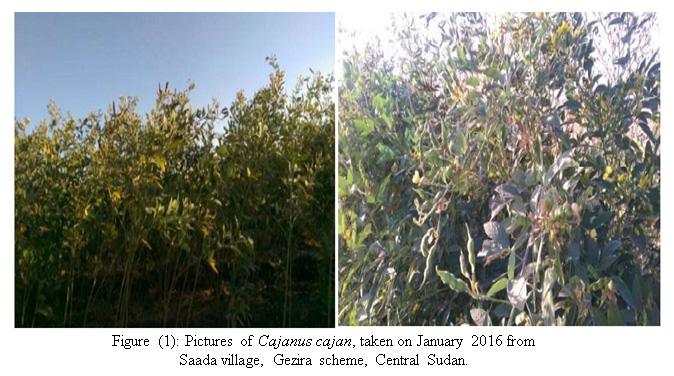 |
Figure 1: Pictures of Cajanus cajan, taken on January 2016 from Saada village, Gezira scheme, Central Sudan. |
Some physicochemical characteristics of starch
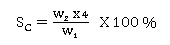
Method of Ashogbon and Akintayo (2012) 16 was used to evaluate the pH. The moisture content was measured using a moisture analyzer (Kern, MLB 50-3N, Kern and Sohn GmbH, Balingen, Germany) and the percentages of weight loss were reported. The cold water solubility (SC) was measured using the method of Zhang et al. (2013) 17 with slight variation, 100 ml of water was added to 2 g (W1) of starch at 30 á´¼C. The mixture was stirred for 20 min using magnetic stirrer (Hot plate stirrer, LMS – 1003, Scott Science and health care, UK) and then centrifuged at 1258 g for 20 min. 25 ml of supernatant was dried in an oven (110 á´¼C) until constant weight (W2). The SC was determined by the following relation:
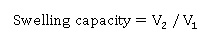
Swelling capacity determined according to method of Odeniyi and Ayorinde (2012) 18. The tapped volume (V1) of 5 g of starch was determined in a cylinder and then dispersed in water (up to 100 ml). The dispersed mixture was rested for 24 hrs and the final volume (V2) of sediment was noted. The swelling capacity calculated from the difference in volumes as shown in the following equation.
The method described by Singh et al. (2011) 4 was used to measure the hydration capacity. Also moisture uptake was evaluated according to method of Muazu J. et al. (2011) 14 and the amylose/amylopectin ratio was determined according to Abdalla et al. (2009) 19.
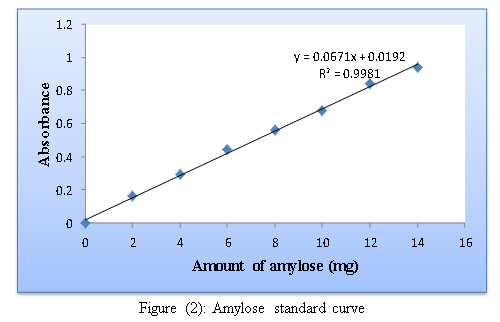 |
Figure 2: Amylose standard curve
|
Microscopic examination and scanning electron microscopy (SEM) of starch
The microscopic examination of starch was carried out according to method of Muazu J. et al. (2011) 14 with some modification, small quantity of each of the starches was mounted in a drop of glycerol on a glass slide and covered with a cover glass. The shape of starch particles were determined with a microscope equipped with digital camera attached to computer system using 40 X magnification.
The surface morphology of CCS granules was observed according to method of Polesi et al. (2011) 8 using scanning electron microscope (ZEISS, DSM 940 A). Scanning electron photomicrographs were recorded at different magnification to ensure clear images.
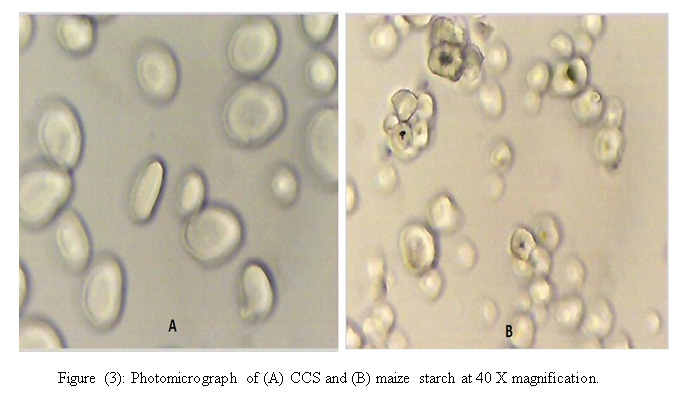 |
Figure 3: Photomicrograph of (A) CCS and (B) maize starch at 40 X magnification.
|
Analyses of Fourier transform infrared (FTIR)
The method of Gbenga et al. (2014) 3 was used to acquire the FTIR spectra of starch samples using FTIR spectrophotometer (IRAffinity-1, Shimadzu, Japan).
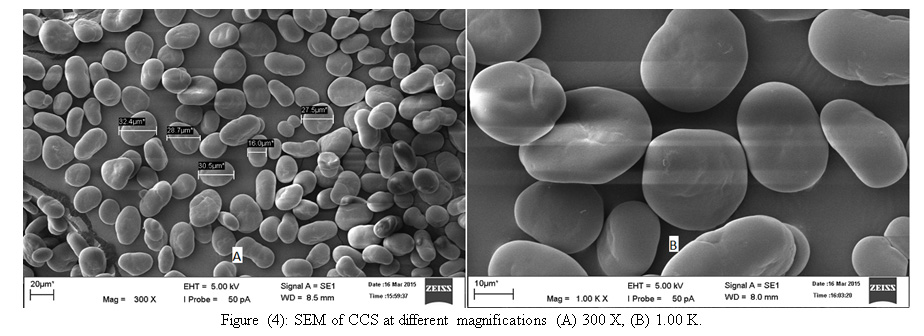 |
Figure 4: SEM of CCS at different magnifications (A) 300 X, (B) 1.00 K.
|
Micromeritics
Bulk, tapped and true densities of starch samples were evaluated using the method of Bayor et al. (2013) 20. The angle of repose (θ) was evaluated according to method of Okunlola and Odeku (2009) 21. Also the carr’s index and hausner ratio were calculated from the bulk and tapped densities using the following equations:

Results And Discussion
Percentage yield
Cajanus cajan seeds yielded 32.6% w/w starch. The high yield of CCS could be due to the granular size which permit easy extraction of the starch granule 22. The low cost of Cajanus cajan seeds and the higher yield of its starch indicate that it can be a suitable alternative source for starch as a pharmaceutical excipient.
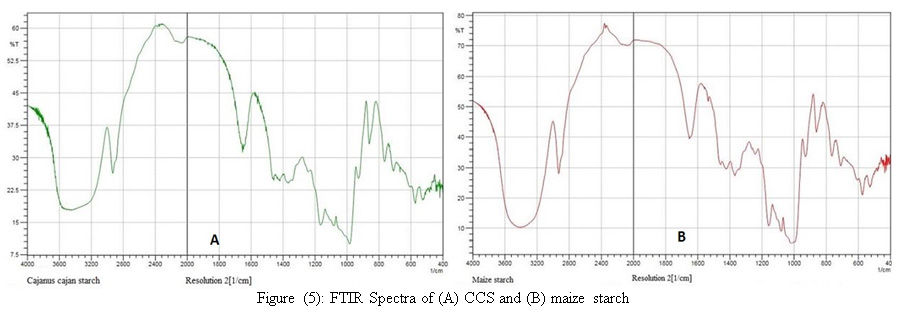 |
Figure 5: FTIR Spectra of (A) CCS and (B) maize starch
|
Identification tests
The identification tests carried out showed that CCS was insoluble in water and alcohol (95%) at room temperature. Also CCS was positive to iodine test. It showed that the CCS compared well with maize starch BP and BP (2013) identification tests.
Some physicochemical properties of starch
Table (1) shows the results of physicochemical properties of the CCS and maize starch. The aqueous dispersions of starch usually have a pH in the range of 4 to 8 6. Both starch samples showed pH values within that range. The moisture contents of CCS and maize starch were 9.6% and 8.29% respectively, which within the acceptable limits of less than 15% according to BP (2009) 23. The moisture content for the CCS was highest and this may be due to its larger average grain size which implies that there are larger pore sizes and this may trap water and result in high moisture contents. The cold water solubility was found to be very poor for both CCS and maize starch. Swelling which is generally accepted as an indication of tablet disintegration ability can be assessed by the determination of hydration capacity, swelling capacity and moisture sorption profile 24. The swelling capacity which reflects increase in volume of the starch showed that the CCS having the higher increase in volume than the maize starch. This suggests that the CCS may be a better disintegrant than the maize starch and if incorporated in tablet formulation as a disintegrant, would probably produce tablet disintegration by two mechanisms, capillary or wicking and swelling. The results of hydration capacity indicate that the CCS and maize starch are capable of absorbing approximately two times their own weights of water. Moisture uptake is a measure of moisture sensitivity of a material and it reflects the relative physical stability of the tablets formulated with the material when stored under humid conditions 25. The results show that CCS absorbs moisture more than the maize starch. This could indicate that CCS would give less physically stable tablet than those formulated using maize starch. The amylose standard curve was constructed as seen in Figure (2) and the amylose contents of starch have been determined and found to be 32.9%, 24.2% for CCS and maize starch, respectively. There was significant differences between the amylose contents of the starch (P>0.05). The amylose content of CCS was found to be within the range reported by 8 for the starch extracted from legumes, and more than 28.4 which reported by 26 for CCS. The amylose content of starch determines crystallinity and thus affects solubility, and this is very important in determining the applicability of the starch 22.
Microscopic examination and scanning electron microscopy (SEM) of starch
Figures (3) show the photomicrograph of CCS and maize starch at 40 X magnification. The particles of the CCS were generally oval and larger, this agrees with the observation of 13, while the particles of maize starch were spherical and smaller. The ovoid shape and larger particle size of CCS are expected to promote looser packing of particles than the round shaped and smaller particles of maize starch. The scanning electron photomicrographs, Figure (4), for CCS were shown oval with smooth surfaces with no evidence of cracks. Also the ranges of particle size are presented in Figure (4), the CCS was found to have particle size range between 16 to 32.4 μm.
FTIR Analysis
The FTIR spectra of CCS and maize starch are shown in the Figure (5). Extremely broad band appeared around 3600 - 2950 cm–1 in both CCS and maize starch, which is attributed to the complex vibrational stretches associated with free, inter and intramolecular bound OH groups which make up the gross structure of starch. The peaks at 2900 cm−1 were attributed to C–H stretching of methylene group. The peaks at 1620 cm−1 attributed to O-H bending of H2O entrapped in the starch samples. The peaks at 1450 cm−1 and 1370 cm−1 were attributable to the bending modes of H–C–H and O–C–H. Strong bands in the 1160 to 1020 cm−1 were associated to represent the C–O stretching of C-O-C, whereas, bands at 980, 930 and 890 cm−1 represent (C-O-C) skeletal mode vibration of glycosidic linkage. The bands between 750 and 520 cm−1 represent skeletal mode of pyranose ring.
Micromeritics properties
Table (1) shows the results of micromeritics properties of CCS and maize starch. CCS showed higher bulk, tapped and true densities than those of maize starch; this indicates that CCS exhibited the larger volume reduction than maize starch. The results showed that both CCS and maize starch had passable flow characteristic, Also, CCS had lower value of Hausner’s ratio and Carr’s index, suggesting better flow and compressional properties than maize starch.
Conclusions
Cajanus cajan can be a potential source of starch for pharmaceutical and other industrial applications. From the study, Cajanus cajan seeds locally cultivated in Sudan gave high yield of the starch. CCS favorably compared to maize starch in terms physicochemical characteristics desired to be used as a pharmaceutical excipient. Furthermore, CCS with superior bulk properties such as higher true density, bulk and tapped densities, possibly qualify it as a more robust and effective diluent compared to the maize starch.
References
- Ikoni, O.; Patrick, F. INT.J.PH.SCI. 2010, 2, 561-569.
- Shalini, S. Asian J. Pharm. Res. 2012, 2, 30-39.
- Gbenga, B. L.; Olakunle, O.; Adedayo, A. M. IOSR Journal of Pharmacy 2014, 4, 24-32.
- Singh, A. V.; Kumar, R.; Singh, A. e -Journal of Science & Technology 2011, 3, 73-81.
- Bakheit, A. A.; Abdallah, D. B.; Hamedelniel, E. I.; Osman, Z. A.; Algaobahi, K. M. Orient. J. Phys. Sciences 2017, 2, 42-49.
- Rowe, R. C.; Sheskey, P. J.; M.E., Q. Handbook of pharmaceutical excipients Sixth ed.; Pharmaceutical Press and American Pharmacists Association: London, 2009.
- Nwokocha, L. M.; Nwokocha, K. E.; Williams, P. A. Starch/Stärke 2012, 64, 246-254.
- Polesi, L.; Sarmento, S.; Anjos, C. Brazilian Journal of Food Technology 2011, 14, 74-81.
- Rajesh, K.; Ganguly, I.; Srinivasan, B.; Rajamanickam, D.; Veerabhadraiah, B. B.; Madhavan, V. International Journal of Pharmaceutical and Phytopharmacological Research (eIJPPR) 2013, 3, 63-67.
- Elzaki, O. T.; Khider, T. O.; Omer, S. H. American-Eurasian J. Agric. & Environ. Sci. 2012, 12, 159-163.
- Hassan, H.; Mustafa, A.; Ahmed, A. Advance Journal of Food Science and Technology 2011, 3, 413-417.
- Hassan, H. A.; Mustafa, A. I.; Ahmed, A. R. Advance Journal of Food Science and Technology 2013, 5, 976-981.
- Lawal, O. S. "Hydroxypropylation of pigeon pea (Cajanus cajan) starch: Preparation, functional characterization and enzymatic digestibility," LWT-Food Science and Technology, 2008.
- Muazu J.; Musa H.; Isah AB.; Bhatia PG.; GM., T. J. Nat. Prod. Plant Resour 2011, 1, 41-49.
- BP In Her Majesty‟s Stationery Office The Pharmaceutical Press: London, 2013.
- Ashogbon, A.; Akintayo, E. International Food Research Journal 2012, 19, 665-671.
- Zhang, Y.; Huang, Z.; Yang, C.; Huang, A.; Hu, H.; Gong, Z.; Sun, G.; Huang, K. Starch/Stärke 2013, 65, 461-468.
- Odeniyi, M. A.; Ayorinde, J. O. International Journal of Pharmacology and Pharmaceutical Technology (IJPPT) 2012, 1, 23-28.
- Abdalla, A. A.; Ahmed, U. M.; Ahmed, A. R.; El-Tinay, A.; Ibrahim, K. A. Journal of Applied Sciences Research 2009, 5, 2016-2027.
- Bayor, M. T.; Tuffour, E.; Lambon, P. S. Journal of Applied Pharmaceutical Science 2013, 3, S17-S23.
- Okunlola, A.; Odeku, O. A. Farmacia 2009, 57, 756-770.
- Izuagie, T.; Hassan, L.; Uba, A.; Achor, M.; Sahabi, D. Bayero Journal of Pure and Applied Sciences 2012, 5, 60-65.
- BP In Her Majesty‟s Stationery Office; The Pharmaceutical Press: London, 2009.
- Bakre, L. G.; Jaiyeoba, K. T. Asian Journal of Pharmaceutical and Clinical Research 2009, 2, 83-91.
- Olayemi, O.; Oyi, A.; Allagh, T. Nigerian Journal of Pharmaceutical Sciences 2008, 7, 131– 138.
- Sandhu, K. S.; Lim, S.-T. Carbohydrate polymers 2007, 71, 245-252.

This work is licensed under a Creative Commons Attribution 4.0 International License.