
The Ability of the Ever Silver Container to Resist Corrosion When Exposed to the Puli Kulambu Recipe, Both With and Without the Addition of Sodium Chloride
T Umamathi 1  , M Harthika2 , P Arul Deepa2 , D Delphin2 , V Pappathi2 , A Preethi Christina2 , T Priyadharshini2 , R Yuasri2 , Anitha Nilavan2 , Susai Rajendran2,3* , Caslav Lacnjevac4 and Abdulhameed Al-Hashem5
1Department of Chemistry, Sri Meenakshi Government Arts College for Women (A), Madurai, Tamil Nadu India .
2Corrosion Research Centre, St Antony’s College of Arts and Sciences, Dindigul, India (Affiliated to Mother Teresa Women’s University, Kodaikanal), Tamil Nadu India .
3Centre for Nanoscience and Technology, Pondicherry University, Puducherry, India .
4Faculty of Agriculture, University of Belgrade, Serbia .
5Petroleum Research Centre, Kuwait Institute for Scientific Research, Kuwait .
http://dx.doi.org/10.13005/OJPS10.01.07
The corrosion resistance of Ever Silver (SS 304 alloy) has been assessed through polarization studies while immersed in various environments, including a water system,
Puli Kulambu Recipe, Puli Kulambu Recipe + salt (sodium chloride ) (5000 ppm) system.
This study leads to the following conclusions. LPR values decrease in the following order:
Puli Kulambu Recipe > water > Puli Kulambu Recipe + salt
Corrosion current values increase in the following order:
Puli Kulambu Recipe < water < Puli Kulambu Recipe + salt
Corrosion resistance decreases in the following order:
Puli Kulambu Recipe > water > Puli Kulambu Recipe + salt
These findings imply that, Puli Kulambu Recipe can be stored in Ever Silver without any hesitation when compared with other systems; Puli Kulambu Recipe with salt should not be stored in Ever Silver containers; Officer goers / students should add salt with Puli Kulambu Recipe just before eating.
Copy the following to cite this article:
Umamathi T, Harthika M, Deepa P. A, Delphin D, Pappathi V, Christina A. P, Priyadharshini T, Yuasri R, Nilavan A, Rajendran S, Lacnjevac C, Al-Hashem A. The Ability of the Ever Silver Container to Resist Corrosion When Exposed to the Puli Kulambu Recipe, Both With and Without the Addition of Sodium Chloride. Oriental Jornal of Physical Sciences 2025; 10(1).
DOI:http://dx.doi.org/10.13005/OJPS10.01.07Copy the following to cite this URL:
Umamathi T, Harthika M, Deepa P. A, Delphin D, Pappathi V, Christina A. P, Priyadharshini T, Yuasri R, Nilavan A, Rajendran S, Lacnjevac C, Al-Hashem A. The Ability of the Ever Silver Container to Resist Corrosion When Exposed to the Puli Kulambu Recipe, Both With and Without the Addition of Sodium Chloride. Oriental Jornal of Physical Sciences 2025; 10(1).
Download article (pdf) Citation Manager Publish History



Introduction
Daily, we encounter various cans filled with beverages. These metal containers are transforming the beverage packaging sector. Their elegant design, convenience, and ecological benefits have made them an essential component of our everyday existence. Now, let us explore how these cans are maintaining the Flavors we enjoy.
Beverage cans, often referred to as drink cans, are metallic vessels specifically engineered to hold a predetermined volume of liquid, including carbonated soft drinks, alcoholic beverages, fruit juices, tea, and other liquids. These containers are widely utilized in the beverage sector for the packaging and distribution of a diverse array of drinks.
The popularity of drink cans surged quickly, attributed to their convenience and ease of transport. Their lightweight and stackable design facilitates mobility, making them ideal for consumption while on the move. Furthermore, drink cans offer excellent preservation and quality retention by shielding the contents from light, air, and moisture, thereby ensuring the beverages remain fresh and flavorful.
The prevailing trend involves the utilization of steel and aluminium in the production of containers. Numerous studies have been conducted regarding the containers utilized for the storage of beverages and food products 1-10.
Corrosion resistance of passive films on different stainless steel grades in food and beverage industry has been undertaken by Santamaria et al. 1. Passive films were grown on 304 L, 316 L and Duplex stainless steels by immersion at open circuit potential in solutions mimicking food and beverage industry environments. In acidic food stainless steel surfaces are covered by Cr rich passive films, and generalized dissolution occurs on their surface with consequent ions release into the electrolyte.
Study of corrosion resistance of Stainless Steels for food and beverage industry has been investigated by Tranchida et al. 2 who have performed the physico-chemical characterization of passive films grown on different stainless steel grades after long exposure time in hot purified water (HPW). In order to get more insight into dissolution phenomena that can induce rouging on equipment materials typically involved in food and beverage industries, 304L, 316L and a super duplex 2507 SS samples were passivated at the open circuit potential by different immersion times in HPW at 60°C. Photoelectrochemical and Electrochemical Impedance measurements were performed in the attempt to correlate the electronic properties of the passive films (band gap and conductivity type) to their corrosion resistance.
Santamaria et al.3 have reported that Austenitic stainless steels qualify for processing and packaging applications in the food and beverages industry due to their excellent corrosion resistance and hygienic properties. Nevertheless, poor tribological behavior has limited the use in applications where corrosion and wear resistance are required.
Chang et al.4 have reported that Tinplate containers with high strength, good formability and corrosion resistance, has been widely used in food, beverages, grease, chemicals and other applications. In recent years, because of the significantly progress of tinplate container manufacturing technology, many tinplate cans have been opened in easy-open rings. However, a large number of food cans still use can openers as an important tool for opening cans.
It has been reported by Mareci et al5.that Austenitic stainless steel alloys are used in different food industry applications, including the preparation and storage of acidified carbonated soft drinks. Yet, austenitic stainless steels are not inert materials in contact with these drinks, and eventual modifications of these alloys must be investigated.
Rossi el al.6 have reported that AISI 304L stainless steel is widely used in the processing equipment and food and beverage handling industries due to its corrosion resistance, hygienic properties, and cost-effectiveness. However, it is prone to pitting and crevice corrosion phenomena, the development of which can be influenced by factors such as chloride concentration, temperature, humidity, and bacterial presence. Surface treatments, including roughness levels and residual tensile stress, can significantly affect the corrosion behavior and resistance of the material.
It has been reported by Baeghbali et al.7 that vats, vessels, and tanks are used in various industries for the storage, transport, and processing of liquids. In this chapter, after an introduction to food industry storage equipment mainly being vats, vessels, and tanks, the different types and applications of these equipment for various types of liquids in the food industry are discussed. These applications include the dairy industry, edible oil industry, beverages industry, as well as traditional and industrial tanks, vats, and vessels used in various food processing operations.
Hossain has reported8 that the corrosion resistance of stainless steels, in combination with their good mechanical properties and manufacturing characteristics, makes them an extremely valuable and flexible material for designers. The most dominant product form for stainless steels is cold rolled sheet and the major application areas include consumer products and plant and equipment for the oil and gas, chemical process, and food and beverage industries. Within this context surface of stainless steel equipment components and tube systems must fulfill the process requirements. The most important function must be corrosion resistance, neutral, easy to clean etc.
After 18 months in service, localized corrosion pits were observed on stainless-steel products used in the food- and beverage-processing environments of a snack bar. Steiner Petrovic and Mandrino have investigated whether the observed corrosion of the austenitic and ferritic stainless steels AISI 304 and AISI 430, respectively, could be caused by the improper maintenance of the steel surfaces. To check for the presence and identity of possible corrosive agents in an aggressive cleaner, surface-sensitive Auger electron spectroscopy (AES) and X-ray photoelectron spectroscopy (XPS) of the steel surfaces were performed9.
Friedrich et al.10 have reported that Austenitic stainless steels qualify for applications in the food and beverages industry due to their good corrosion resistance, inertness, cleanability and hygienic properties. Nevertheless poor tribological behavior, especially low abrasive/adhesive wear resistance and a tendency to fretting, has prevented the use of these materials in applications where both corrosion and wear resistance are required. Low temperature carburising or nitriding has offered a solution to enhance mechanical properties without altering the corrosion resistance.
Objective of the present study
Can Puli kulambu recipe be stored in ever silver vessels? That is the question before us. To answer this question the present work in undertaken. The corrosion behavior of Ever Silver (SS 304 alloy) has been assessed in three different environments: water system, Puli kulambu system , and Puli kulambu system + salt (sodium chloride 5000 ppm) utilizing AC impedance spectroscopy.
Methods and Materials
This section outlines the experimental methods and materials employed in the study.
Puli Kulambu Recipe
Puli in tamil means ‘tamarind’ and Kuzhambu means ‘curry / gravy’. So puli kuzhambu means gravy using tamarind, vegetables like ladies finger.
Puli Kulambu is one of the most popular tangy South Indian curries that serves as a great side dish for rice. We make Puli Kulambu to go with rice for lunch and use the leftover as a side dish for idli, dosa for dinner11.
Ever Silver Composition
Ever Silver was sourced from the vessel markets. Ever Silver is also known as SS 304 12 - 15.
Composition SS 304
The constituents of SS 304 (Stainless Steel 304) are as follows:
Chromium (Cr): 18-20%; Nickel (Ni): 8-10.5%; Carbon (C): Maximum 0.08%; Manganese (Mn): Maximum 2%; Silicon (Si): 0.75%; Phosphorus (P): Maximum 0.045%; Sulfur (S): Maximum 0.03%
Electrochemical study
Polarization study
A three-electrode cell setup was utilized to acquire polarization curves. Different test solutions, such as water system, Pulikulambu recipe system, and Pulikulambu recipe + salt (sodium chloride- 5000 ppm) system were tested with the Ever Silver electrode. Polarization investigations were carried out using a CHI 660A electrochemical workstation. The corrosion resistance of the Ever Silver electrode was evaluated while submerged in the various test solutions. The configuration included a working electrode composed of Ever Silver, a saturated calomel electrode (SCE) functioning as the reference electrode, and a platinum counter electrode (refer to Figure 1).
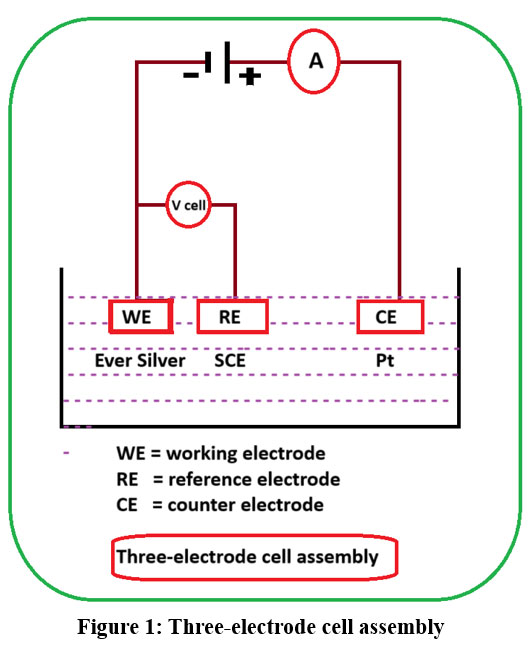 | Figure 1: Three-electrode cell assembly |
Results
The corrosion resistance of Ever Silver (SS 304 alloy) has been assessed through polarization studies while immersed in various environments, including a water system, Puli Kulambu Recipe, Puli Kulambu Recipe + salt (sodium chloride) (5000 ppm) system.
The resulting polarization curves are illustrated in Figures 2-4. Key corrosion parameters, including corrosion potential, Tafel slopes (Bc for cathodic and Ba for anodic), linear polarization resistance (LPR), and corrosion current values, are presented in Table1. A comparative analysis of these values is depicted in Figures 5-7. It is widely recognized that in polarization studies, an increase in corrosion resistance corresponds to a rise in LPR values and a decrease in corrosion current, as shown in Figure 8 16 - 20.
Table 1: Corrosion parameters of Ever Silver (ES) (SS 304) immersed in various test solutions obtained from polarization study Puli Kulambu Recipe
System | Ecorr mV vs SCE | Bc mV / decade | Ba mV / decade | LPR Ohmcm2 | Icorr A/cm2 |
water | -567 | 168 | 454 | 61698 | 8.638 x 10⁻⁷ |
Puli Kulambu Recipe | -666 | 172 | 242 | 123699 | 3.541 x 10 -7 |
Puli Kulambu Recipe + salt | -686 | 137 | 274 | 43025 | 9.243 x 10 -7 |
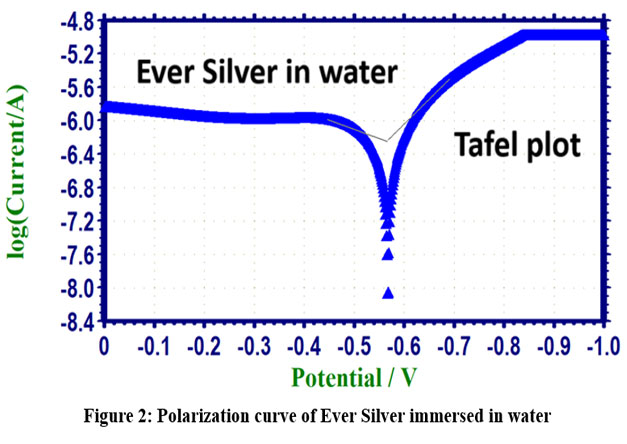 | Figure 2: Polarization curve of Ever Silver immersed in water |
 | Figure 3: Polarization curve of Ever Silver immersed in Puli Kulambu recipe |
 | Figure 4: Polarization curve of Ever Silver immersed in Puli Kulambu recipe + Sodium chloride |
 | Figure 5: Comparison of corrosion potentials of Ever Silver in various systems |
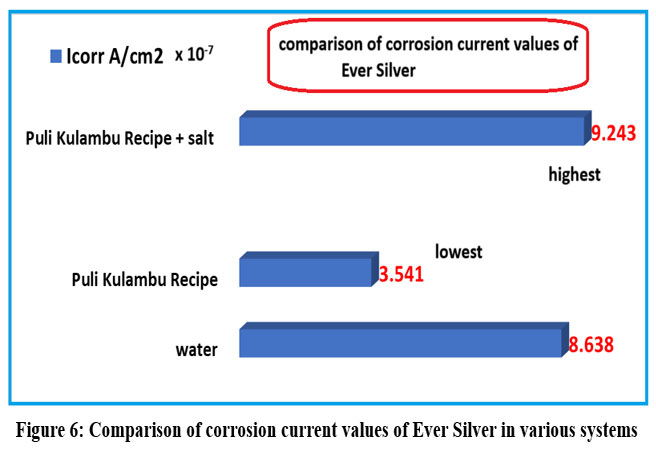 | Figure 6: Comparison of corrosion current values of Ever Silver in various systems |
 | Figure 7: Comparison of LPR values of Ever Silver in various systems |
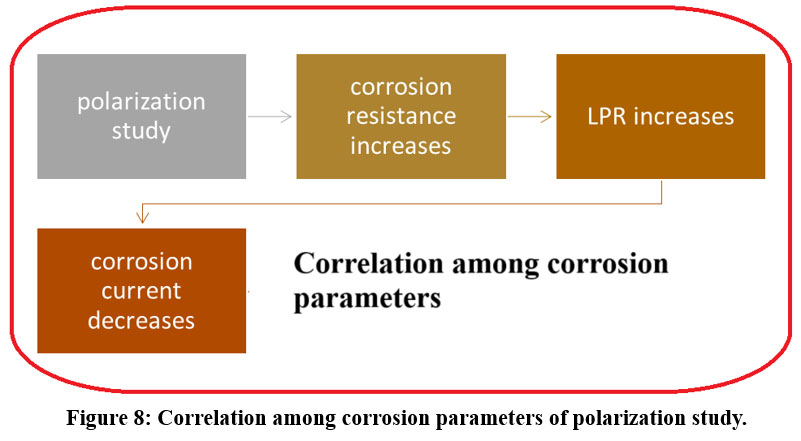 | Figure 8: Correlation among corrosion parameters of polarization study. |
Discussion
Ever Silver immersed in various systems
Ever Silver immersed in Water system
When Ever Silver is immersed in water the corrosion potential is -567 mV vs SCE. The LPR value is 61698 Ohmcm2. Corrosion current is 8.638 x10⁻⁷ A/cm2.
Ever Silver immersed in Puli Kulambu Recipe system
When Ever Silver is immersed in Puli Kulambu Recipe system, the LPR value increases and corrosion current decreases. This indicates that the corrosion resistance increases. The active principles of the Puli Kulambu Recipe system would have been adsorbed on the metal surface. It implies that Puli Kulambu Recipe can be stored in Ever Silver vessels.
Ever Silver immersed in Puli Kulambu Recipe + salt (sodium chloride) (5000 ppm) system.
When Ever Silver is immersed in Puli Kulambu Recipe + salt (sodium chloride) (5000 ppm) system, the LPR value decreases and corrosion current increases. This indicates that the corrosion resistance decreases. This may be due the corrosive nature of chloride ions.
It implies that Puli Kulambu Recipe containing salt (sodium chloride) should not be stored in Ever Silver vessels.
Polarization study leads to the following conclusions.
For Ever Silver system
LPR values
LPR values decrease in the following order:
Puli Kulambu Recipe > water > Puli Kulambu Recipe + salt
Corrosion current values
Corrosion current values increase in the following order:
Puli Kulambu Recipe < water < Puli Kulambu Recipe + salt
Implication
Puli Kulambu Recipe can be stored in Ever Silver without any hesitation when compared with other systems
Conclusions
Overview and Final Thoughts
The corrosion resistance of Ever Silver (SS 304 alloy) has been assessed through polarization studies while immersed in various environments, including a water system,
Puli Kulambu Recipe, Puli Kulambu Recipe + salt (sodium chloride ) (5000 ppm) system.
This study leads to the following conclusions.
LPR values decrease in the following order:
Puli Kulambu Recipe > water > Puli Kulambu Recipe + salt
Corrosion current values increase in the following order:
Puli Kulambu Recipe < water < Puli Kulambu Recipe + salt
Corrosion resistance decreases in the following order:
Puli Kulambu Recipe > water > Puli Kulambu Recipe + salt
Implication
Puli Kulambu Recipe can be stored in Ever Silver without any hesitation when compared with other systems
Puli Kulambu Recipe with salt should not be stored in Ever Silver containers
Officer goers / students should add salt with Puli Kulambu Recipe just before eating.
Acknowledgement
The authors are thankful to their respective managements for their help and support.
Umamathi is thankful to the Principal of Sri Meenakshi Government Arts College for Women (A), Madurai, India.
M Harthika, P Arul Deepa, D Delphin, V Pappathi, A Preethi Christina, T Priyadharshini, R Yuasri, Anitha Nilavan, and Susai Rajendran are thankful to the Principal of , St Antony’s College of Arts and Sciences, Dindigul, India.
Caslav Lacnjevac is thankful to the Head of University of Belgrade, Serbia.
Abdulhameed Al-Hashem is thankful to Head , Petroleum Research Centre, Kuwait Institute for Scientific Research, Kuwait.
Funding Sources
This paper is not funded by any agency.
Conflict of Interest
The authors do not have any conflict of interest.
Data Availability Statement
This statement does not apply to this article.
Ethics Statement
This research did not involve human participants, animal subjects, or any material that requires ethical approval.
Informed Consent Statement
This study did not involve human participants, and therefore, informed consent was not required.
Author Contributions
Susai Santhammal Rajendran, Caslav Lacnjevac : Conceptualization, Methodology, Writing – Original Draft.
P Arul Deepa, D Delphin, M Harthika, V Pappathi, A Preethi Christina, T Priyadharshini, R Yuasri, Anitha Nilavan: Data Collection, Analysis, Writing – Review & Editing.
Abdulhameed Al-Hashem, T Umamathi: Visualization, Supervision, Project Administration.
References
- Santamaria, M., Tranchida, G., Di Franco, F., Corrosion resistance of passive films on different stainless steel grades in food and beverage industry, Corrosion Science, 2020; 173:108778. https://doi.org/10.1016/j.corsci.2020.108778
CrossRef - Tranchida, G., Di Franco, F., Megna, B., Santamaria, M., Study of corrosion resistance of SSs for food and beverage industry | Studio della resistenza alla corrosione di acciai impiegati nell’industria alimentare e delle bevande, Metallurgia Italiana, 2020; 112(4): 16–21. http://www.aimnet.it/la_metallurgia_italiana/2020/aprile/santamaria.pdf
- Rossi, S., Leso, S.M., Calovi, M., Study of the Corrosion Behavior of Stainless Steel in Food Industry, Materials, 2024; 17(7): 1617. https://doi.org/10.3390/ma17071617
CrossRef - Chang, Y.H., Iyama, Y., Kawaguchi, S., Takarada, T., Sato, H., Nomoto, R., Tadenuma, K., Falina, S., Syamsul, M., Shintani, Y., Suehiro, J., Kawarada, H., Ion-Sensitive Stainless Steel Vessel for All-Solid-State pH Sensing System Incorporating pH-Insensitive Diamond Solution Gate Field-Effect Transistors, IEEE Sensors Journal, 2023; 23(9): 9110–9119. http://dx.doi.org/10.1109/JSEN.2023.3257348
CrossRef - Mareci, D., Trinca, L.C., Cotea, V.V., Souto, R.M., Electrochemical studies on the stability and corrosion resistance of two austenitic stainless steels for soft drinks containers, International Journal of Electrochemical Science, 2017; 12(6): 5438–5449. https://doi.org/10.20964/2017.06.35
CrossRef - Rossi, S., Leso, S.M., Calovi, M., Study of the Corrosion Behavior of Stainless Steel in Food Industry. Materials, 2024; 17(7): 1617. https://doi.org/10.3390/ma17071617
CrossRef - Baeghbali, V., Hedayati, S., Jafari, S.M., Storage vats, vessels, and tanks, Transporting Operations of Food Materials within Food Factories: Unit Operations and Processing Equipment in the Food Industry, 2022; 15–30.
CrossRef - Hossain, M.R., Metallurgical aspect of chemical pickling and recent developments Stainless Steel: Microstructure, Mechanical Properties and Methods of Application, 2015; 141–167.
- Steiner Petrovic, D., Mandrino, D., AES and XPS investigations of the cleaning-agent-induced pitting corrosion of stainless steels used in the food-processing environment, Food and Bioproducts Processing, 2016; 100: 230–237. http://dx.doi.org/10.1016/j.fbp.2016.07.006
CrossRef - Friedrich, A., Migration testing of low temperature surface hardened stainless steels, Italian Journal of Food Science, 2019; 31(5): 109–115..
CrossRef - https://www.sharmispassions.com/vendakkai-puli-kuzhambu-recipe-ladies/
- .https://www.bing.com/search?q=composition+of+ss+304&form=ANNTH1&refig= dbfcb575312041b8a 75412d9298e9dae&pc=HCTS&pq=composition+of+ss+&pqlth=18&assgl=21&sgcn=composition+of+ss+304&qs=
UT&smvpcn=0&swbcn=10&sc=10-18&sp=2&ghc=0&cvid= dbfcb575312041b8a75412d9298e9 dae &clckatsg=
1&hsmssg=0 - Ever Shine Ever Silver | 304 Grade Stainless Steel | Evergreen Manga Eversilver https://www.youtube.com/watch?v=zmBYmMZugmY (video)
- 304 vs 316 Stainless Steel: Difference between 304 and 316 Stainless Steel – What Is Piping https://whatispiping.com/304-vs-316-stainless-steel/#:~:text=316-grade%20stainless%20steel%20has% 20slightly%20greater%20strength% 2C%20hardness%2C,reduces%20the%20weldability%20and%20formability%20of%20316%20grade.
- https://www.bing.com/search?q=difference+between+ss+316l+and+ever+silver+304+grade &qs=GS&pq =difference+between+ss+316l+and+ever+silver+304&sk=GS1&sc=12-46&cvid=72B38853BA11461 F8C5202F2799807D3&FORM=QBRE&sp=2&lq=0&ntref=1difference between ss 316l and ever silver 304 grade - Search
- Soedarsono, J.W., Andoko, A., Diharjo, K., Gapsari, F., Rangappa, S.M., Siengchin, S., Biodegradable PLA/HEC-ZNO Nanocomposite for corrosion protection of ASTM A36 steel: A combined quantum and electrochemical analysis, Case Studies in Chemical and Environmental Engineering, 2025; 11: 101039. https://doi.org/10.1016/j.cscee.2024.101039
CrossRef - Bedair, M.A., Yousif, Q.A., Fadel, Z., Melhi, S., Al-Odail, F.A., Abuelela, A.M., Experimental and theoretical analyses of the corrosion inhibition efficacy of new penicillanic acid derivatives for carbon steel in hydrochloric acid environment, Journal of Molecular Structure, 2025; 1328: 141282. http://dx.doi.org/10.1016/j.molstruc.2024.141282
CrossRef - Zgueni, H., Mesky, M.E., Moussaif, A., Salah, M., Matine, A., Oubair, A., Znini, M., Mabrouk, El. H., Echihi, S., Chebabe, D., Theoretical and experimental study of the corrosion inhibition of carbon steel in 1M HCl solution by a new synthesized organic compound derived from carbendazim, Journal of Molecular Structure, 2025; 1327: 141230. http://dx.doi.org/10.1016/j.molstruc.2024.141230
CrossRef - Xu, D., Wang, X., Li, M., Xie, L., Liu, K., Liu, Y., Lan, J., Han, P., Lin, H., Song, L., Zhang, X., Huang, Y., Enhancing Titanium-Osteointegration: Antimicrobial, anti-inflammatory and osteogenic properties of multifunctional coatings through Layer-by-Layer Self-Assembly, Applied Surface Science, 2025; 686: 162149. https://linkinghub.elsevier.com/ retrieve/pii/ S0169433224028691
CrossRef - Parveen, M., Mobin, M., Huda., Zehra, S., Murmu, M., Banerjee, P., L-tryptophanium picrate as novel anticorrosion agent for mild steel in 5% HCl: A detailed experimental and in silico investigation, Journal of Molecular Structure, 2025; 1324: 140894. https://doi.org/10.1016/j.molstruc.2024.140894
CrossRef

This work is licensed under a Creative Commons Attribution 4.0 International License.