
The Effect of Thickness of A Plectrum Used on The Sound Produced by A Guitar String
Vrushank Charan Agrawal1*
1Delhi Public School R K Puram, Grade 12, New Delhi, India .
http://dx.doi.org/10.13005/OJPS03.02.03
It is believed that the human ear is very sensitive to subtle changes in sounds. In the context of a guitar, the myriad of sounds produced by the strings depends majorly on the plucking technique of the player, but it is hypothesized that the sound produced by a string is also influenced, to some degree, by the thickness of the plectrum used for playing. This has led many to speculate whether bands and artists like the Beatles, Led Zeppelin and the Rolling Stones would have sounded very different if they hadn't used the right guitar plectrum. In this research paper, three plectrums of different thickness have been used to pluck electric guitar strings and the output electric voltage has been documented using the software Visual Analyzer. The observations show that the thickness of a plectrum indeed influences the sound produced by a guitar string to a significant extent
Copy the following to cite this article:
Agrawal V. C. The Effect of Thickness of A Plectrum Used on The Sound Produced by A Guitar String. Orient J Phys Sciences 2018;3(2).
DOI:http://dx.doi.org/10.13005/OJPS03.02.03Copy the following to cite this URL:
Agrawal V. C. The Effect of Thickness of A Plectrum Used on The Sound Produced by A Guitar String. Orient J Phys Sciences 2018;3(2). Available from: https://bit.ly/2O3kxq2
Download article (pdf) Citation Manager Publish History
Introduction
It is likely that in the context of musical performance, rather subtle effects may sometimes matter. Guitarists have for long been faced with the question of which factors can affect the sound produced by their instrument. In this study I aim to focus on a guitar accessory which for many is indispensable for its utility but has hardly received major attention: the plectrum. The fact that guitar plectrums come in a variety of thicknesses, shapes and materials in itself poses a difficult question for a guitarist, in choosing the right plectrum for the kind of music he or she wants to produce. Moreover, it is believed that the thickness of a plectrum significantly influences the sound produced by a guitar string, but it is easier to speculate on the matter without firm experimental or theoretical proof for it. In,1 a simple vibrational analysis of the guitar is provided. When a guitar string is plucked, the player creates certain initial conditions of displacement and velocity in the string and the guitar body, before releasing the strings so that they oscillate freely in a simple harmonic motion, and it was found out that the harmonic composition of standing waves in the strings of a guitar is strongly dependent on the way the strings are played. In,2 it has been accepted that a guitar player can, to a certain extent, control the amplitudes making up a modal mixture, but factors such as frequency, decay rate and radiation behaviour of each mode are governed by the instrument’s construction and stringing, and the player can only exert a very minor influence on them for musical effect. An extensive search in literature, although, did not reveal any prior studies that have investigated the role of a plectrum in the sound produced by a guitar string. Many authors, like in,7 have analysed and produced physical models of a guitar in which it was assumed that the player would pluck the string with a finger. This assumption may introduce significantly different results and conclusions when a plectrum is used to vibrate a guitar string. The main objective of this research study is to find out how a guitarist can influence the sound produced by the guitar strings by using plectrums of the same material but of different thickness in vibrating the strings.
The paper is organised into different sections. Section 3.0 explains the methodology used in carrying out the experiment. Sections 3.1 and 3.2 give a description of the graphs which were drawn from the readings obtained using the methodology. Section 4 provides a general discussion of the results of the study done. Section 5 provides potential questions for future research work which can be explored and worked upon to further our understanding in the field of physics of musical instruments and more specifically physics of guitar. Section 6 provides the conclusion of the research work and the general application of the results obtained in the paper.
Methodology
The guitar used in the experiment is an Epiphone Les Paul Standard Pro electric guitar with D’addario EXL-120 Nickel wound 0.009 - 0.042 gauge strings. Three different strings, E2 (diameter 0.042 inches), D3 (diameter 0.024 inches), and G3 (diameter 0.016 inches), tuned precisely to their standard frequency, were used in this analysis. The strings were plucked by D’addario Duralin plectrums of thickness 0.5mm, 1.0 mm and 1.5mm ten times each. The radiated sound was turned into an electrical voltage by the magnetic coil of the guitar which was transmitted to the amplifier, Volvetronix VT20, which in turn was connected through an auxiliary wire to a computer where the software Visual Analyzer 2014 rel.0.3.1 STD 64 bit was used to compute the root mean square (TRMS) value of the electric voltage produced by the radiated string, in volts. Voltage was used as a parameter in computing the electrical kinetic energy generated from the guitar strings as it provides a simpler method for comparison between two different range of values. A cloth was wrapped around other strings to minimize any effect they might have on the output of the particular string being played. The circuit was calibrated before recording the values to nullify any error produced by external or internal noise in the circuit or the software. After each recording, the observations were tabulated in a table and plotted on a graph using Microsoft Excel 2016.
Graph
The three graphs are for different plectrums of thicknesses of 0.5mm, 1.0mm, and 1.5mm respectively. The y-axis represents the values of the output electrical voltage (in Volts). The x-axis has been plotted with 10 observations each. In each graph the three discrete rows of observations correspond to the three different strings plucked in the experiment. In each graph, the top row represents string E2 marked in orange, the middle row represents string D3 marked in green, and the bottom row represents string G3 marked in yellow colour.
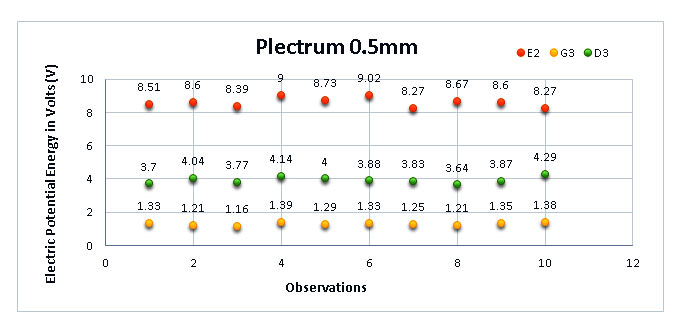 |
Graph 1 |
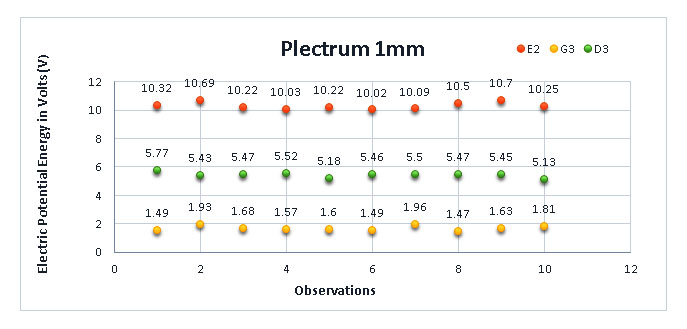 |
Graph 2 |
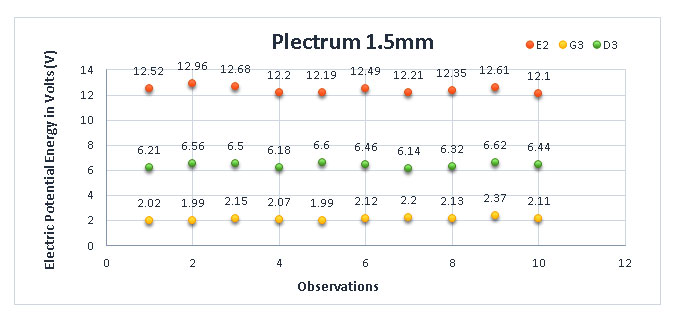 |
Graph 3 |
Anomalies In Graphs
The difference in the values recorded can be subject to minor experimental errors such as improper muting of strings, irregular velocity, force, momentum exerted by the mechanical arm to pluck the strings, the angle at which the plectrum was held to pluck the strings (difference in the plucking positions of the plectrum) with respect to the magnetic pickup of the guitar, which has been previously worked upon on in.5 To minimize the influence of these effects, ten readings were taken for each combination of plectrum and guitar string which were further averaged down. The values have been tabulated in the table provided in appendix Table 1.
Appendix
Table 1
|
Plectrum |
String Note |
Average TRMS value (Volts) |
|
1.5mm |
E2 |
12.43 |
|
|
G3 |
2.12 |
|
|
D3 |
6.40 |
|
1.0mm |
E2 |
10.30 |
|
|
G3 |
1.66 |
|
|
D3 |
5.44 |
|
0.5mm |
E2 |
8.60 |
|
|
G3 |
1.29 |
|
|
D3 |
3.92 |
Results
In the study carried out, it has been investigated how a plectrum can influence the sound produced by a guitar string. A mechanical arm was used to pluck the strings to ensure that each pluck was done with a constant force, momentum and velocity.4 The plucking distance was kept constant as it has been found in 5 that the position of plucking on a guitar string can significantly influence the resulting vibrations produced.
It can be clearly observed through the observations that each of the nine computed average TRMS values is different. This implies that each unique combination of a different guitar string and a plectrum, on the basis of its thickness, can result into an altogether different electrical voltage value which eventually results in a different sound effect produced by the guitar. This property of the guitar is essential for a guitar player as it provides a myriad of options to the player to choose the right plectrum for the type of music he/she wants to produce.
From the observations, it can be concluded that the output electrical voltage of a guitar string depends mainly upon two factors - the thickness of the plectrum used and the thickness of the guitar string plucked. It can be observed from the graphs that the thicker the plectrum and the string used are, the greater is the output voltage. In,3 it has been established that the magnetic pickup of an electric guitar uses electromagnetic induction to convert the kinetic energyof a ferromagnetic guitar string, given by ½ mv2, into magnetic energy, given by ½μ0μr ∫H2 dV, and finally into electrical signal, given by ∫VI dt, where V is the electrical AC voltage. Hence, the electrical voltage produced by the guitar string plucked is almost proportional, though not exactly due to losses through friction and heat in the complicated process of conversion, to the kinetic energy produced by the radiating string. As the average electrical energy associated with each of the 9 observations in the experiment is different, from table 8.1, so will be the kinetic energy associated with each of them.
Future Research
The sound produced by a guitar string is affected by numerous parameters of which some can be analysed and some cannot be analysed. The thickness of a plectrum is one such parameter which was known to significantly affect the sound produced by a guitar string but had not been previously analysed and has been analysed in this research paper. Other parameters which can be analysed in the future are:
Does the material of a plectrum used affect the sound produced by a guitar string?
Do strings of different gauges and tensions produce different volumes of sound?
- Johnson W., Perov P. The physics of guitar string vibrations, American Journal of Physics. 2016;84:38.
CrossRef - Woodhouse J. On the Synthesis of Guitar Plucks, Acta Acustica united with Acustica, Volume 90, Number 5, September/October. 2004;928-944(17).
- Horton N. G., Moore T. R. Modelling the magnetic pickup of an electric guitar, American Journal of Physics. 2009;77:144.
CrossRef - Carral S., Paset M. The influence of plectrum thickness on the radiated sound of the guitar, Journal of the Acoustical Society of America. 2008.
CrossRef - Traube Caroline and Smith III J.O. Extracting the fingering and the plucking points on a guitar string from a recording, Proceedings of the 2001 IEEE Workshop on the Applications of Signal Processing to Audio and Acoustics (Cat. No.01TH8575)
- Fletcher Neville and Rossing Thomas, The Physics of Musical Instruments, Springer, Second Edition. 1998.
- Guiseppe Cuzzucoli and Vicenzo Lombardo, A physical modal of the classical guitar, including the player’s touch, Computer Music Journal. 1999;23(2):52–69.
CrossRef

This work is licensed under a Creative Commons Attribution 4.0 International License.