
Galaxy Rotation Dynamics
Kuzminov Igor Vladimirovich* 
1Russian Geographical Society (Russian Academy of Sciences) per., Grivtcova, SPb, Russian Federation, Royal Geographical Society, 1Kensington Gore London , UK .
http://dx.doi.org/10.13005/OJPS10.02.08
The proposed article is a development of the topics of gravity, the inverse temperature dependence of gravity forces, the action of the inverse temperature dependence of gravity forces and the second law of thermodynamics, dark matter. All interaction schemes are built on the basis of the laws of classical Newtonian mechanics. In relation to the dynamics of rotation of the matter of the Galaxy, the formation of a lattice of gravity forces is noted. The article provides a comparison of the lattice of gravity forces of the Galaxy and the lattice of gravity forces for the planets of the Solar system. The comparison of these lattices explains the dynamics of these systems. The key point in the comparison is the definition of the rigidity of the lattice of gravitational forces.
Copy the following to cite this article:
Vladimirovich I. K. Galaxy Rotation Dynamics. Oriental Jornal of Physical Sciences 2025; 10(2).
DOI:http://dx.doi.org/10.13005/OJPS10.02.08Copy the following to cite this URL:
Vladimirovich I. K. Galaxy Rotation Dynamics. Oriental Jornal of Physical Sciences 2025; 10(2). Avialable here: https://bit.ly/44FPk1j
Download article (pdf) Citation Manager Publish History



Introduction
The proposed article is a development of the direction presented in articles.1, 2, 3 Gravitational forces, inertial forces are presented in this direction as reaction forces to external influence. For gravitational forces, the external influence is the expansion of the Universe. The reaction mechanism is absolutely identical and has an inverse temperature dependence. The inverse temperature dependence is that when heated, the forces of gravity and inertia decrease, and when cooled, they increase. Articles 1, 2, 3 note that the action in conjunction with the inverse temperature dependence of gravitational forces and the second law of thermodynamics forms the appearance of the Universe. Forms Galaxies, among other things. The action of these laws is the basis for the processes of separation and condensation of matter. Without these laws, matter would be a homogeneous amorphous mass. The proposed article examines the dynamics of rotation of objects (planets) of the Solar system and objects (star systems) of the Galaxy.
Main part
The articles4,5 consider the process of transformation of matter. Processes 1-2 and 2-3 occur inside the Black Hole. These processes are similar to the combustion of fuel in the cylinder of an internal combustion engine. In terms of time, these processes are instantaneous. Process 3-1 significantly exceeds processes 1-2 and 2-3 in time. Process 3-1 is similar to the process of expansion of combustion products in the cylinder of an internal combustion engine. In general, the cycle is similar to the indicator diagram of an internal combustion engine. Galaxies are formed and live in this process.
In the process of formation of the Galaxy, a Black Hole, a bar, and arms of star systems are formed within the Galaxy. All matter in the Galaxy is in a dynamic process of rotation of matter around the Black Hole. Scientists have noted a significant difference in the dynamics of rotation of the matter of the Galaxy from the dynamics of rotation of the matter of a separate star system, for example, the Solar System. The main difference in the dynamics of rotation of these systems is that the matter of the Galaxy rotates with a constant angular velocity, while the matter of the stellar system rotates with different angular velocities. In a stellar system, the angular velocity of rotation of a planet decreases for a larger radius of the planet's orbit. Fig. 1, 2 show the diagrams of rotation of planets and matter of the Galaxy. The conventional diameter of the planetary system and the conventional diameter of the Galaxy are taken as a unit. It is obvious that the density of matter in this diagram is different. The density of matter of the planetary system (Fig. 1) is significantly less than the density of matter of the Galaxy (Fig. 2). For each system, lattices (grids) of gravitational connections between the centers of mass of objects in the system are constructed. Gravitational connections are aimed at attraction between objects. Gravitational connections create a certain lattice (grid) of object rigidity (in this case, the planetary system and the galactic system are considered as objects). The rigidity of such objects has a significant effect on the dynamics of rotation of objects. At maximum rigidity, an object can be considered as a single whole. At minimum rigidity, the object can be considered as an amorphous formation, the gravitational lattice is weak and does not significantly affect the structure of the object, does not significantly affect the dynamics of rotation. When compiling and considering these schemes, the absolute values ??of gravitational bonds are not taken into account. When considering these schemes, the density and rigidity of gravitational bonds in general are significant. The scheme shows a disk-shaped spiral galaxy with a bar. In reality, there are several types of galaxies. The type of galaxy is not of fundamental importance. All galaxies have a sufficiently high density of matter and, accordingly, high rigidity of the gravitational lattice. It is likely that the type of galaxies is due to different stages of development and sizes of galaxies. The processes that are presented in the article4,5 can explain different stages of development. The rigidity of the lattice decreases depending on the distance from the center of the galaxy. High rigidity in the area of ??the black hole forms the core (bulge) of the galaxy, the bar (bar). For this part of the galaxy, the conventional rigidity k = 100 is adopted. The unit of rigidity is taken as the conventional rigidity of the gravitational lattice of the planetary system. For this part of the galaxy, the angular velocity of rotation of matter is almost the same for all participants in the movement. The diagram shows the arms of the galaxy, here the lattice has a conventional rigidity of k=50. This part of the galaxy is affected by the gravitational forces of dark matter. These forces slow down the motion of matter (these forces are not shown in the diagram, but they are implied). For this part of the galaxy, the angular velocity of rotation of matter decreases as it moves away from the center of the galaxy. It should also be noted that in the structure of the galaxy, each element of the galaxy moves along a spiral trajectory in the direction of the black hole. This corresponds to section 3-1 of the closed cycle of transformation of matter, the cycle is presented in article.4,5
 | Figure 1: Diagram of the dynamics of the Solar system |
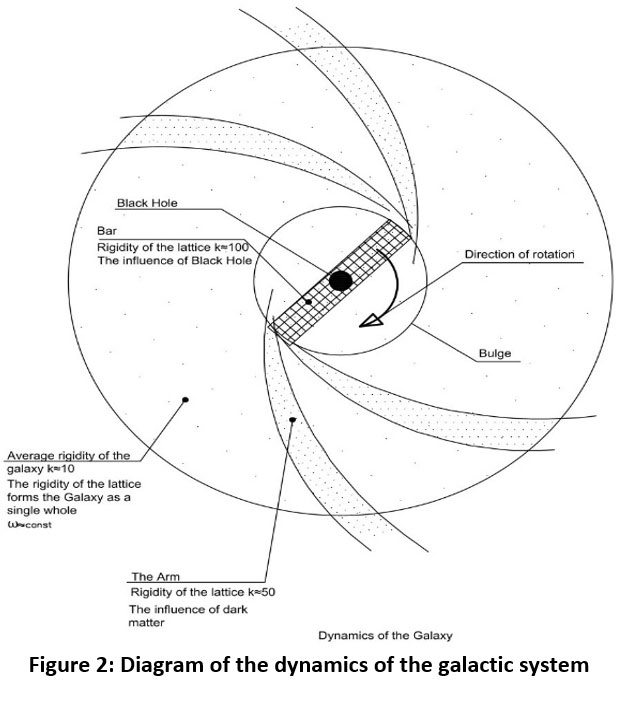 | Figure 2: Diagram of the dynamics of the galactic system |
Materials and methods
A series of articles on the topic of gravity were adopted as source materials for compiling the article. In these articles,1-5 gravity is presented as a force absolutely identical to the forces of inertia. The forces of inertia are the forces of reaction to external influence. For the forces of gravity, the external influence is the forces of expansion of the Universe.
The proposed article is a development of the topic of gravity. The dynamic processes that are considered in this article find their real reflection in the kinematics of the movement of celestial objects.
Results
The proposed series of articles1-5, including this article, is a separate concept on the theory of gravity. Naturally, this concept rejects all existing versions on this topic. The concept is based on the concepts of classical Newtonian physics. The concept does not use any "innovative" assumptions, postulates,conventions, etc. For example, the dominant theory of relativity considers a certain gravitating mass and a non-gravitating one, in this theory there is no concept of interaction. Newton's gravity provides for complete interaction between all bodies. The proposed article is based on this interaction.
Discussion
At this stage, the main task is to put forward a hypothesis for discussion in the scientific community. A full discussion of the proposed hypothesis has not yet been possible. Since the dominant theory of gravity does not assume interaction. To begin with, it is necessary to recognize the hypothesis of gravity based on the concepts of classical physics.1
Conclusion
This article is a hypothesis. This article aims to give a new direction in the study of the Universe. The article considers the difference in the dynamics of rotation of matter in a planetary system6,7 and a galaxy8,9 in the general case. The difference in the dynamics of rotation of matter in these objects is due to the difference in the rigidity of the lattices of gravitational forces. A more rigid lattice gives the object the properties of a single whole, accordingly, the rotation process should be considered as the rotation of a single object.
Thus, it has been established that the gravitational lattice of a planetary system (using the solar system as an example) has very low rigidity. The gravitational lattice of this system has virtually no effect on the dynamics of rotation of the planets. Rotation of the planets occurs under conditions of equilibrium of centrifugal forces and gravitational forces between each planet and the star. Under such conditions, each planet has its own angular velocity of rotation. The value of the angular velocity decreases as the planet moves away from the star. Under equilibrium conditions, the planets have stationary orbits.
Rotation of matter in a galaxy occurs under conditions of a very rigid gravitational lattice. The rigid lattice gives the matter the properties of a single whole. It should be noted that the lattice rigidity decreases as the matter moves away from the center of the galaxy. The core (bulge) of the galaxy has the maximum rigidity. This part of the galaxy rotates with almost the same angular velocity. The angular velocity of the arms decreases as it moves away from the center of the galaxy. The decrease in the angular velocity of this part of the galaxy is due to the influence of gravitational forces from dark matter.
In article 2, galaxies are presented as vortices in the process of expansion of matter 4,5 (section 3-1 of the closed cycle of transformation of matter). At this stage, the process of separation and condensation of matter occurs. The initial impulse of all thermodynamic processes in the visible and invisible Universe is received in section 2-3.
The numerical values ??of the physical indicators are given conditionally, the indicators are given to give significance, to determine the proportions.
Acknowledgement
The author would like to thank Magadh University for granting the Ph.D. research work. The Department of Environmental Science, A.N. College, Patna of the Magadh University, is highly appreciated for allowing the GIS laboratory work. The author is also profoundly grateful to the National Remote Sensing Center (NRSC), Indian Space Research Organisation (ISRO), Govt. of India for their guidance during the Satellite data procurement.
Funding Sources
The author received no financial support for the research, authorship, and publication of this article.
Conflict of Interest
The authors do not have any conflict of interest.
Data Availability Statement
This statement does not apply to this article.
Ethics Statement
This research did not involve human participants, animal subjects, or any material that requires ethical approval.
Informed Consent Statement
This study did not involve human participants, and therefore, informed consent was not required.
References
- Kuzminov I.V. “The Physics of Gravity. Breakthrough Hypothesis”, WASET Conference: Newtonian Mechanics and Gravity, November 2023 in Singapore, code paper: 23SG110049;
- Kuzminov I.V. “Picture of the World by the Second Law of Thermodynamic” WASET Conference: Newtonian Mechanics, Power and Kinetic Energy, November 2023 in Amsterdam, code paper: 23NL110093;
- Kuzminov I.V. “Physics of Gravity. The Inverse Temperature Dependence. Experiments”, “Physics of Gravity. Comments, Explanations and Additions”, Journal of Physics and Chemistry Research, 2023; vol 5 (3)
- Kuzminov I. V. “Physics of Black Holes. A Closed Cycle of Transformation of Matter in the Universe“, WASET Conference: Molecular Physics and Astrophysics, November 2024 in London, paper code 24GB110139;
- Kuzminov I. V. “Comments on article “Physics of Black Holes. A Closed Cycle of Transformation of Matter in the Universe“, 2024, Open Access Journal of Astronomy vol.2(2) Medwin publisher, 000151;
- Bowring S., Housh T. The Earth's early evolution, Science. — 1995. — Vol. 269, no. 5230. — P. 1535—1540;
CrossRef - Stephen C. Tegler. Kuiper Belt Objects: Physical Studies // Encyclopedia of the Solar System / Lucy-Ann McFadden et al. — 2007;605—620;
CrossRef - Galactic Plane. Astronomy. Melbourne: Swinburne University of Technology;
- Byrd D. Every visible star is within Milky Way . Earth & Sky (10 september 2020).

This work is licensed under a Creative Commons Attribution 4.0 International License.